Author Archive

Venice I: What’s Carnival Really Like?
What is Venice’s carnival actually like?

Venice’s modern carnival is not a traditional folk and fertility festival.  It does not have mummers and green men and pitchforks and man-women and ceremonial uses of straw and swords and alcohol (for that see a friend’s excellent post on a Basque Carnival).  It is also not what it was in the Renaissance, an elaborate civic celebration-reversal, at which the rules of propriety were (witin limits) reversed, as the city displayed its wealth with gilded ships and gem-covered costumes, and paid vast sums to prominent artists to produce elaborate parade floats covered with mechanical universes and moving golden lions and actors dressed as confusing allegories.

What it is now is a very grand tourist attraction at which an already overwhelmingly beautiful and alien city is suddenly populated by fantastical creatures and time travelers in elegant finery and three-cornered hats.
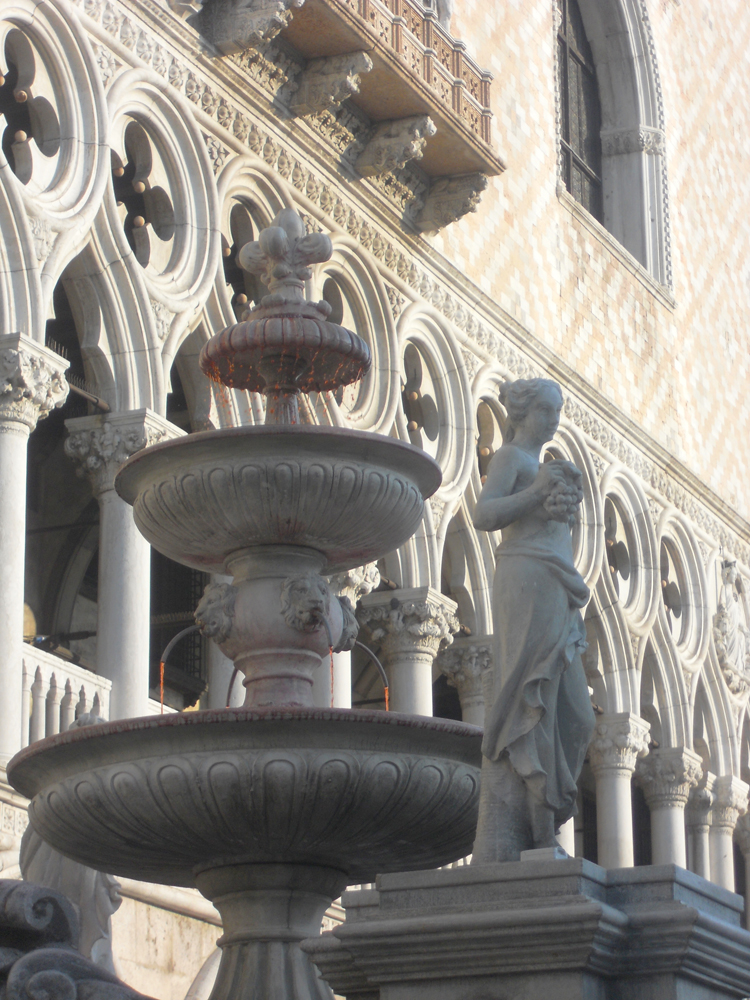
A Fountain by the Doge’s Palace flows with wine. Really.

In Saint Mark’s square a not-very-well-engineered stage hosts mediocre entertainments, from ad hoc costume contests to poorly-microphoned musical acts.  Behind the closed doors of expensive palaces-turned-hotel-restaurant-theater, people pay $200+ a head to attend grand pseudo-period fantasy banquets and masked balls. Venice’s year-round delights also remain: the gold mosaic Basilica of San Marco, the Doge’s palace, unique and world-class museums and galleries.  All this is wonderful but unnecessary.  As I promised the friends who joined me for Carnival this year (and as they can now cheerfully confirm) one does not need any activities or entertainments of any kind to have a blast at Carnival.  One simply has to do one thing: get lost.

Even without its Carnival-only costumed population, Venice is eerily beautiful, and distant-feeling even when you’re there.  If reaching Florence feels like stepping into a cross-section of the past, our ancestors’ world, not ours, Venice feels like a cross-section of the past of a different species.  Everything is too delicate, ornamented with too many curves, too-elaborate windows, too colorful stonework, every surface a faerie facade.  Many of the palaces (there are no non-palaces in Venice) are pink, even the blown glass street lamps pink, but you don’t even notice that it’s pink because the color itself doesn’t register as much as the fact that everything is just a hair more beautiful, calculated for ornament rather than defense or practicality.  Where are the battlements?  Where the ditches?  Where the triangles of struggling grass between ill-laid streets?  This is not a real city, it’s some kind of theater set, all ornament with all the practical parts left out.
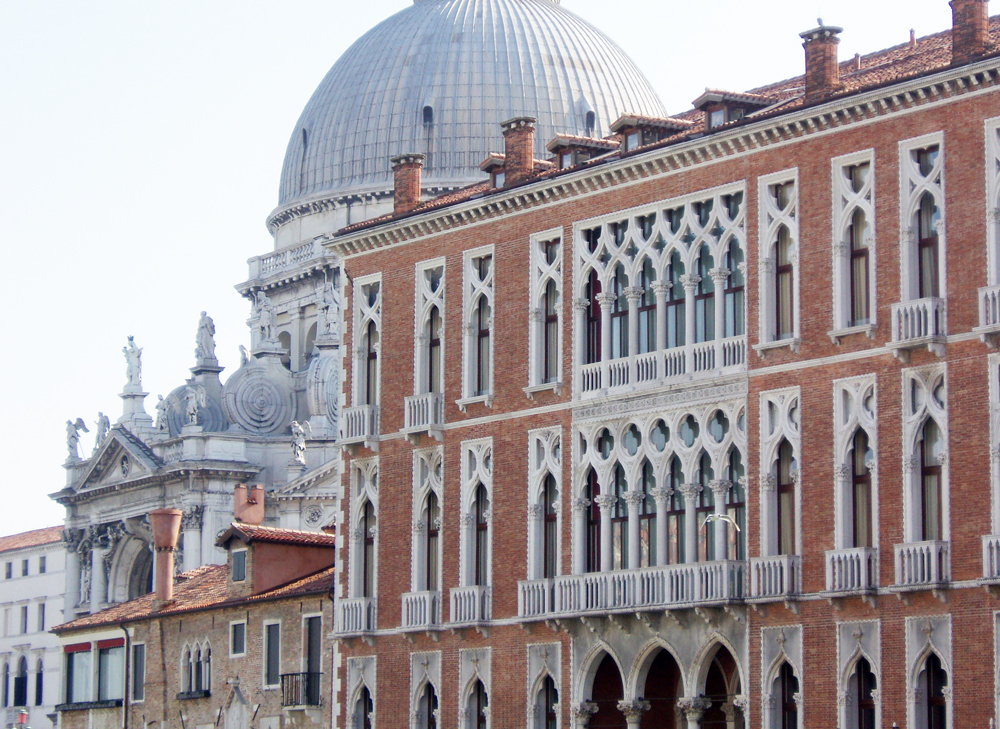
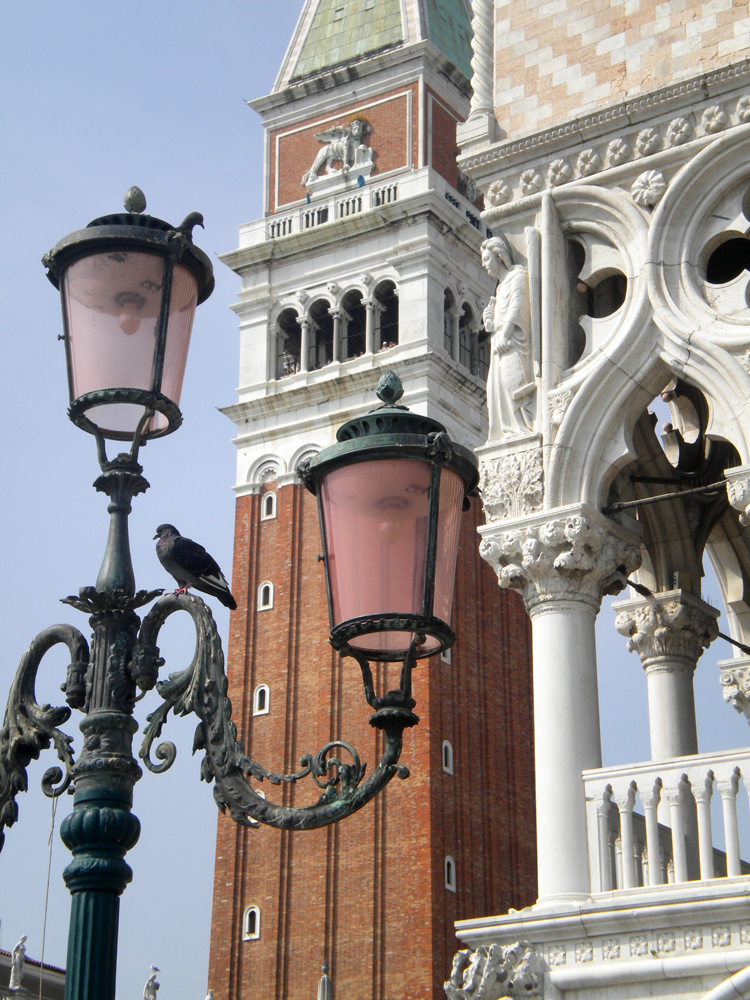
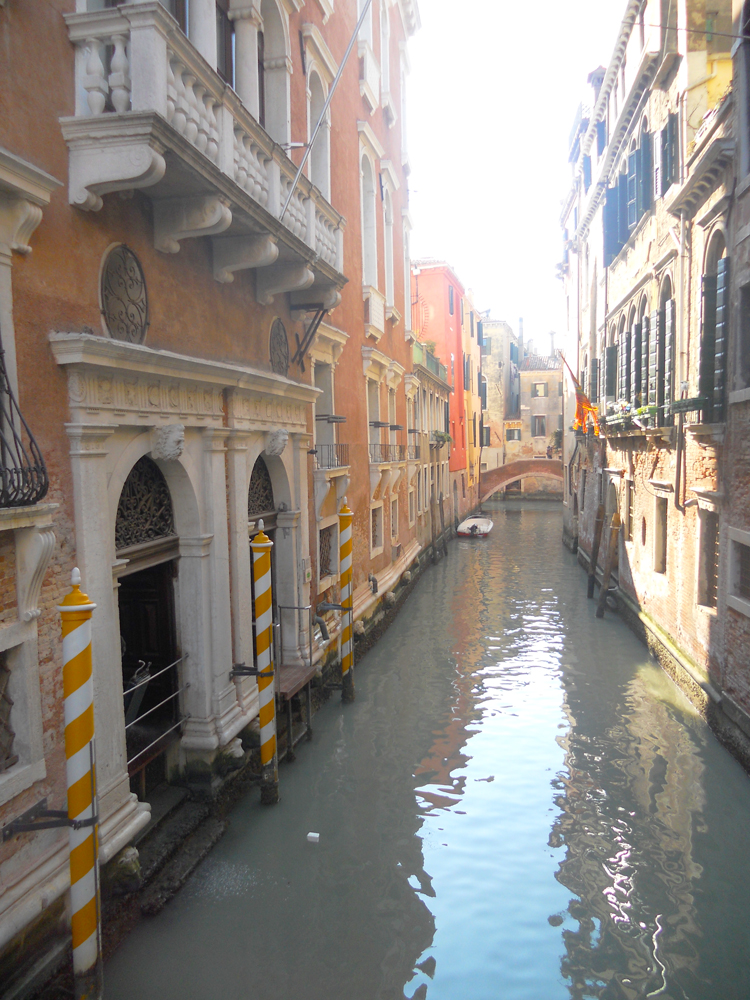
A main street in Venice.

Venice is also a maze of twisty passages all unique, and the most difficult city to navigate that I have ever found.  It isn’t just that it lacks a grid system, but that it lacks any main streets whatsoever and consists entirely of meandering alleys.  After all, the main streets are canals, so you can’t walk on them – imagine navigating any other town without being allowed to ever go on any large street.  In addition, no angle is 90°, no street is straight, no two points are connected by any kind of line, and a quarter of the streets are tunnels leading under palaces which have grown to cover them like a forest canopy uniting over an abandoned campsite.  The streets are also incredibly narrow, so one can’t look up at an angle and see that a particular tower or landmark is That Way therefore That Way is East.  The lack of 90° angles makes it very easy to get gradually turned around, and even people very good at navigating frequently end up thinking North is East and East South as a series of turns which seem to be heading consistently in one direction meander in another.  Hence my summary: in Venice one is either (A) in Saint Mark’s Square, (B) on the Rialto bridge, or (C) lost.
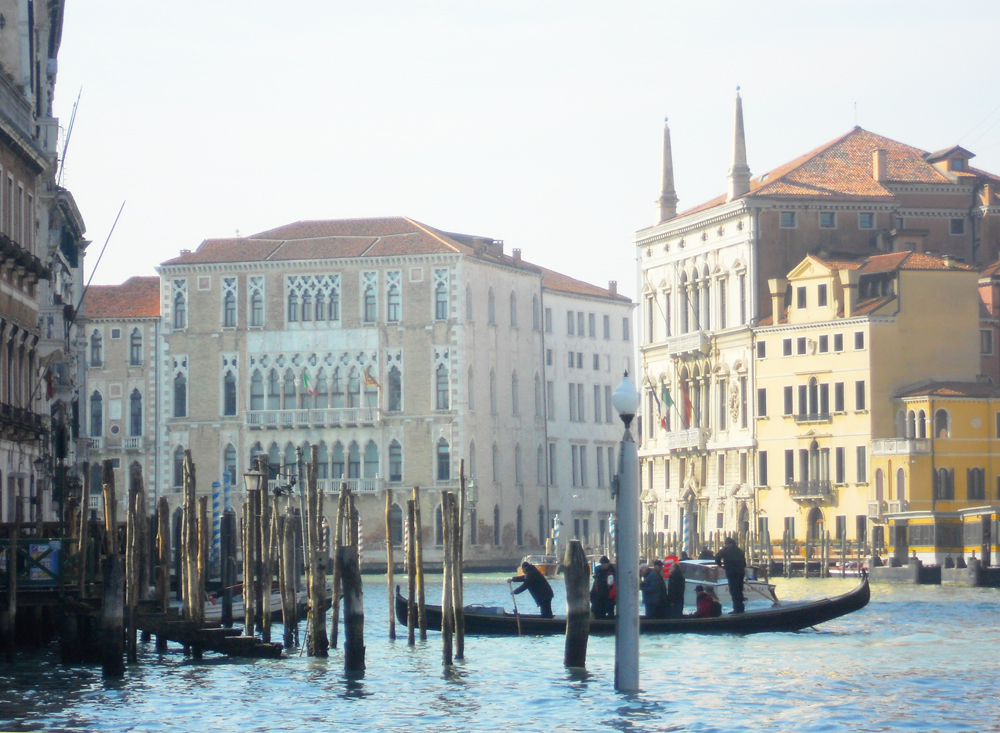
Standing on Rialto bridge, therefore not lost.


It is, in fact, possible to navigate in Venice, but it requires a huge amount of concentration and constant map checking, so unless one has an appointment, why bother?  Everything is equally beautiful.  It’s an island; it’s not as if you can accidentally fall off the edge and wind up in Padua.  Wherever you go there will be amazing palaces, intriguing mask shops, overpriced pizza, zillions and zillions of winged lions (Saint Mark, the symbol of the city) and you may as well turn left as right at any given point.  It’s like the genius of Tom Sawyer’s Island at Disneyland, where joyful parents can sit down while kids run wild and wear themselves out on the self-contained plastic island which it is impossible for an unaccompanied child to escape.  While on this island, everything is fine.  The city is filled, furthermore, with signs pointing to either San Marco or the Rialto, so, wherever you are, you can find one of these two points and, from it, take the water shuttle to where you need to be.  In fact, I highly recommend finding a hotel as close as possible to Saint Mark’s square (here is my preferred), since then magically Venice is filled with signs directing you home.  Often, of course, a square will have two signs pointing to San Marco in completely different directions; both are correct, because there is no straight line, not in Venice.
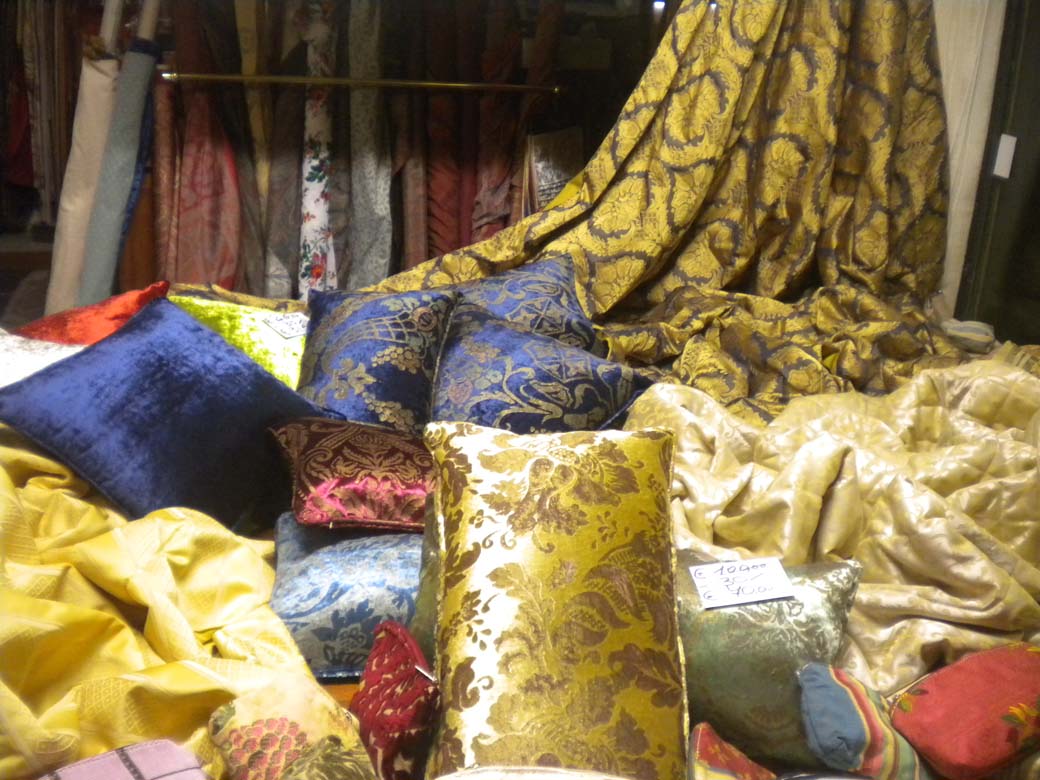
Time flies incredibly when one is wandering from alley to alley through an alien wonderland, and no further planned activity is necessary.  Venice cycles through many repeated shops, selling the same mass-produced tourist items which are still worth getting, for the most part, since they’re really nice mass-produced tourist items: velvet pouches and purses, masks, lace, beautiful glass work, masks, silk and satin draperies, masks, art prints, masks, beads, masks, and also masks.  During Carnival masks appear even in the shops that don’t sell masks, and every restaurant and hotel hangs up a few of these mandatory proofs that one is not a stick-in-the-mud.  Between these and the costumes, the days vanish, an afternoon seeming an hour, as one wanders and wanders and simply wanders.  When footsore, one hops on the water bus and rides around the city circumference or along the grand canal, where the most elaborate palace facades face, since, after all, water, not land, is the intended approach to these grand houses.

It is worth mentioning that on the last weekend there is usually something quite spectacular in Saint Mark’s Square (a fire show when I went, with dancers with flaming spears, and a huge dragon puppet that they set on fire) but apart from that, none of the public entertainments are generally as exciting as the city itself.
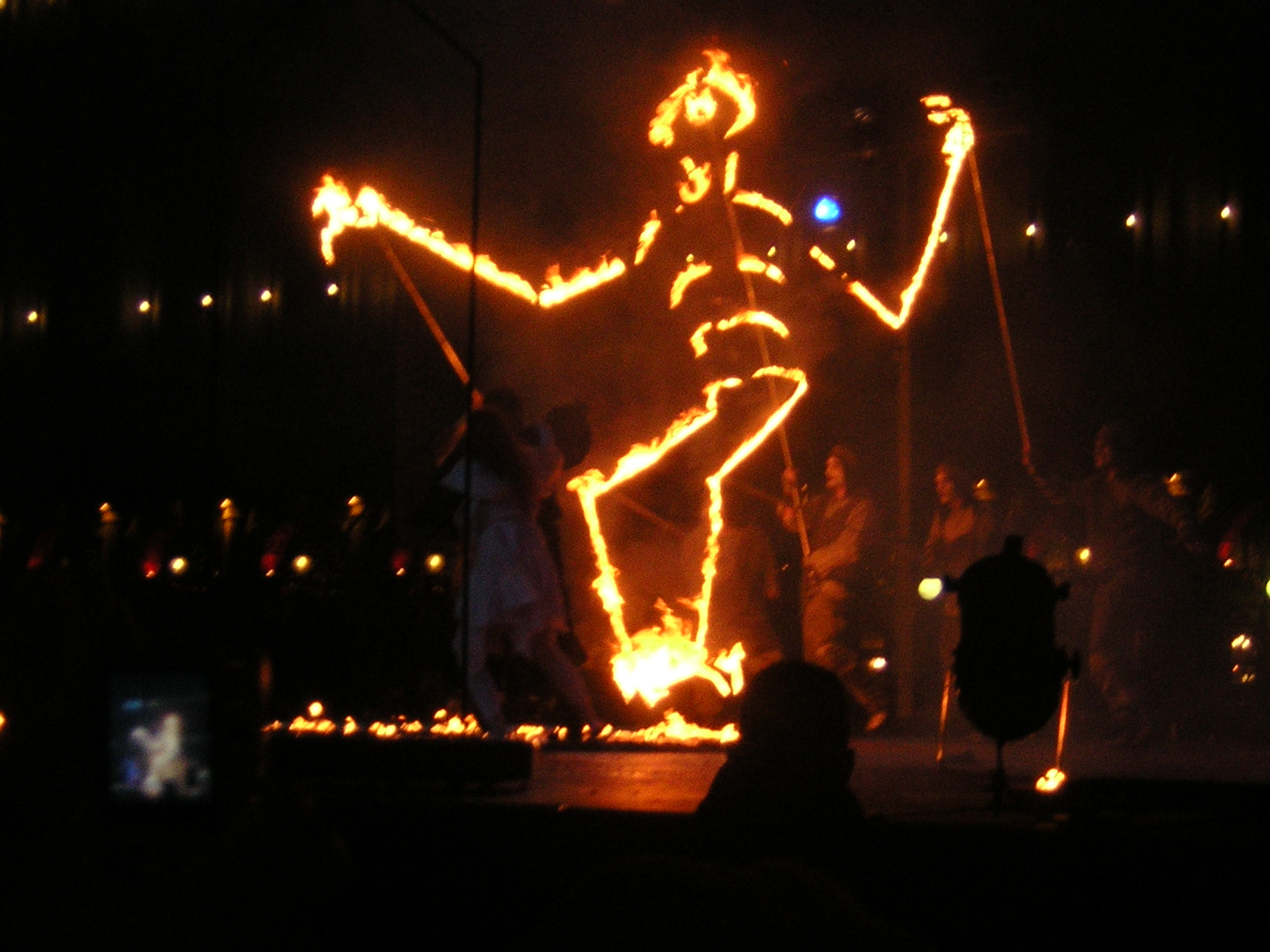
A flaming cyclops at the Carnival finale.


There are four categories of costumes seen on the streets at Venice’s contemporary carnival.
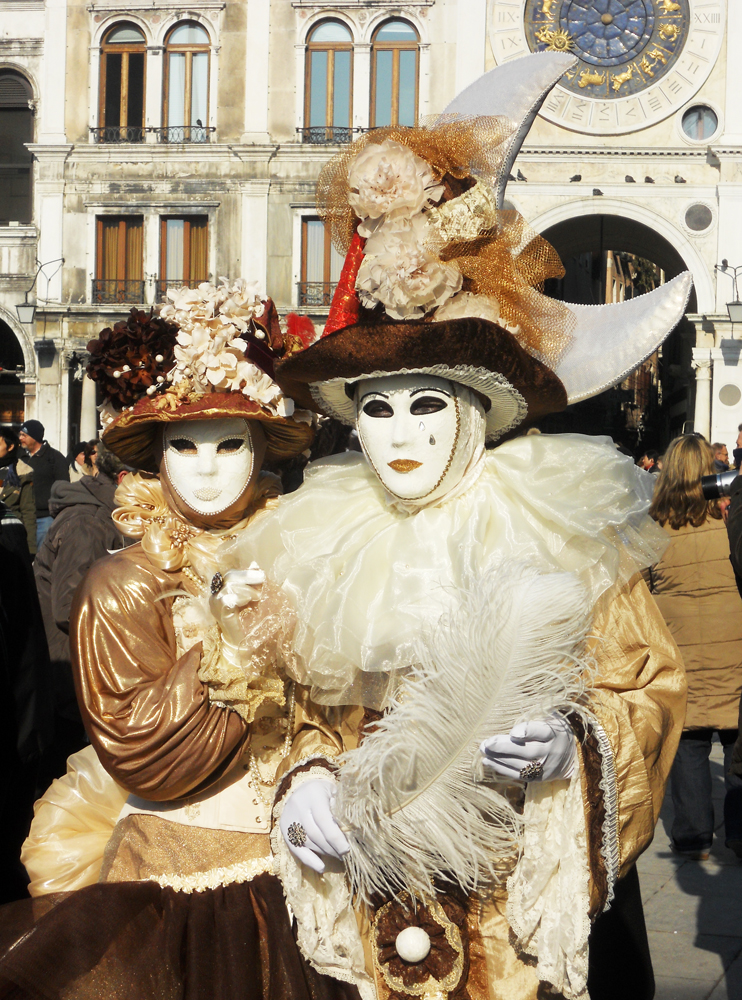
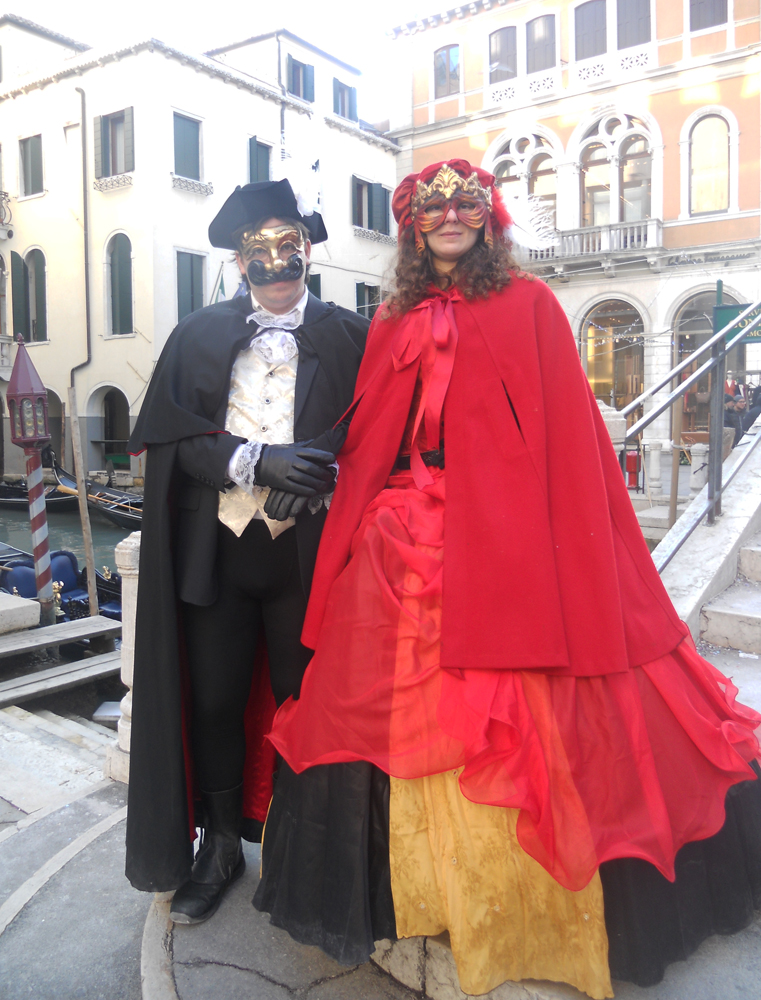
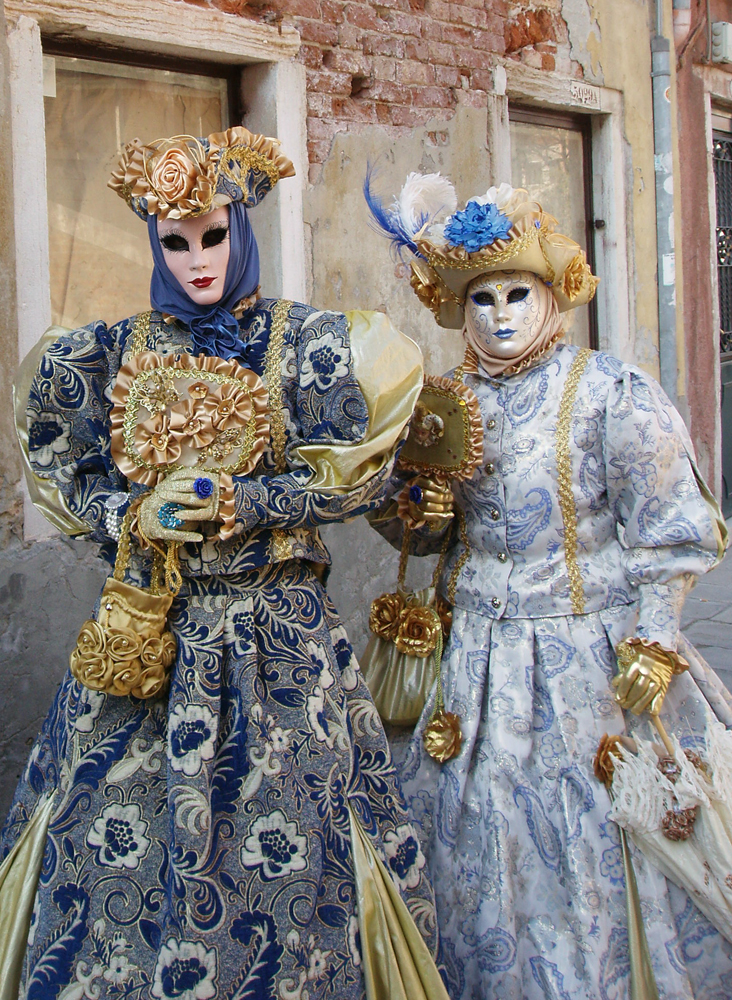
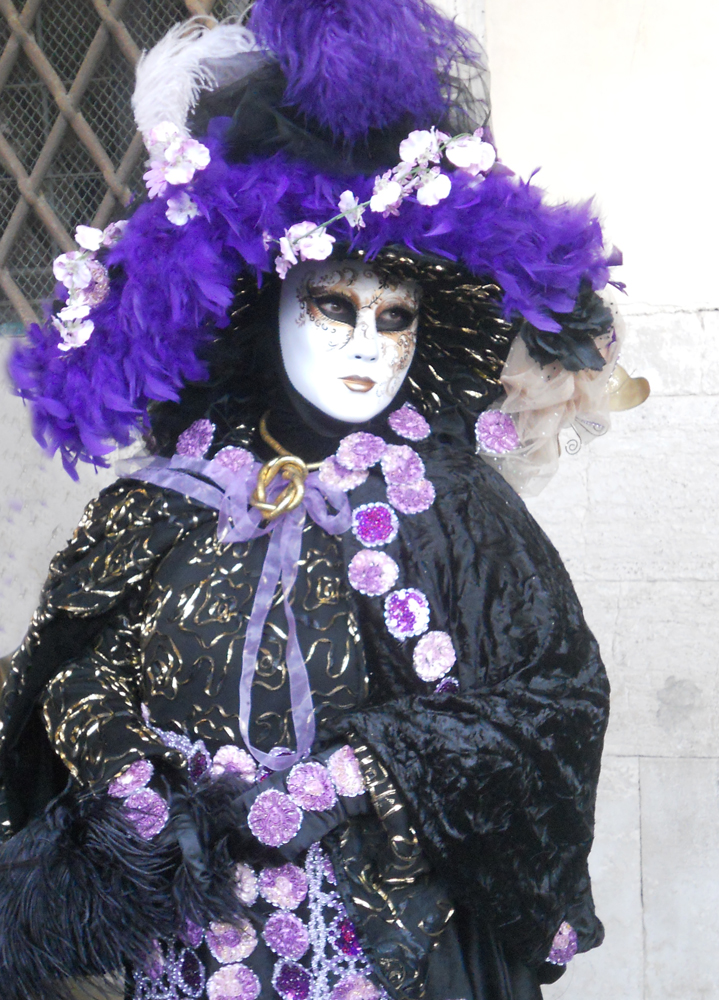
The first are extremely elaborate, colorful fantasy pieces with full-face masks in bold, overwhelming colors and luxurious fabrics, many period but some modern, designed to create the most visually striking thing a human being can still arguably stand up in.  Some are home-made, many rented.  Most commonly one sees couples, pairs, one male one female, intended to be worn together, but sometimes solos and sometimes larger groups.  Such costumes completely restrict one’s ability to do anything, including eat, talk, see more than a tunnel in front of you, and also doom you to the mercy of temperature, and walking too becomes a challenge.  For this reason, these costumes cluster around San Marco square, where they stand to be seen and photographed, and one can spend happy hours in the square going from group to group and enjoying the ingenious whimsy of the tailor’s art.
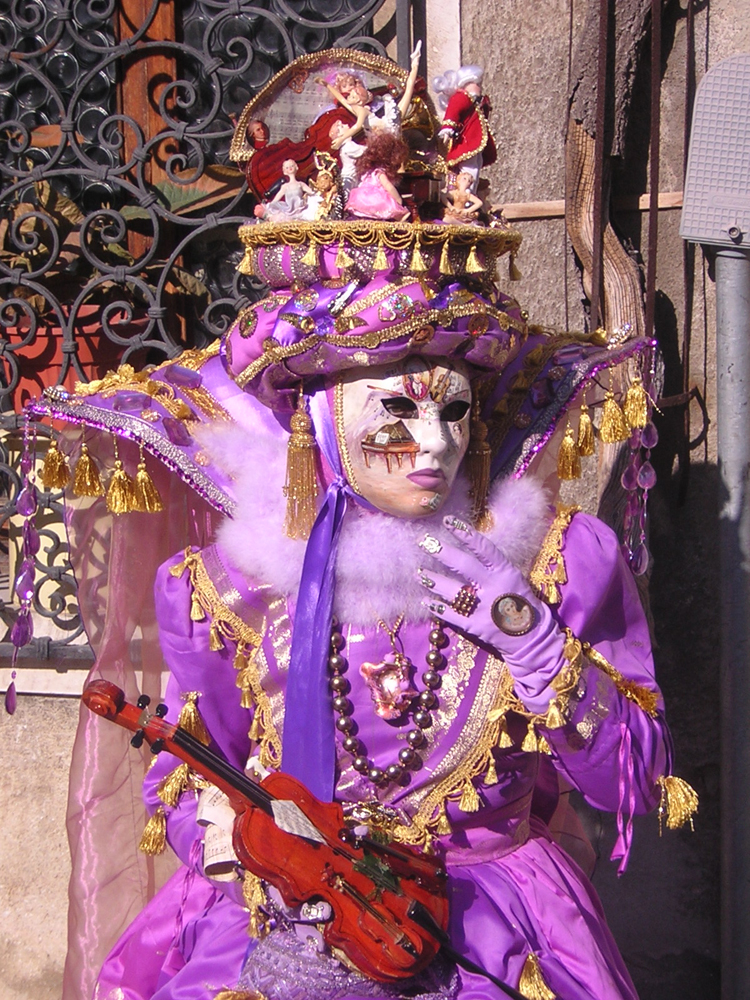
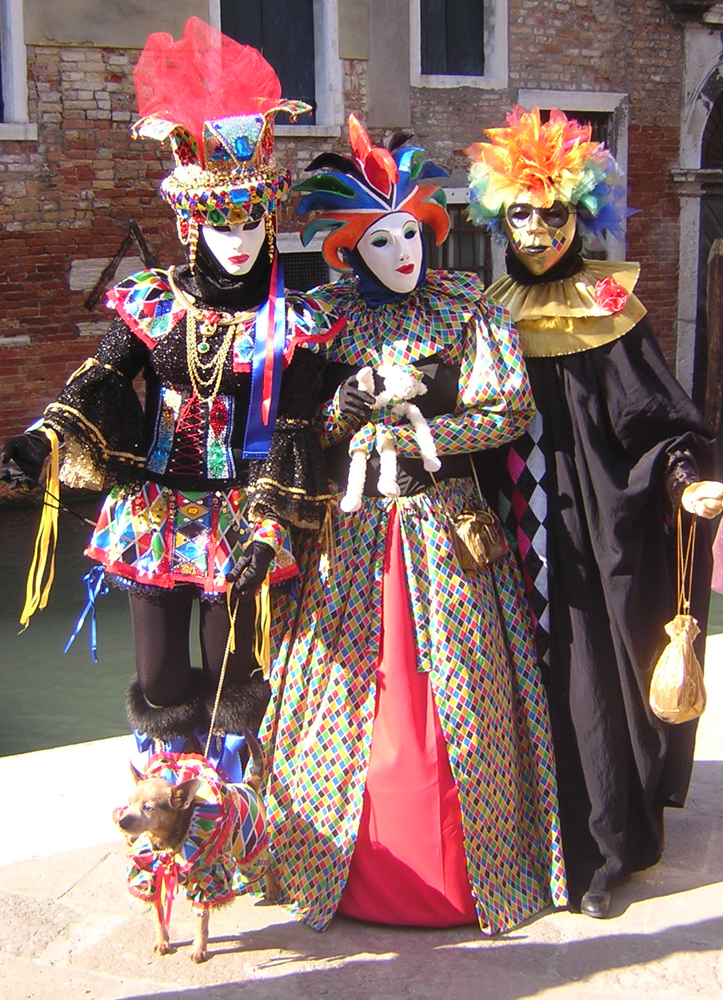
 

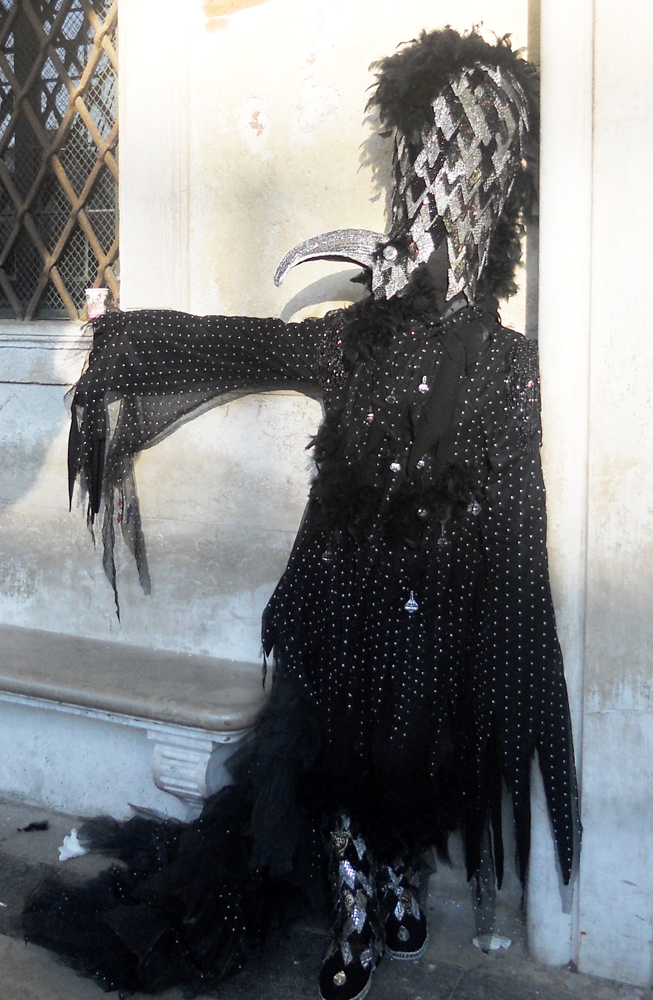
Not all the costumes are designed to look or feel period.  Modern fabrics, contemporary neon colors, and modern themes are worked in.  Some of the more ambitious modern designs move farther and farther from the notion of “Garment”:
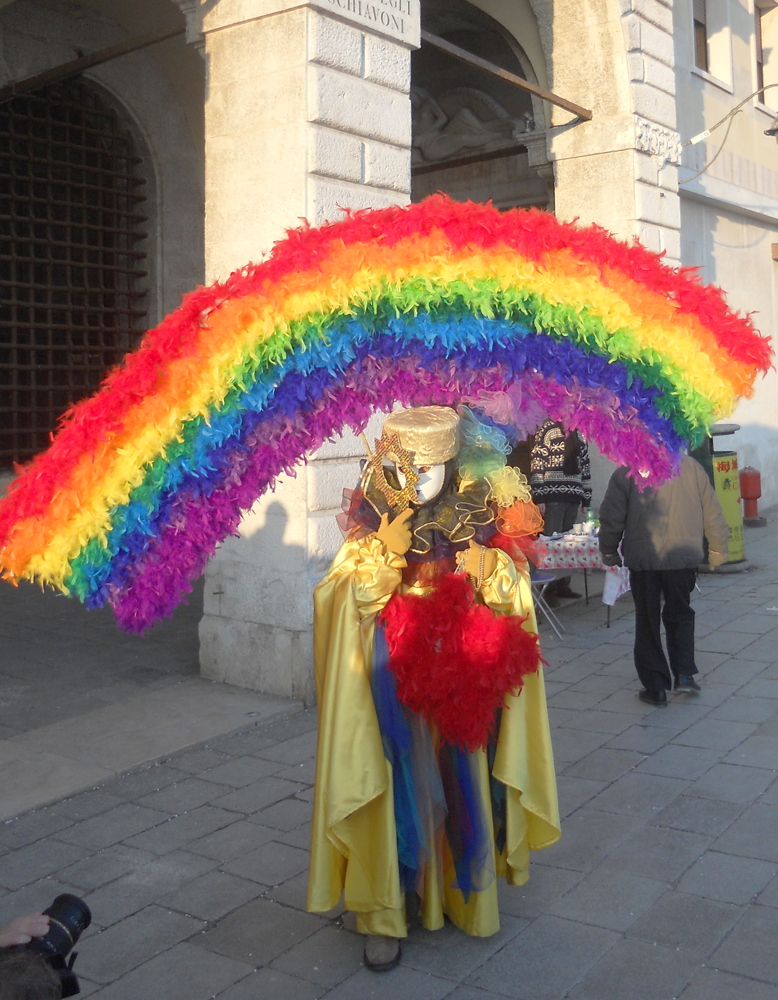
The average alley in Venice is about 4 feet wide.  This person will be here all day.

The second category are period pieces, inspired not by the wholly fantastic costumes of those who rode the parade floats in the Renaissance, but by the spectators:
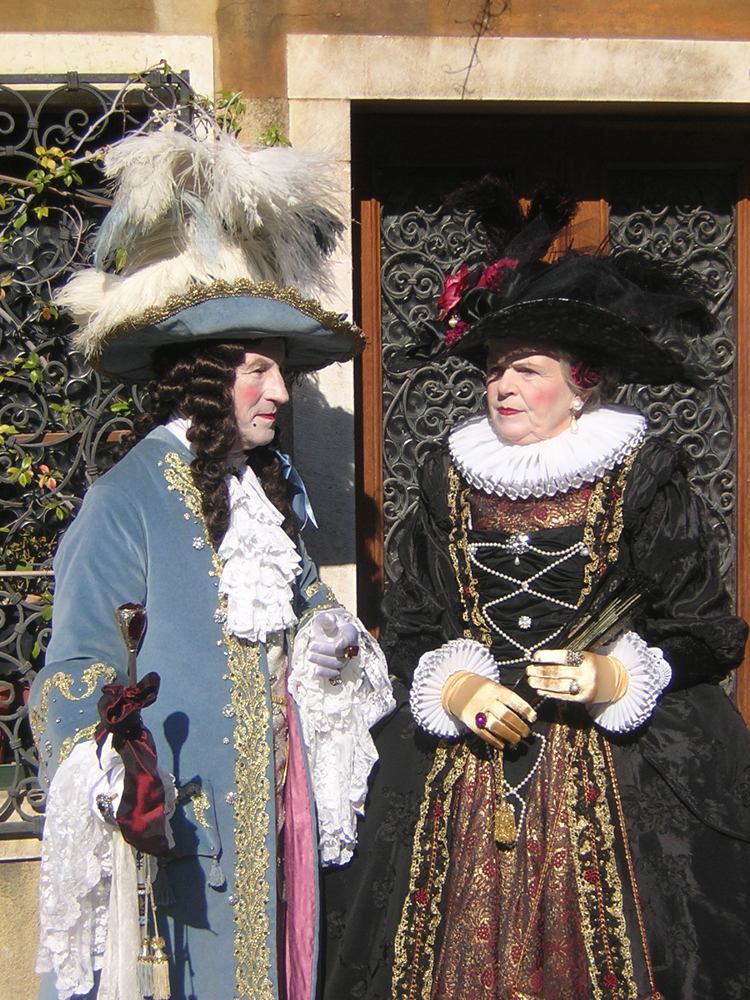
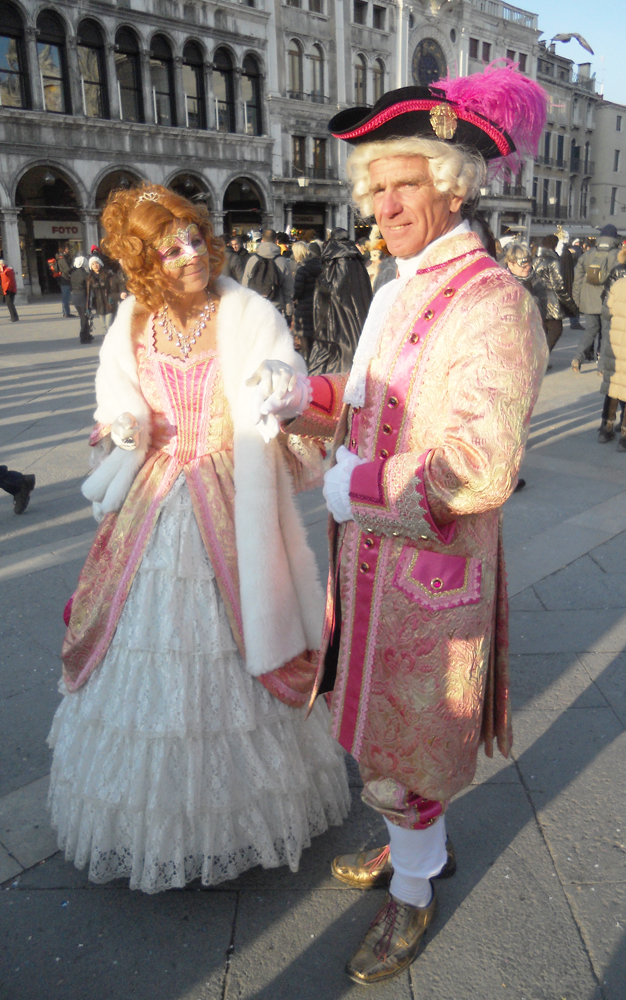
The Eighteenth Century: when pink was still a manly color.

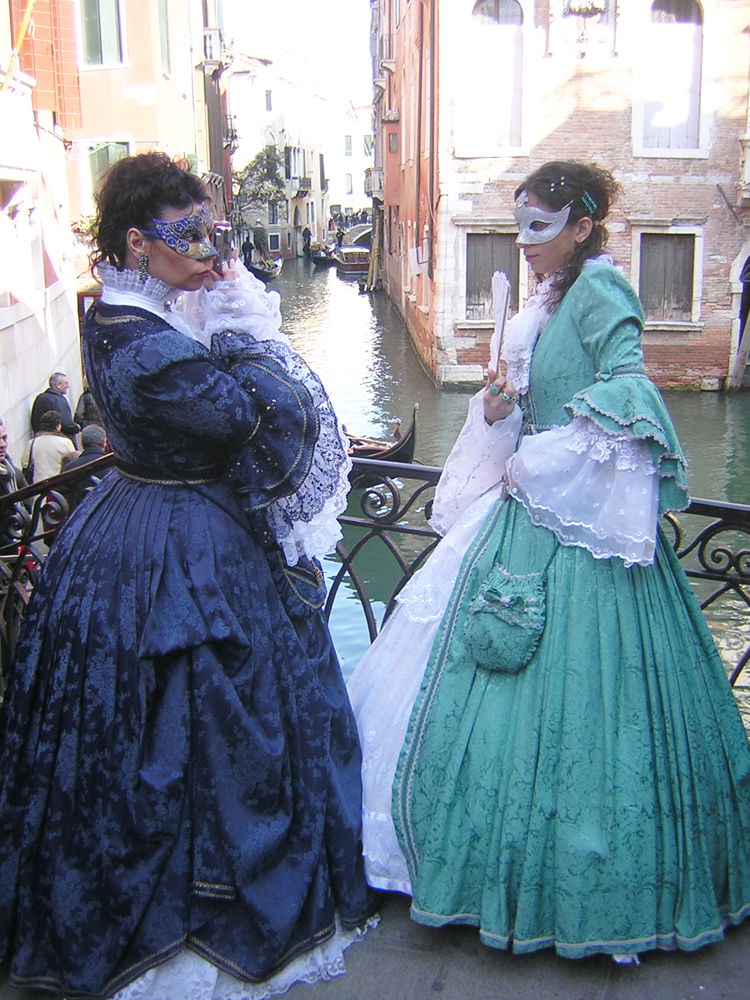
These costumes tend to imitate the period of the peak of the carnival’s opulence and fame, which was not, in fact, in the Renaissance proper, but in the Eighteenth Century, so the costumes one sees are mainly Eighteenth Century.  This means for gentlemen long waistcoats, lacy cuffs and cravats or jabots, tricorne hats, coats with vast pleated tails, richly worked brocades, white powdered wigs, heavy walking sticks, and the kind of leather shoes with buckles or bows that one associates in US culture with the founding fathers.  For ladies, the brocades are even more richly worked, the sleeves usually elbow-length with lace dripping to the wrists, the bodices taut and square with the lacing hidden, the skirts wide, not with circular hoops but with panniers which extend the skirts far out to each side (trivia of the moment, the word derives from baskets hung on either side of a donkey), and the wigs tall with clusters of bizarre objects like feathers and scarves and gems and seashells and toy boats woven into them in what should look like birds’ nests but do manage to register to the mind as hats.  Such costumes are worn sometimes with beautiful but practical half-masks, and sometimes without.
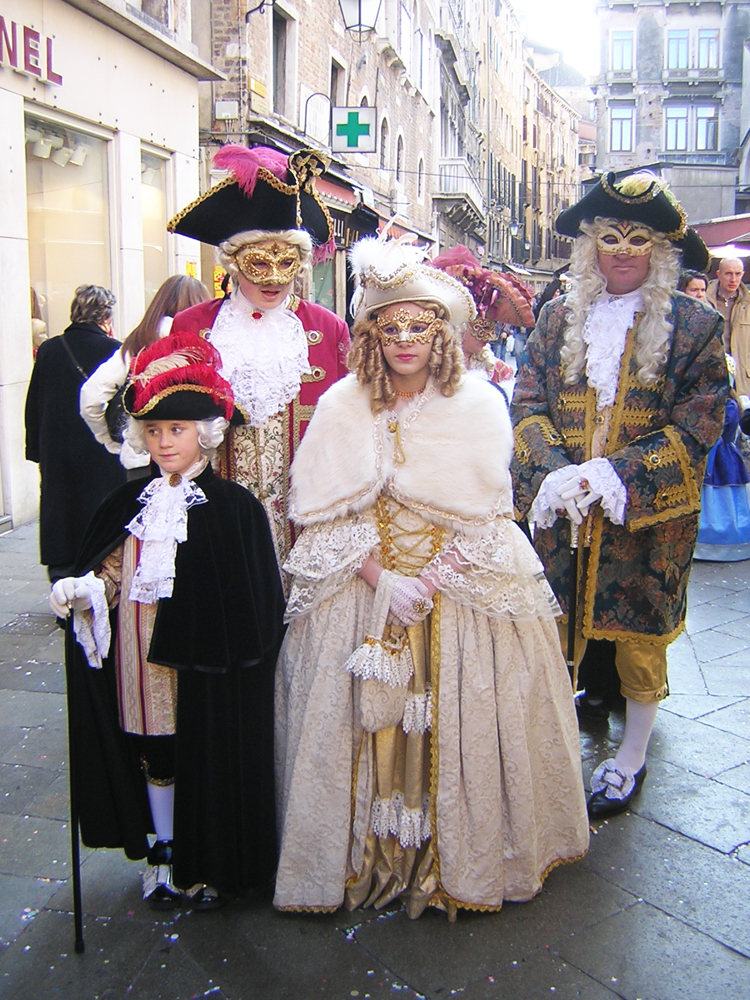
 

Venice: where ladies in hoop skirts go to take pictures of ladies in hoop skirts.


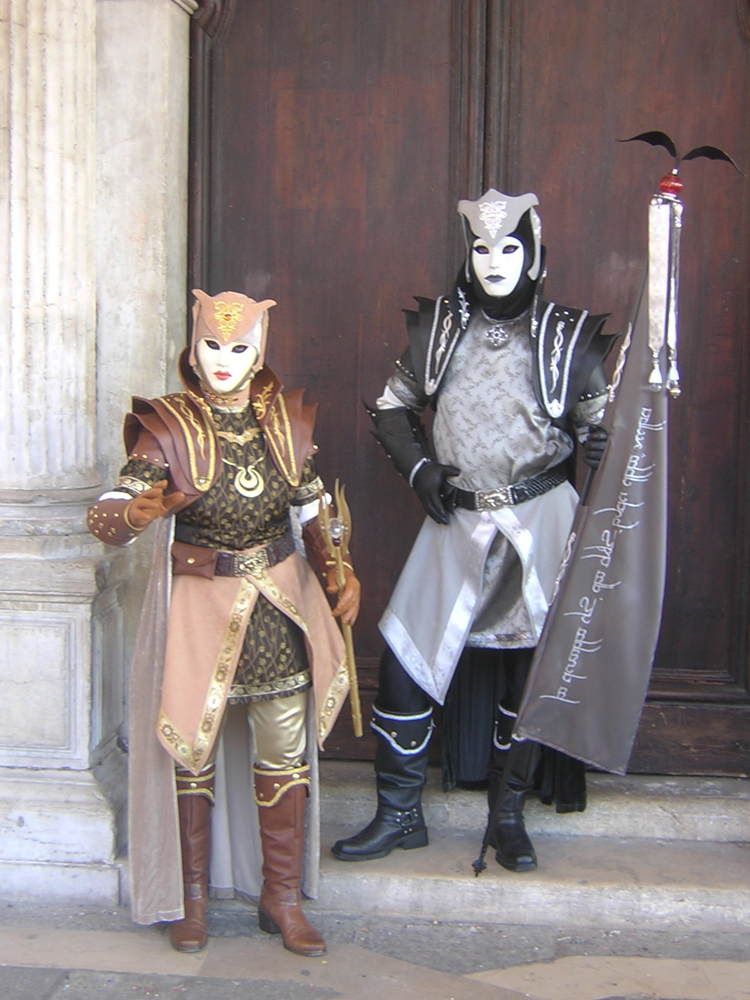
Third come irregular historical and whimsical pieces.  Someone always dresses as the Doge.  Other historical figures like Dante or Galileo may crop up.  Some adopt characters from the Commedia dell’Arte, so Pulcinella, Harlequin, others generic 13th or 14th or 15th or 16th or 17th or 19th Century dress.  Into this category then creep more marginal costumes: women in leather bodices and not much else, girls in Renn Fest gear, the odd Naruto or other anime creature, and young people with pink hair and neon green tail coats with sparkly skulls embroidered on them and platform shoes that light up.  Why not?
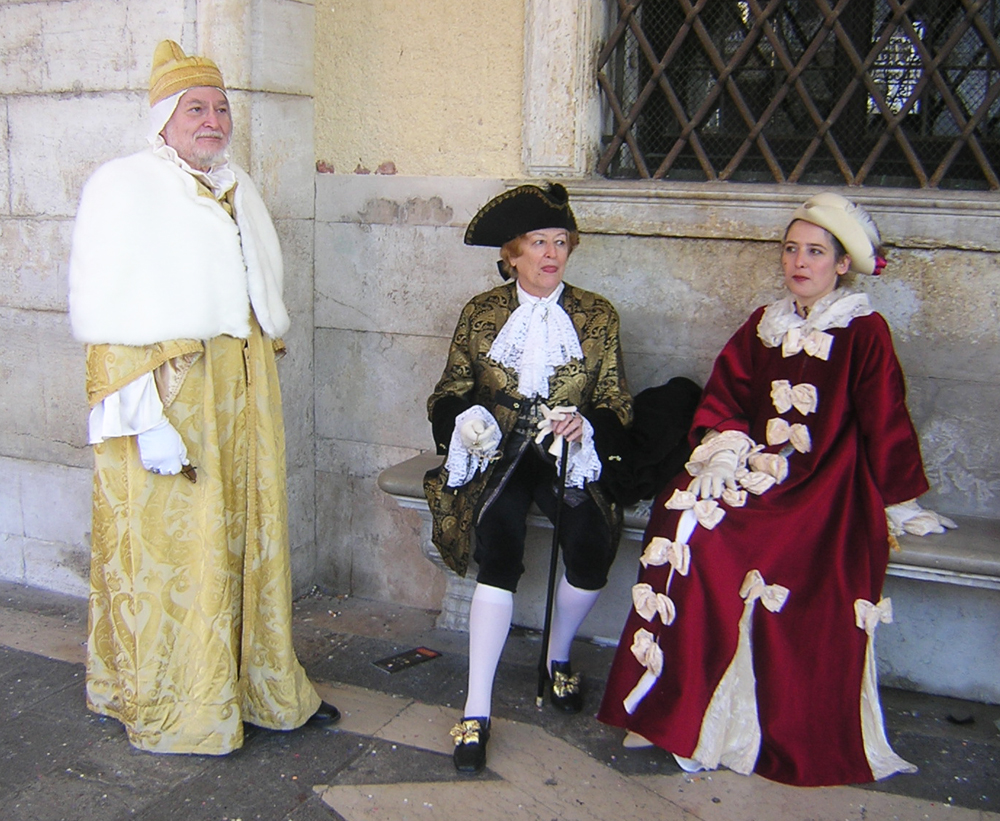
Only the Doge can have the Doge Hat. It’s the Best Hat.
Tolkein’s Elves put in an appearance.


Dramatically posing gothic silver crystal scale bird plague thing?

And last, there are little kids in the kind of cheap costumes as clowns or faeries or witches or batman that one buys mass-produced, just like at Halloween.
By my estimate 15% of the Carnival attendees are in costume.  Another 20% are just in masks, which they buy mostly on arrival to get into the spirit of the thing, and a further 15% succumb to the desire for costume enough to buy a cloak and/or hat to wear over coat and jeans.  Of those in fancy costume almost all are foreigners, mainly anglophone.  Of those just in masks, 50% may be Italian.  Keep in mind that Venice’s tourist population outnumbers its native population at least 3:1 at all times, moreso at Carnival, and that its separate population of resident foreign college students, also substantially anglophone, also outnumbers the native population not quite 2:1, making Venetians less than 20% of the people on the streets.  In fact, there are only 20,000 Venetians and something well over 100,000 outsiders at any given time, and most of the Venetians, for real estate price reasons, have retreated to living on the shore anyway.  A hotel or shop simply makes so much money that it is very difficult to turn that down in favor of a residence.  It is for this reason that it’s not rare to find someone who both identifies as Venetian and grew up in Padua.
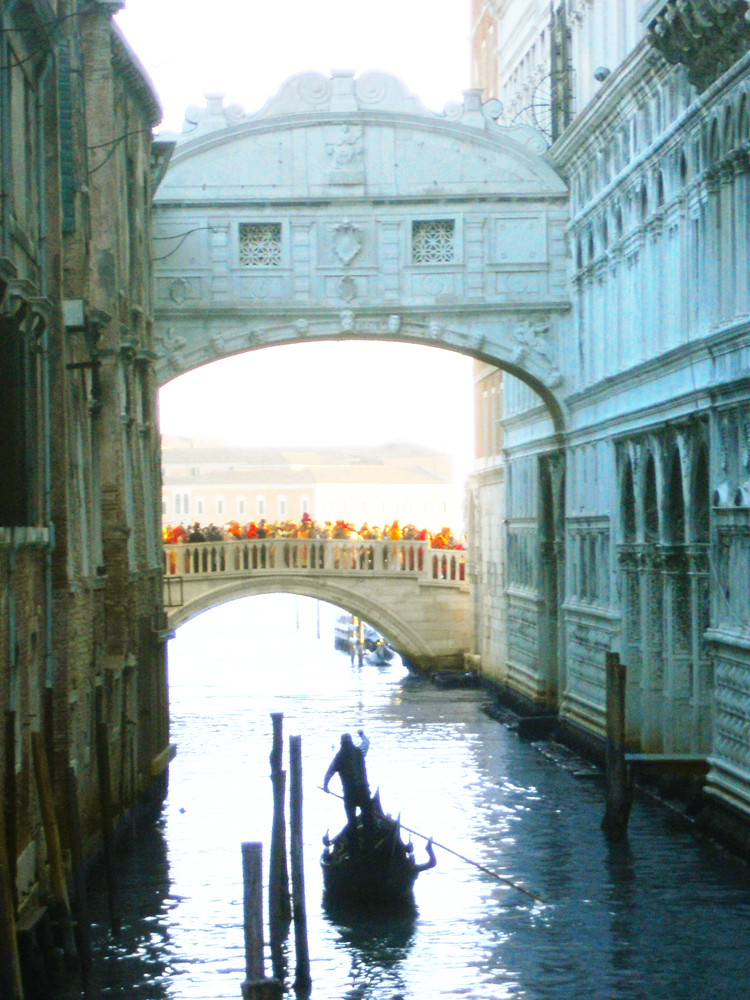
Venice at Carnival is also incredibly crowded.  This year I went in the middle of a deadly cold snap, and it was simply very crowded.  In good weather it is so crowded that one can barely walk through the streets.  At one point I literally encountered deadlocked foot traffic, an intersection at which so many people were shoving in from all 4 directions that it became physically jammed with bodies and was impossible to move, and the poor people in the center were literally trapped and unable to escape – after fully 30 minutes of shoving I gave up and went back the way I came.

The question of whether one wants to go to Venice for Carnival thus comes down to how fun one thinks it is to see the city populated with fantastic creatures in among the masses.  Venice is always beautiful, the canals always serene, the sunsets always stunning, the mask shops always open, a simple ride around and around on the water bus always perfect.  During Carnival prices go up, hotels fill, restaurants run out of tables, streets are crammed with people, attendants outside monuments get more fed-up and rude, but in the streets one catches little dream-like glimpses Doges, and Counts and dramatic cloaked figures, and mysterious masked ladies, and fantastic creatures from the historic other-race that instinct tells you built this miracle city.  For me, it’s a fair trade.
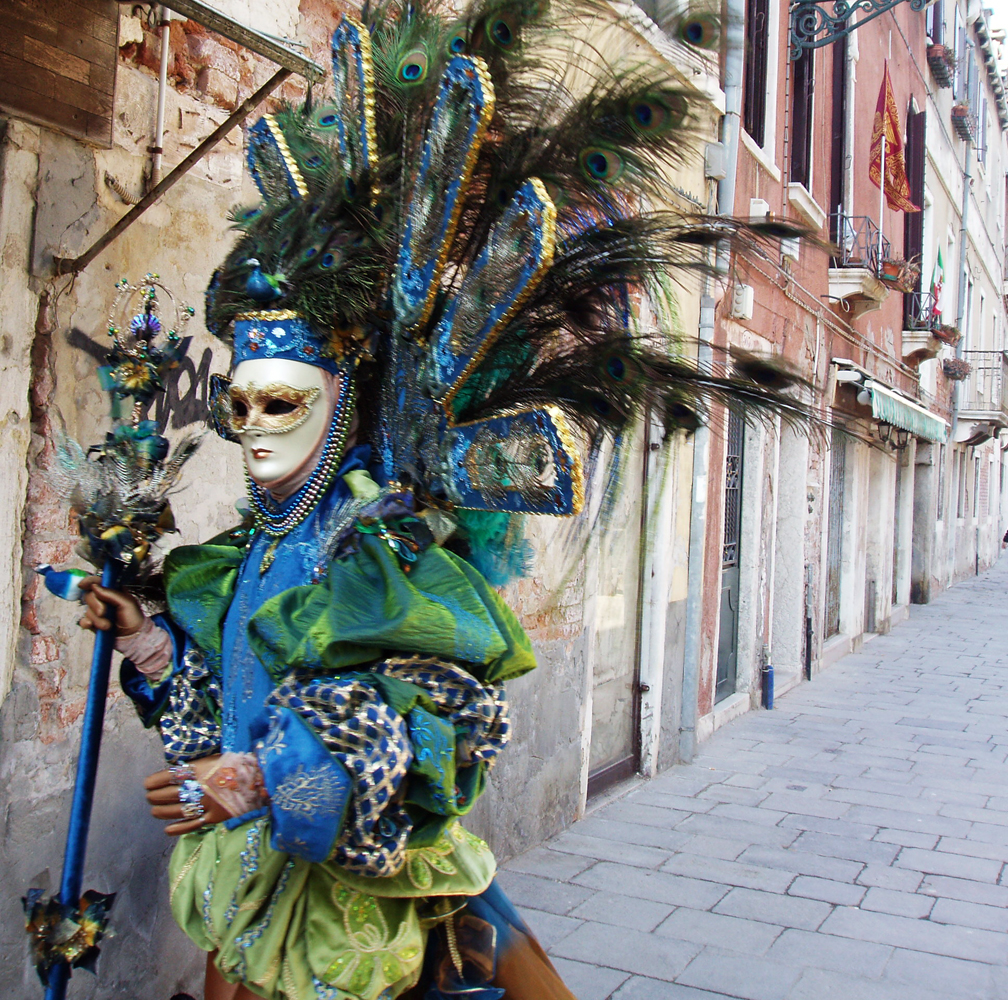
Read more about Venice’s Mask Culture.
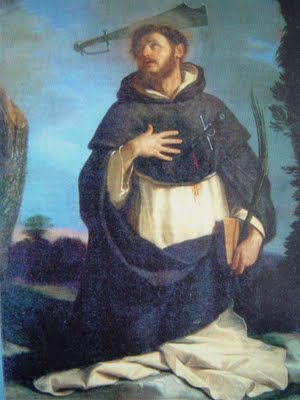
Spot the Saint Mini-Quiz

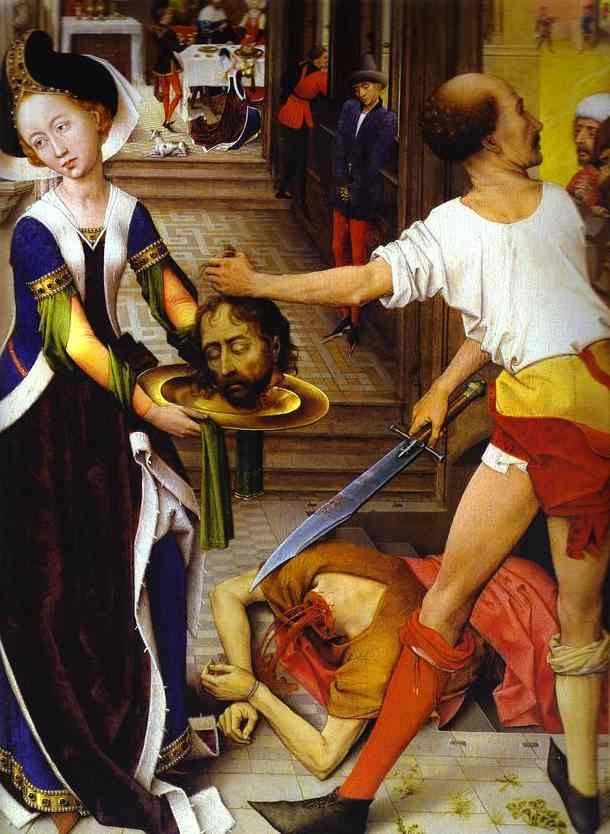
Hello, all. My latest post has been delayed by, among other things, Venetian Carnival, book projects, visiting friends, private tours of the back rooms of the Cathedral, doing my taxes, preparing to upgrade this website, and the investment of the Archbishop of Florence as a Cardinal. I hope to post soon, but as a quick consolation in the meantime, here are are some saint-spotting pictures, so those who enjoy it can quiz yourselves on the saints you know so far:

If you hover the mouse over an image, it will tell you the file name, which tells you who it is.  Don’t hover accidentally, or it’ll give it away.

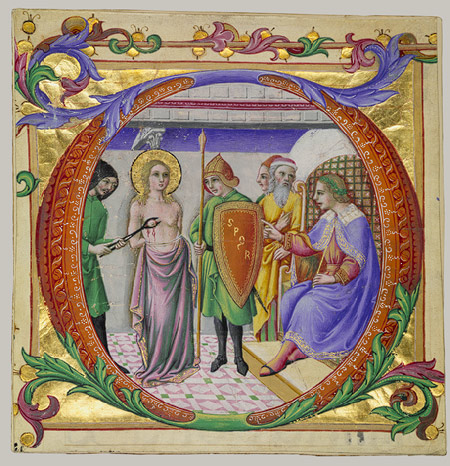
JohnTheBaptist-Martyrdom

Jump to the next Spot the Saint entry.

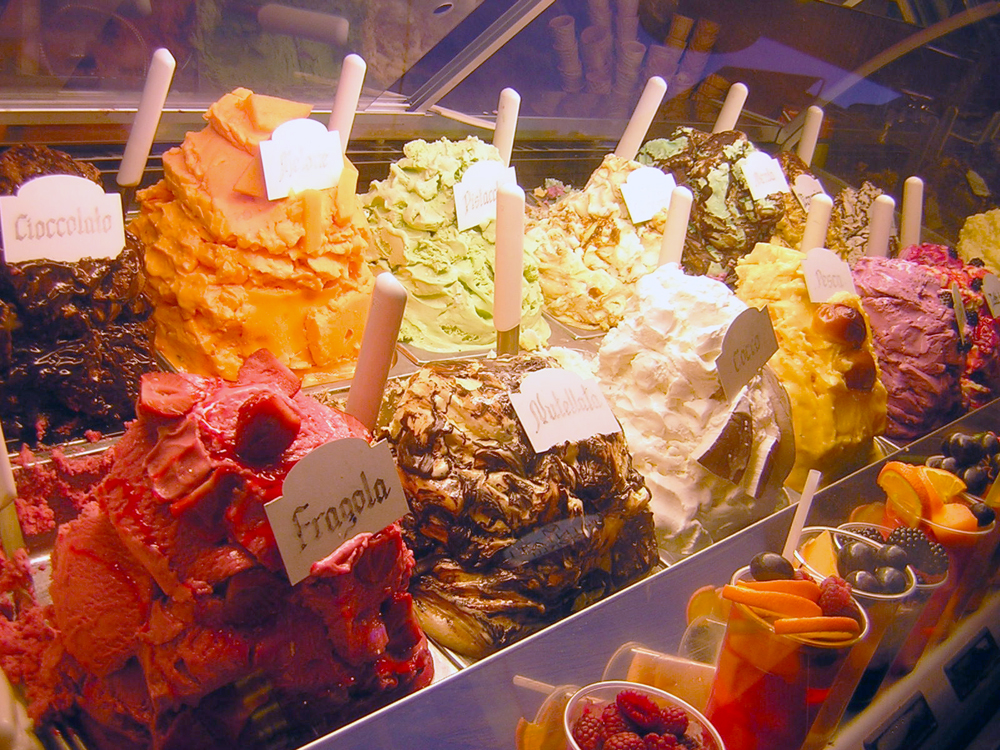
Relax. Have a gelato.

I was cheered recently by the juxtaposition of a pair of articles on my Italian news feed:

Both articles struck me, of course, as perfectly natural, since, as the ever-groaning gears of the Italian government, law and economy grow slower and more exhausted under austerity pressures, the only sane reaction is to relax and have a gelato. Gelato is an indispensable defensive measure in my experience of life in Italy, where truly obnoxious and stressful things do happen a lot, and you have to just accept that, 50% of the time, whatever you were trying to do just won’t happen.  The shop you spent an hour looking for is closed for no reason?  Relax.  Have a gelato.  The hotel you booked turns out not to exist?  (This DID happen to me, in Modena).  The paperwork you waited in line for 2 hours to file turns out to require something they never told you you didn’t have?  A pickpocket got you on the Rome 64 bus?  The museum you were looking forward to turns out to close early on the second Tuesday of each alternate month?  The romantic cobblestones broke your suitcase’s left wheel a half-mile from home?  These things happen all the time here, all the time, not to mention the constant frustrations of impossible-to-open doors and whimsical plumbing.  But even something as frustrating as a pickpocketing is much easier to deal with sensibly, and feels much less like the end of the world, if you relax and have a gelato.  I generally have a gelato the instant I get off the plane when I arrive in Italy, to give me the stamina necessary to brave the mobs around the baggage claim.   In fact, “Relax.  Have a gelato,” has become so ingrained in me as a default reaction to stress or failure that I habitually say it at home, to the great chagrin of my poor US-bound housemates, who would love to relax and have a gelato, were gelato achievable in the New World.

Luscious, seductive... bad gelato.

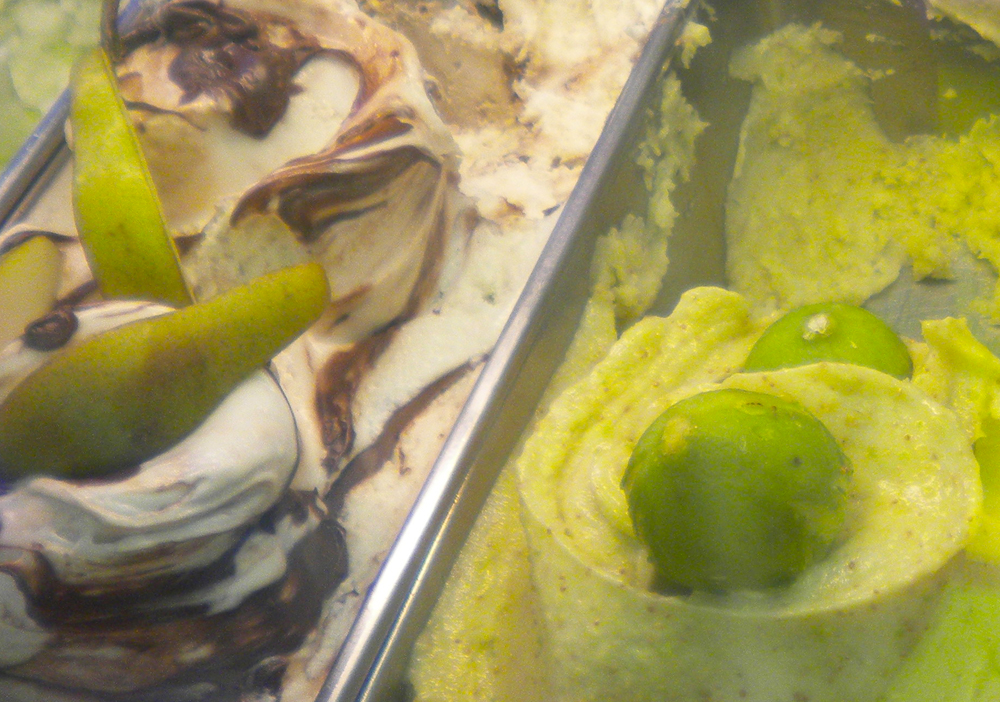
“But it is!” you say.  “They have gelato at the fancy grocery store by the mall.  Or at the import shop, or that pizzeria downtown, or in little Italy.”  They do.   There is gelato in the US, quite often these days, but, the important thing to note, is that it is (almost) always bad gelato, mere Hershey Bar ranked against artisanal truffles.  I have had good gelato in North America, in three locations, the Suite 88 gourmet chocolate shop in Montreal, the ChikaLicious Desert Bar in New York City (their cupcake bar across the street also has apple gelato of extraordinary quality), and, of all places, the underground cafeteria in the National Gallery of Art in Washington DC (here too get the apple flavor).  (Note: the organic gelato chain GROM also has branches in NYC, and I expect these too would have respectable gelato; my full thoughts on GROM another day.)  But for the most part, even in Italy-town subsections of US cities, the gelato is no better than one would find in an Italian train station.  Not what a gelato snob would call “good gelato,” and I am, I will comfortably admit, a true gelato snob.

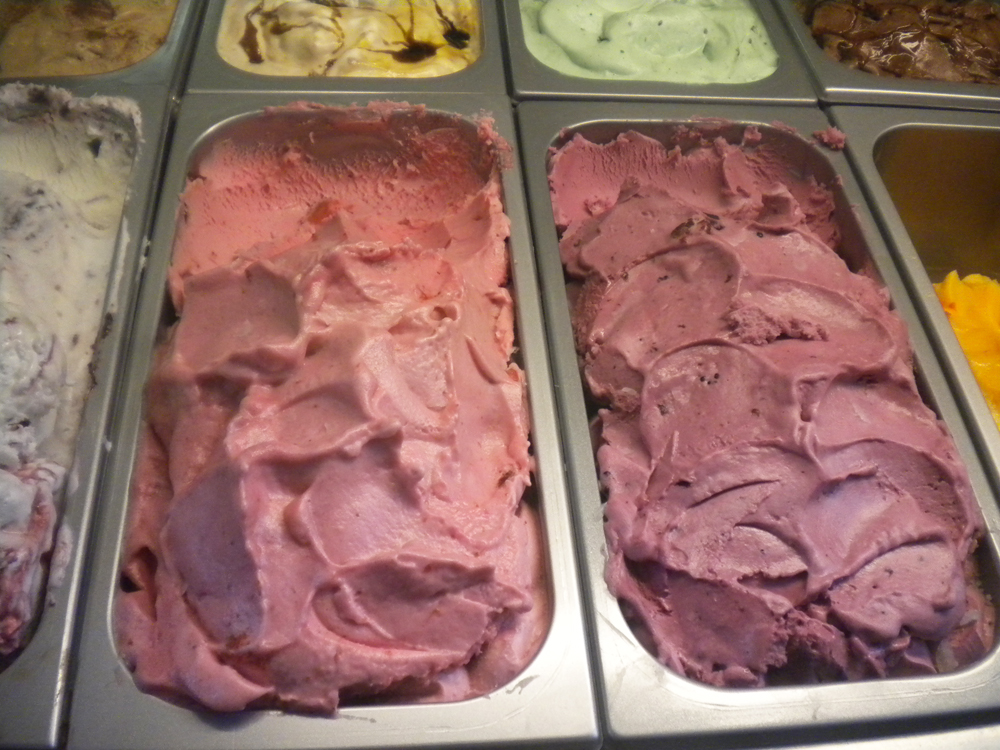
See the fibrous and variable texture of the apple gelato on the right? That's a good sign.

What is the difference between good and bad gelato?  Good gelato is made from all natural ingredients, as pure and as few as possible, while bad gelato is made with artificial colors, flavors, preservatives, and coagulants.  Good fruit gelato is made directly from the fruit, bad from fruit extracts.  Really bad gelato is made from a powdered mix with no fresh ingredients at all.  Keep in mind that I do not say this as any kind of organic food purist.  I do often buy organic when I can, but I will never pretend that organic always tastes better, merely often.  I do not shrink from eating radioactive orange mac ‘n’ cheese out of a box when the craving hits me, and I heartily repented of my folly the one year I procured an organic turkey for Thanksgiving, and discovered to my horror and chastisement the true merits of the hormone-stuffed, brine-injected Butterball.  But gelato is very delicate, because it is so pure, involving so few ingredients.  You can taste the chemicals when there are chemicals.  You can taste the quality of the milk and fruit used, and if you frequent a place you can tell day by day how ripe the figs were, how in season the oranges.  Bad gelato has an inescapable tinge of candy-like artificial flavor.  It’s still a yummy substance, still worth eating, but it’s infinitely inferior to the pure article. There are, from what I have uncovered, four reasons for the scarcity of good gelato in the US.

  1. Fresh gelato without preservatives does not last more than a day, and has to be made from scratch every morning.  This is labor-intensive and expensive, and is why so many places even in Italy don’t bother.
  2. The companies that manufacture and distribute commercial-sized gelato makers in the US want to make continual money off the restaurants that buy them, so have designed them to require the mix, and not to work with fresh ingredients, so the restaurants will have to continually subscribe to fresh batches of mix.  The kind of machine you get in Italy, that uses real ingredients, exists in the US only in the tiny use-it-at-home form, but is nearly impossible to find industrial-sized.
  3. Gelato, being so sensitive, requires really top quality fresh ingredients, both the milk and the fruit.  Such ingredients are expensive, and actually rare in the US where fruit is, usually, harvested unripe, and milk ultra-processed.  It is difficult and above all expensive to find ingredients of gelato quality in the US, and most restaurants could only cover costs if they charged more for their gelato than most people will pay for a scoop of ice-cream.
  4. American ice-cream is, in fact, pretty good.  It’s not gelato, and does not excel at the same things, but it is good.  If gelato excels at accentuating the purity of a single flavor: lemon, chocolate, milk; American ice-cream excels at creating triple chocolate fudge peanut swirl mars bar cookiedough crunch peach marshmallow ripple surprise.  These luxurious, over-the-top concoctions are delicious, and also complex enough to largely mask the artificial preservatives and inferior dairy that tends to go into US ice-cream.  Such products are  satisfying, mass-producible, preservable, and cheap.  Good gelato, which is more expensive to produce and doesn’t last, struggles to compete commercially.

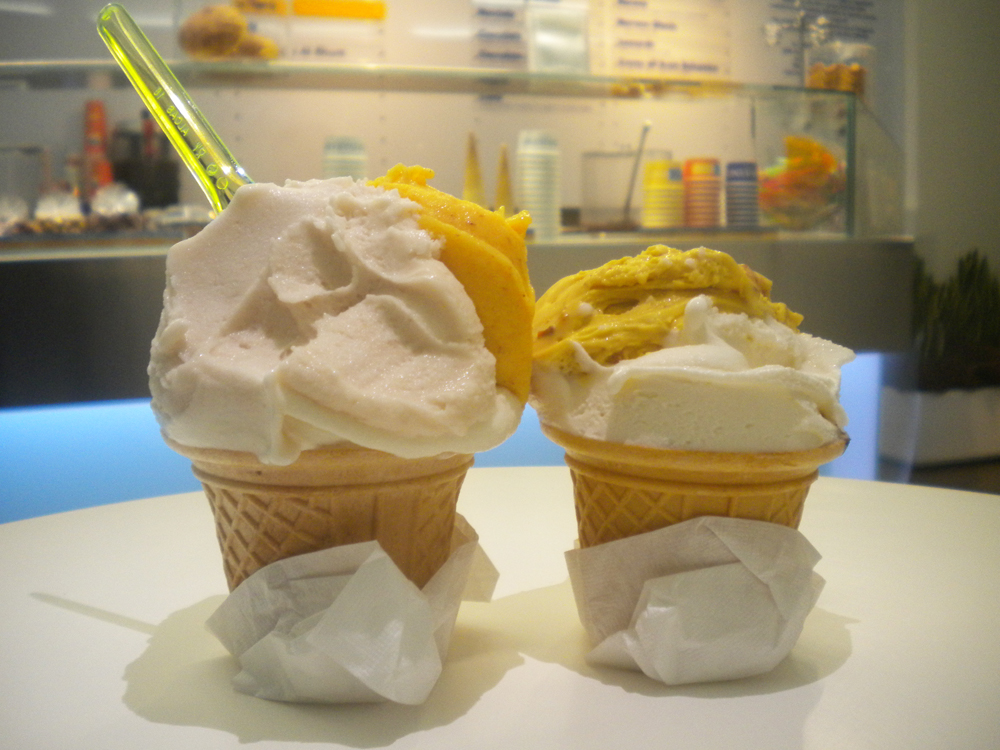
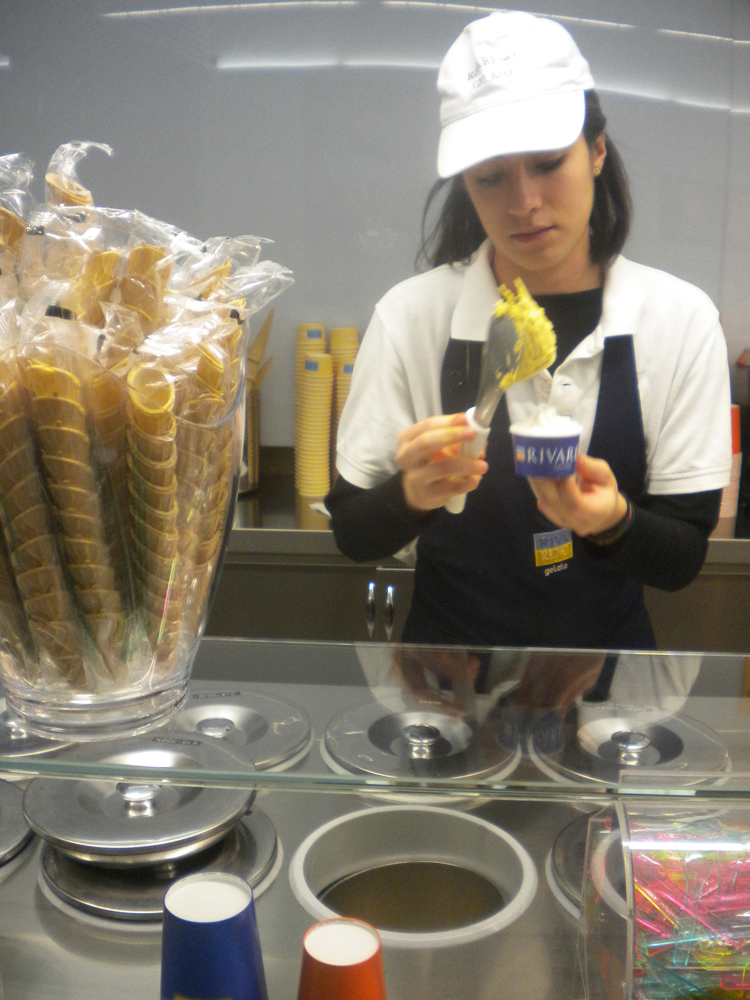
Pear, persimmon, crema & yogurt gelato at Rivareno (Florence). Few flavors, but so good!

Reinforcing scholarship: in a published poll, when asked which they would prefer, an ice-cream shop with (A) 25 flavors or one with (B) flavors that were all really good, most Americans chose (A), most Italians (B), and the northern sections of Europe mixed both choices.

(This, by the way, is, I suspect, why, among Rome’s elite gelato joints, the world-famous Giolitti is so popular with Americans and San Crispino with Europeans.  I recommend going to both, as each excels at some things the other does not.   More on these when I eventually review different gelato places (if wordpress will ever let me create the kind of index I want to use to do so, grumble, grumble.)

What is the difference between gelato and icecream?

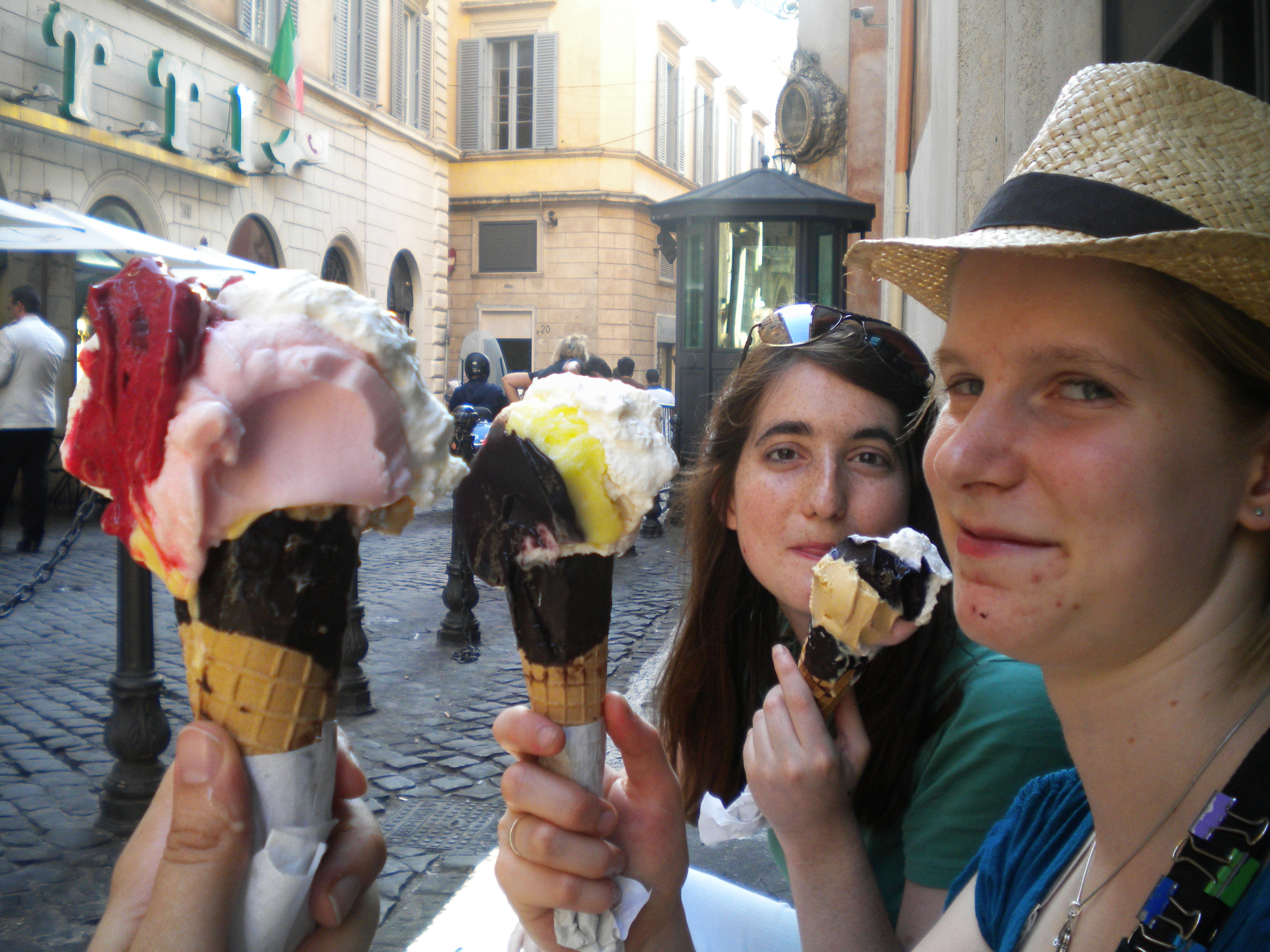
Friends enjoy elaborate cones at Giolitti (Rome).

I get this question a lot, and have two answers. In a technical sense, gelato is made with much less fat than ice-cream, in fact gelato is usually made with milk, not cream, but it has much more sugar, to compensate, since milk and sugar are the things that keep frozen concoctions soft and creamy.  A fruit gelato is, at its purest, a sorbet and contains no dairy whatsoever. In an aesthetic sense, however, gelato is much more about accentuating the substance from which it is made, whereas ice-cream is about combining flavors.  Strawberry ice-cream is an experience of the delightful comingling of strawberry juice with cream, producing a rich, strong, syrupy dairy experience, and reminding one pleasantly of strawberries and cream if one has ever had them together; strawberry gelato is the experience of eating a soft frozen strawberry, with no presence of dairy or commixture.  It is in the fruits and the nuts that this difference is most extreme.  A top quality chocolate gelato is quite similar to a top quality chocolate ice-cream, but a pistachio gelato is like eating a real pistachio, and a raspberry gelato will sometimes leave you with seeds between your teeth, which ice-cream never would.  Gelato, real gelato, doesn’t taste like it’s flavored with the thing, it tastes like it’s made of the thing. This last fact often makes it difficult for foreigners in Italy who are ordering gelato for the first time to choose flavors they will actually enjoy.   Pistachios and Pistacho Ice-Cream do not taste the same, and many people like one and not the other, and consequently make the wrong choice when trying to guess whether or not they’d like Pistachio Gelato.  I myself would run in terror from watermelon icecream, since I know from dumdums and artificial lemonade the horrors that watermelon flavor can inflict, but watermelon gelato (gelato di cocomero), which tastes like the entire fresh summer zest of a real watermelon distilled into each bite, is one of my great delights.  Conversely, many people like cherry syrup, in cocktails, on cakes, in Dr. Pepper, and these people are often wildly disappointed at the first bite of a cherry gelato, which bears no resemblance to the syrup, but simulates the experience of a, usually very acidic, sour cherry. Vanilla is the pinnacle of this cultural flavor misunderstanding.  Many Americans come to a gelateria wanting to try the equivalent of vanilla, and different people propose different equivalencies, but I have concluded, with careful study, that there is not an equivalent.  There are three equivalents.   This is because there are three different reasons people like vanilla ice-cream:

  1. Do you like vanilla for its pure, milky, creaminess?  The absence of any secondary flavor to interfere with the richness of pure dairy?  In that case you want fiore di latte (flower of milk) or, at a really good gelateria, fiore di panna (flower of cream), a gelato made of the pure milk or cream with sugar and nothing else to interfere.
  2. Do you like vanilla for its rich, custardy feeling, preferring the yellower French Vanilla flavors to traditional vanilla?  In this case you want crema, custard flavor, modeled on the eggy custards that fill pastries and doughnuts.
  3. Do you like the actual flavor of the vanilla bean, with its memories of Christmas cookies and traditional perfumes?  In this case and this case only you want gelato di vanilla, if they have it, but be warned: it means it that it’s really, honestly vanilla flavor, like a cookie, or liqueur.

Thus “Gelato is Italian ice-cream,” remains one of the more misleading truths involved in Italian travel.  Gelato is indeed Italian ice-cream, but one cannot apply the same logic to it, and there is nothing like a 1:1 correspondence between which flavors one should order in a gelateria and an ice-cream parlor.  Unfortunately, this concept is difficult to pass along quickly.  You must remember, that I feel true emotional pain whenever I see a happy-looking person step up to a truly terrible gelato place when there’s a good one next door, and I very frequently strike up conversations with passing anglophone tourists which lead inevitably to my showing them a good gelateria.

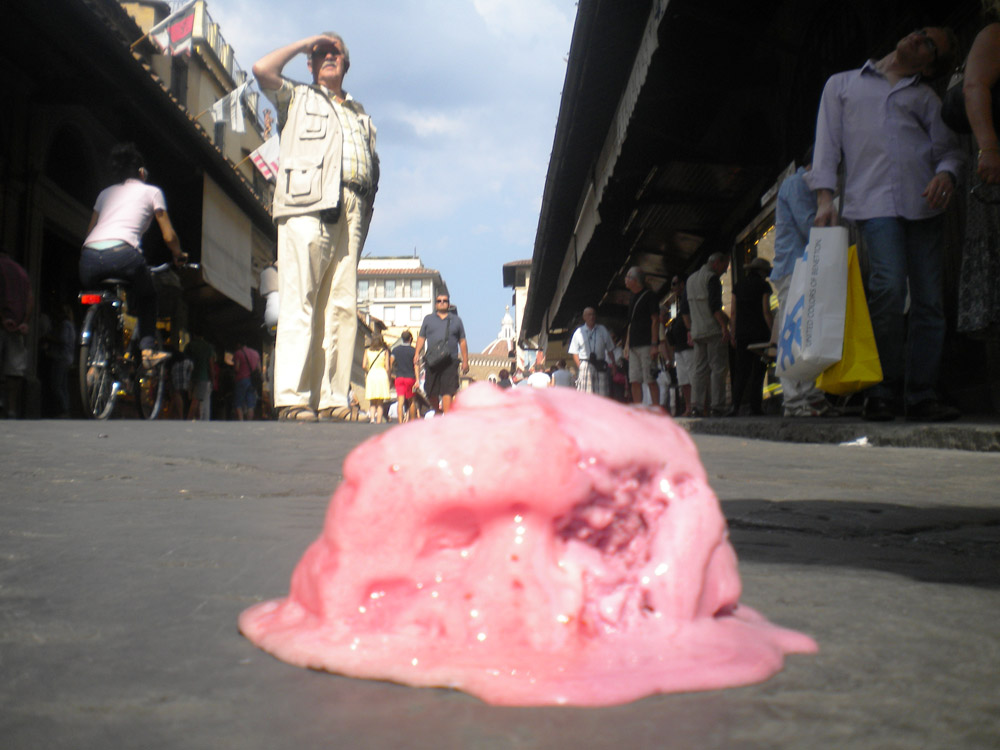
Witness a small tragedy on the Ponte Vecchio.

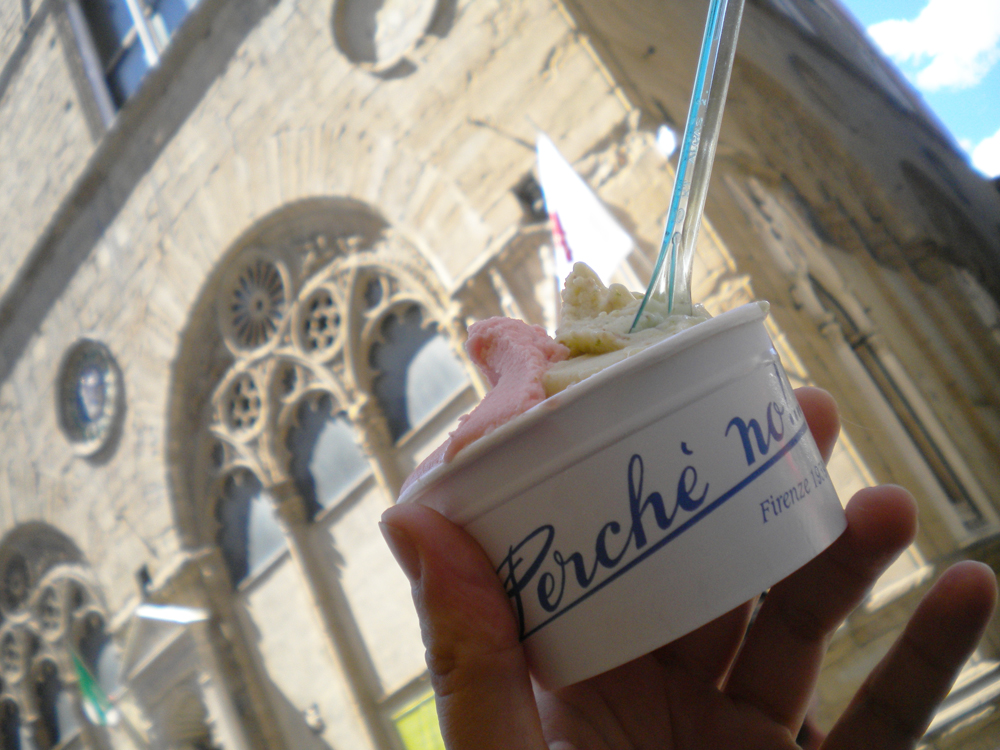
At this point follows the test, and the suspense, when I start recommending flavors.  Will they listen?  Will they not?  Since often I’m recommending flavors they would never want in ice-cream.  I can generally convince people about one flavor by having the employees give them a spoonful to taste, but a lot of people just aren’t prepared to believe that “Yogurt and Mandarin Orange” or “Grapefruit and Sour Cherry” are winning combos.  “I’ll take Chocolate and Chocolate Chip.” My two recent favorite people I took to gelato places were both middle-aged American men, with wives in tow who refused on diet grounds to get gelato and thereafter ate a hunk of their husbands’.  One, when we arrived at Giolitti and I started discussing flavors, simply said: order for me, I trust you.  One dark chocolate-coated whipped cream-stuffed waffle cone with Champagne, Sour Cherry and Fleur de Sel Caramel Gelato later, he was a very happy man.  The other I took to Perche no…! (The sensibly named “Why not…!” gelateria which is the reason I live on the street  I live on here in Florence).  I recommended Yogurt, Strawberry Mousse and Mixed Berry (Frutti di Bosco).  He ordered Chocolate and Coffee.  After he tasted his, I let him taste my own cone.  He sighed and smiled.  “Well, you told me so.”

New Travel Tips Section

I am (if I can persuade WordPress to condescend to let me) about to create a new “Travel Tips” index section of Ex Urbe, in which I will gradually review restaurants, museums, hotels, coffee bars, and also provide general city-specific travel tips, things like where the public restrooms in Florence are hidden, and which are the better-tasting Roman water fountains.

Bad gelato, lurking in its homogeneous slimyness!

I shall initiate it with an updated, web-friendly but also printable version of my little guide: How to Spot Good and Bad Gelato.  So vital is the skill that I, in fact, routinely distribute it as a handout to my students, and have often been thanked for it. I will also, in it, review specific preferred gelato places in major Italian cities, but sticking always to one principle: There Is No Best Gelateria.  There are bad gelaterias and good gelaterias, but in ranking the good ones against each other, I have never found one which beat all others in EVERY way.  Each has its points.  Perche no…! excels at sorbets, seasonal fruit flavors and mousses, Rivareno at smooth, creamy, antique flavors, GROM at its raw, organic feel, San Crispino at its meringue semifredo assortment and complex crema variations, Giolitti at its luxurious, elaborate cones and ocean of flavors, Vestri at its chocolate (Oh, its chocolate!), and each of these has three or four signature flavors which cannot be rivaled by the others.  I would never order frutti di bosco at Giolitti, nor fail to order it at Perche no…!; the converse for Caramel.  Both remain superb gelaterias. Remember, though: even bad gelato is still very, very yummy.  So, even if you don’t have access to the best, relax.  Have a gelato.

Spot the Saint: Agatha and Lucy

I have just returned from a jaunt through Sicily, where the change of cityscape was a perfect reminder of how useful the ability to spot saints can be.  I popped into church after church, and by the fourth it was easy to tell we weren’t in Florence anymore, and not just by the prevalence of baroque frufru on the altars.  San Lorenzo was scarcely anywhere to be seen, John the Baptist uncommon at best, Zenobius and Reparata distant memories, while every single church had an altarpiece or, more often, wooden statue of the two virgin martyrs Agatha and Lucy.  Two guesses who are the patron saints of major cities in Sicily.

Saint Agatha (died around 250 AD)

  • Common attributes: Breasts on a platter, breasts cut off, martyr’s palm
  • Occasional attributes: Pliers or pincers or big scissors, dressed in antique Roman-style robes
  • Patron saint of: Victims of rape and torture, single women, wet nurses, protection against volcanic eruptions, and fire, and natural disasters in general
  • Patron of places: Sicily, especially Palermo and areas where Mt. Etna’s eruptions threaten
  • Feast day: February 5th
  • Most often depicted: Standing around with other saints, having her breasts ripped off
  • Relics: Catania (Sicily)

Saint Agatha is, like Catherine, one of the popular set of late Roman beautiful virgin martyr saints.  The story is, like many of such vintage, tangled and unreliable, and follows a fairly stock sequence of romance and persecution, but in Agatha’s case she dedicated her virginity to God but was lusted after by a Roman official, Quintinianus.  He persecuted her for her rejection of him, and sent her to a brothel, but she refused to succumb.  The stories have her make some very sophisticated philosophical arguments against pagan idols.  Eventually he had her tortured, including having her breasts cut or ripped off, though an apparition St. Peter miraculously healed them.  She died in prison.

Agatha is protector against fire because of some of the tortures she endured.  This makes her extremely popular in Sicily, which is dominated by the towering volcano of Mt. Etna.  Some active volcanoes sort-of sit there rather calmly, or lurk building up steam for a millennium or two before destroying Pompeii again, but not Etna.  Etna erupts all the time.   It erupted two or three times last year alone.  Heck, it erupted while I was there, just a little eruption, but enough for the lava to trail visibly down through the snow cap like spilled ink.  Now, usually it just erupts around the crater part where no one lives, but it does erupt enough to destroy some inhabited ground once every few decades, making protection against fire the top question on everyone’s minds.  They have Agatha’s veil there and occasionally get it out and parade it in front of the lava as it’s coming down to try to get it to stop, and, miraculously, it sometimes does.  During one such incident the veil miraculously turned from white to red, confirming its special powers.

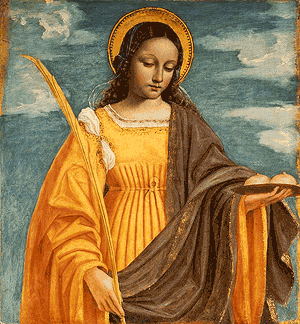
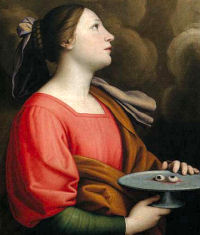
Like many martyr saints, Agatha carries the symbols of her martyrdom, in this case usually her severed breasts on a platter.  In art, the challenge is less to recognize this very distinct attribute, than to overcome the average early artist’s complete inability to visualize what breasts sitting on a platter would look like.   One sees a female saint holding a tray with… are those muffins?  Oranges?  Bells?  Bags?  Little pyramidal paperweights?  Oh!  It’s Agatha.

Saint Lucy (Santa Lucia, 283-304 AD)

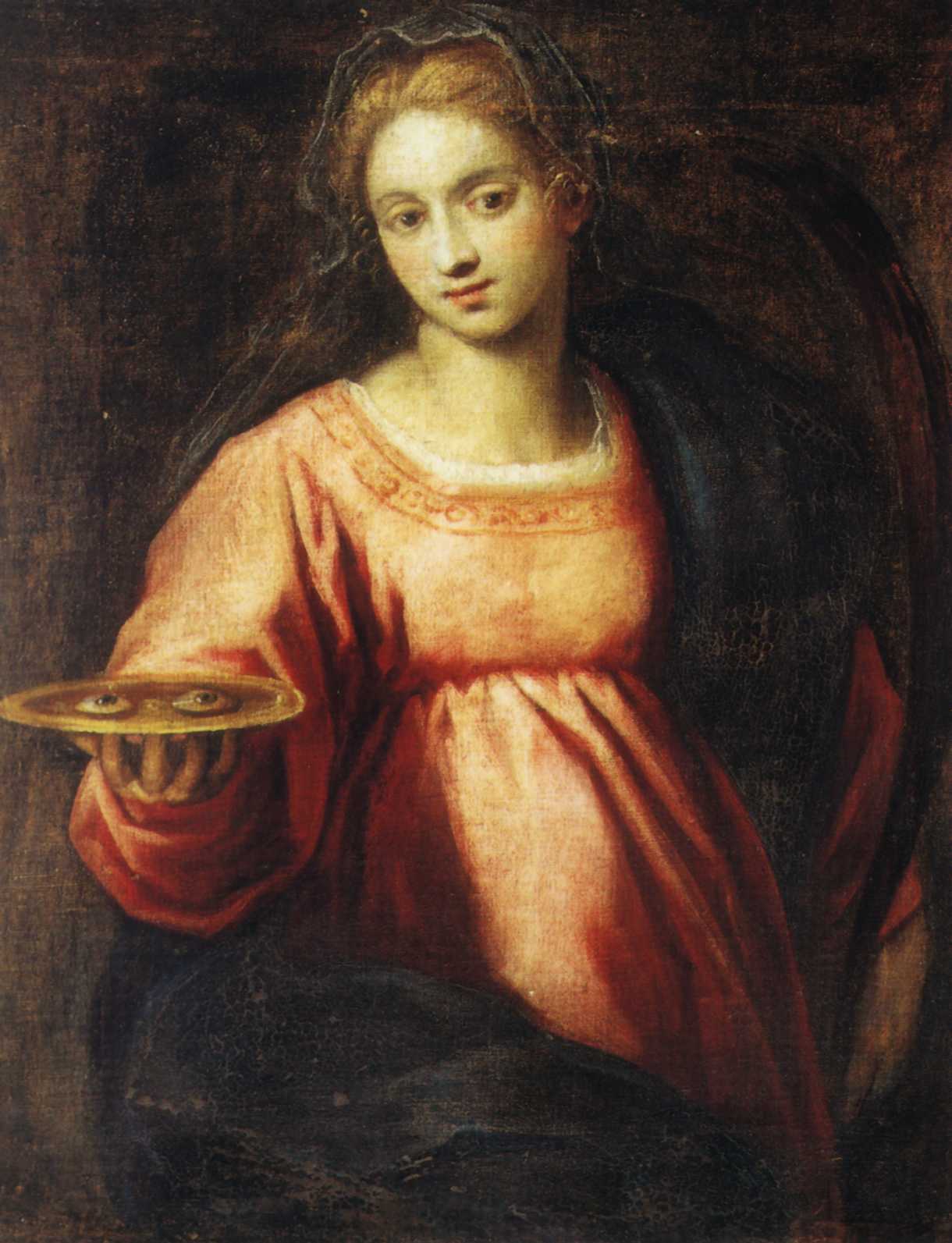
  • Common attributes: Eyeballs on a platter, eyeballs on a cup or something other than a platter, lamp or cup with a flame in it possibly also with eyeballs in it, martyr’s palm.  Note that despite the eyeballs, she will still herself have eyes.
  • Occasional attributes: Sword, dressed in antique Roman-style robes
  • Patron saint of: Eyesight, blind people, writers (who need to read a lot!) especially Dante.
  • Patron of places: Perugia, Syracuse (Sicily), Malta
  • Feast day: December 13th
  • Most often depicted: Standing around with other saints, especially Agatha
  • Relics: Venice

Lucy was a little later than Agatha and intentionally followed her model, even receiving a visit from Agatha’s spirit.  In Lucy’s case she rejected a pagan bridegroom and wanted to give her dowry to the poor.  The disappointed suitor denounced her, and she was sentenced to be taken to a brothel, but became miraculously heavy, so the guards couldn’t lift her, even when they tied her to some oxen and had them pull.  She was then tortured and killed.

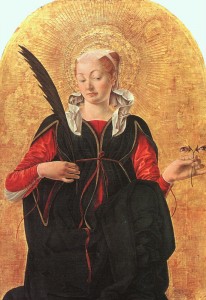
Lucy’s name means light, and this is the source of her association with eyesight.  The story of her having her eyes put out is a late addition, probably derived from the association rather than the other way around.  Renaissance artists are about as bad at drawing eyeballs as they are at breasts, but they generally just paint a pair of non-ball eyes, which are much easier to recognize than Agatha’s muffins.

Lucy was Dante’s personal patron saint, so it is to she that Beatrice turned within the hierarchy of heaven when Beatrice wanted permission to give Dante his tour of the afterlife.  Lucy then went to Mary, who arranged things with the King.

And now, Spot the Saint Quiz Time:

Quiz yourself on the saints you know so far.  (click here for a higher-res image)

Sorry it’s hard to see what she’s holding. Even in the room with the original painting it’s hard to see.

Jump to the next Spot the Saint entry.

Really Real Fake Centurions: Legio I Italica

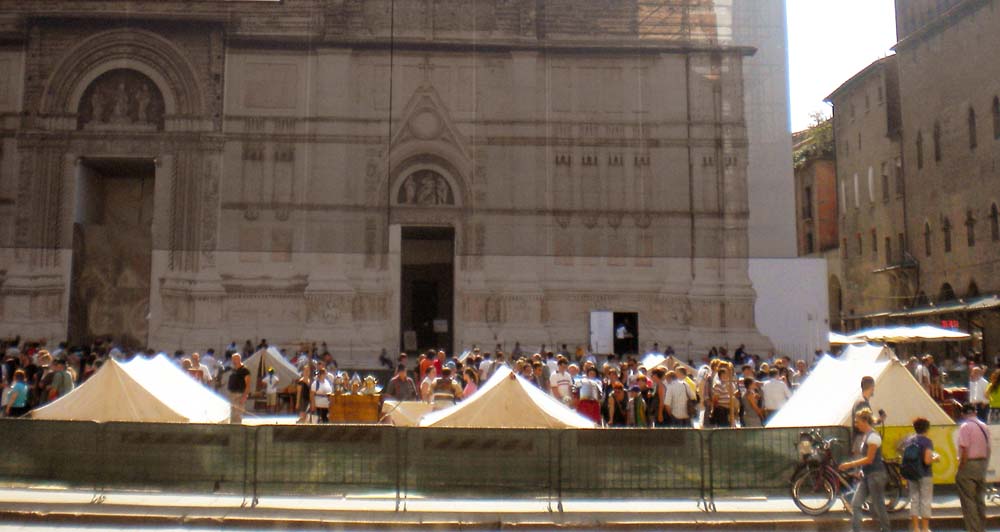
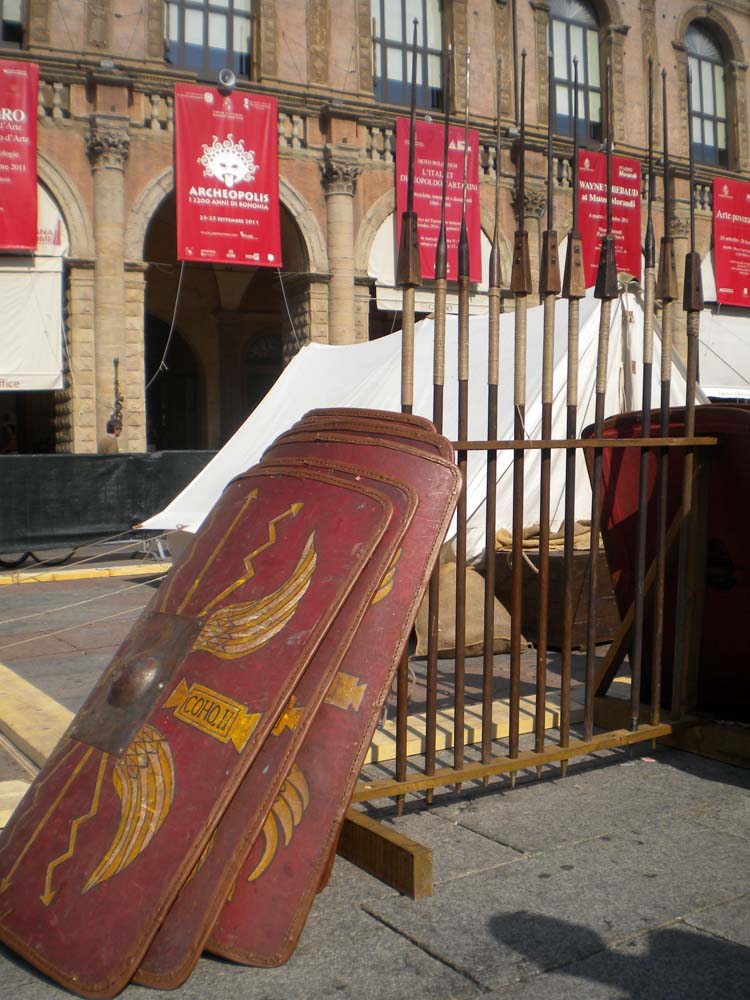
The Italian legal kerfuffle over “Fake Centurions” abruptly came to make sense on my recent visit to Bologna, when I discovered the Legio I Italica camped out in the cathedral square.


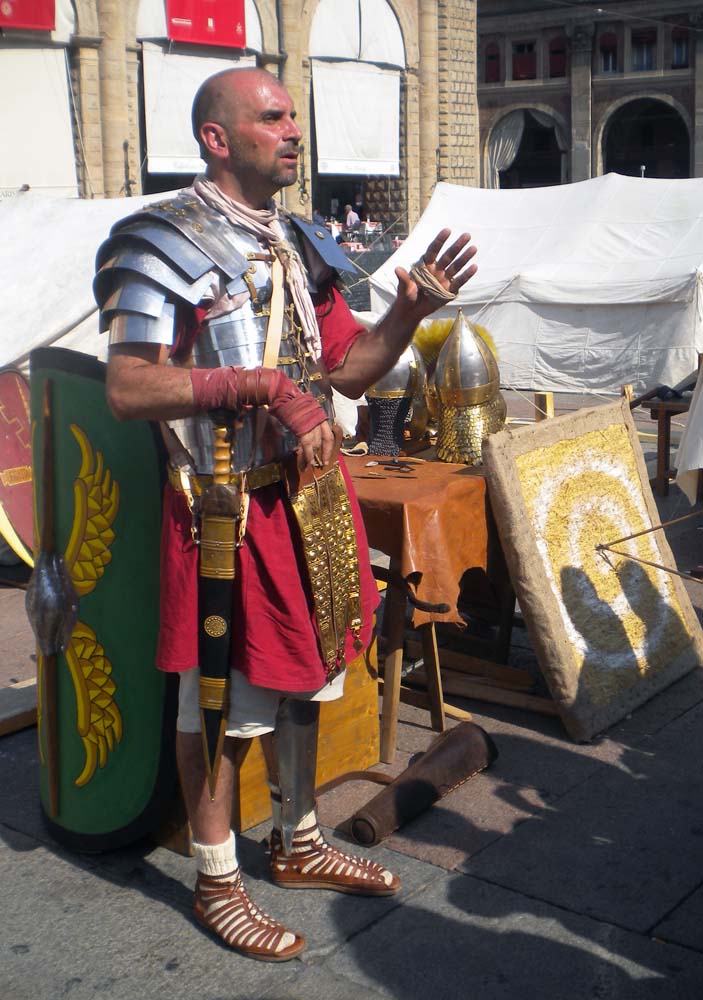
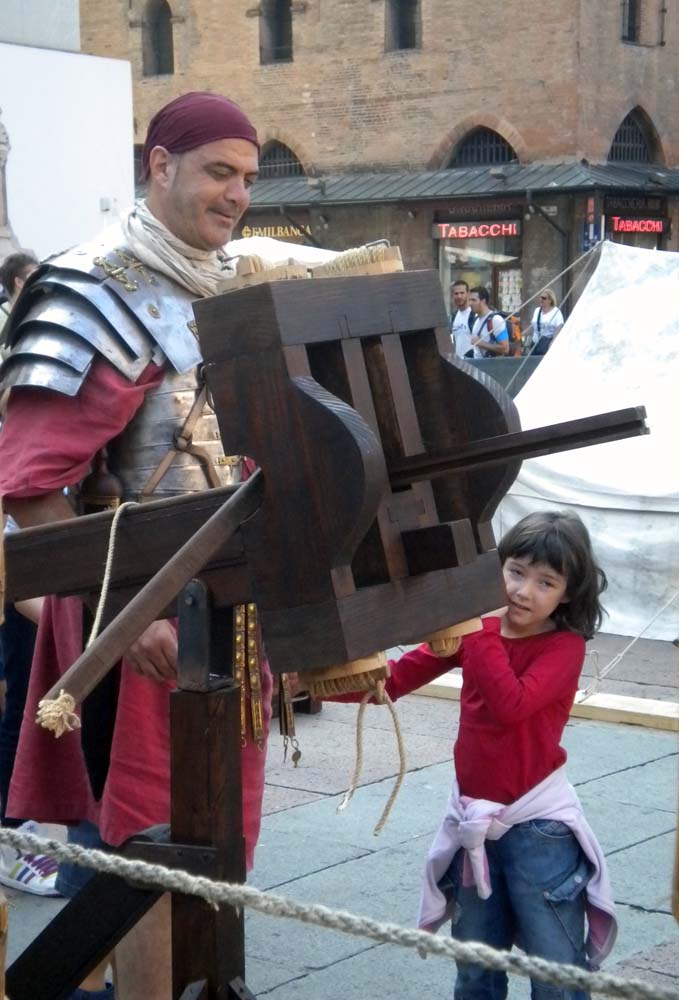
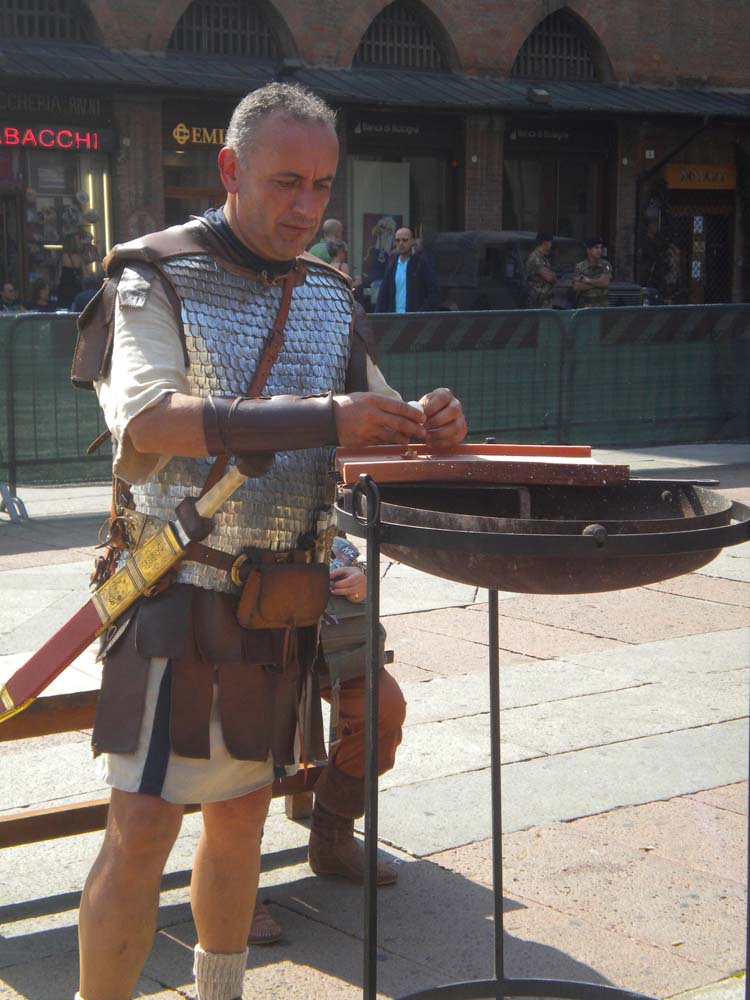
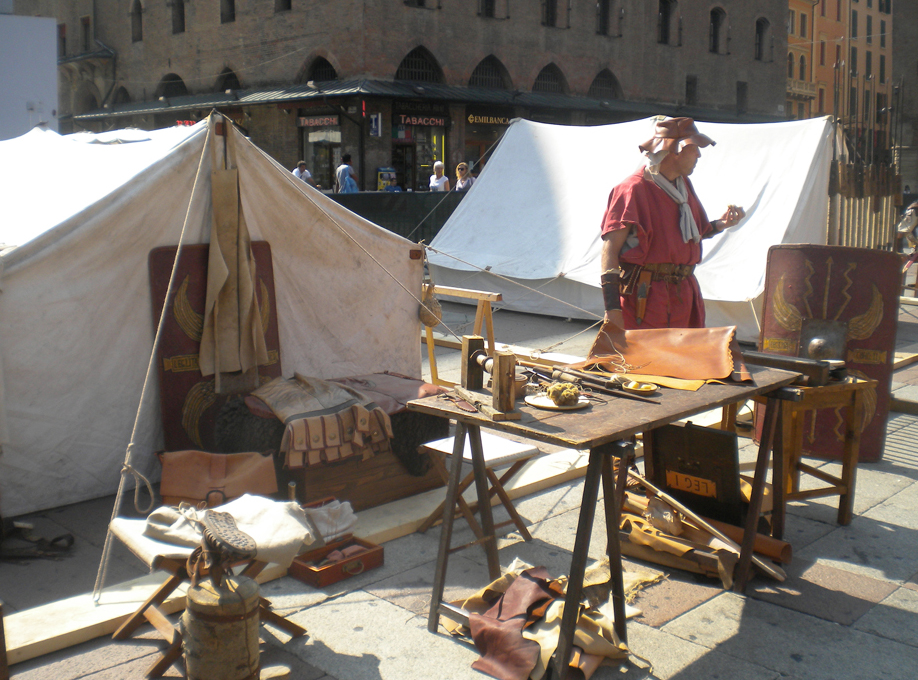
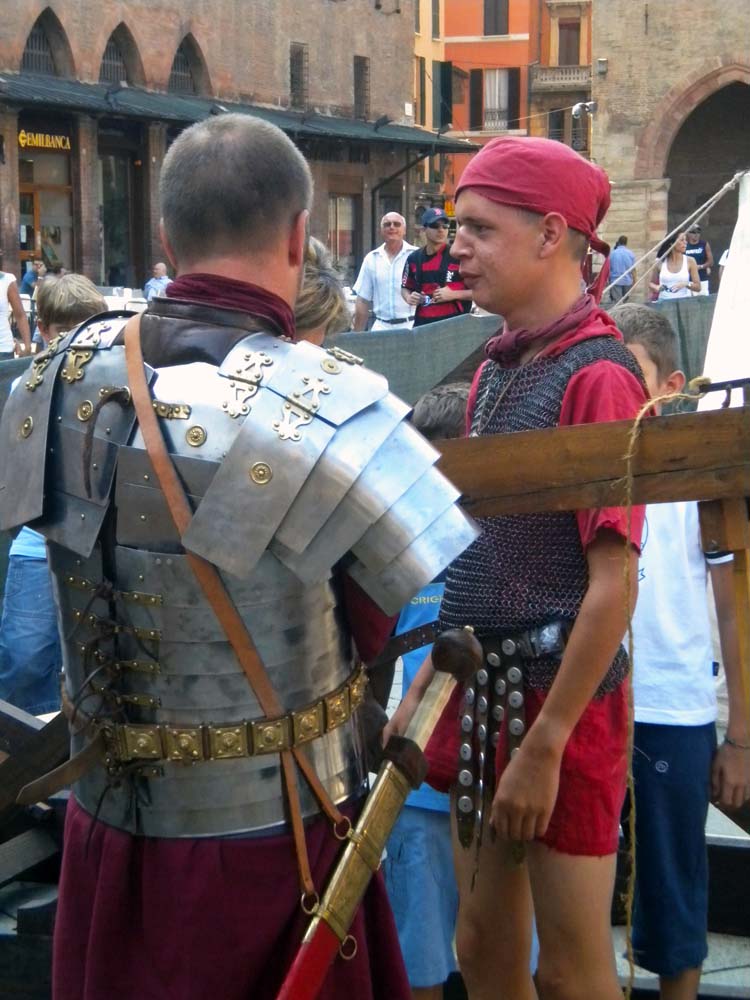
Legio I Italica is a group of top quality, professional Roman Legionary reenactors, who travel around Italy by invitation, making camp in various towns and cities in order to educate Italians, young and old, about the real life of the legions and the ancient world.  Their gear is superb, none of the plastic or anachronistic ornament of those who strut around Rome’s monuments.  Real steel, real bronze, real leather, but more than that.  These soldiers are bruised and bandaged, rough, crude, their sandals worn, their armor dented, their tunics sweat-stained.

They also include the parts of Roman gear we don’t tend to identify as Roman: a sweat-catching handkerchief around the neck, an anti-sun bandanna, broad straw sun-hats only subtly different from the hundreds for sale at street stalls a block away. Parts that reinforce the continuity between history’s dirty work and today’s, and decrease, rather than augmenting, the feeling of antiquity.  Parts that should be there.

Their demeanor is perfect too, a lazy, languid casualness in interacting, both with people, and with gear, so they really feel like soldiers on their day off.  “Hey, kid, wanna pull this string?”  (Hands small child trigger rope for massive crossbow).  “Naah, your Mom doesn’t need to help, here, just pull that.”  They often just sit, doing their own thing, until curious bystanders approach them, rather than accosting.

The juxtaposition of Roman Legion with Bologna’s main square’s elaborate cathedral, Renaissance facades, medieval fortress-palaces, and the statues of popes and allegorical figures watching is, of course, fantastic.

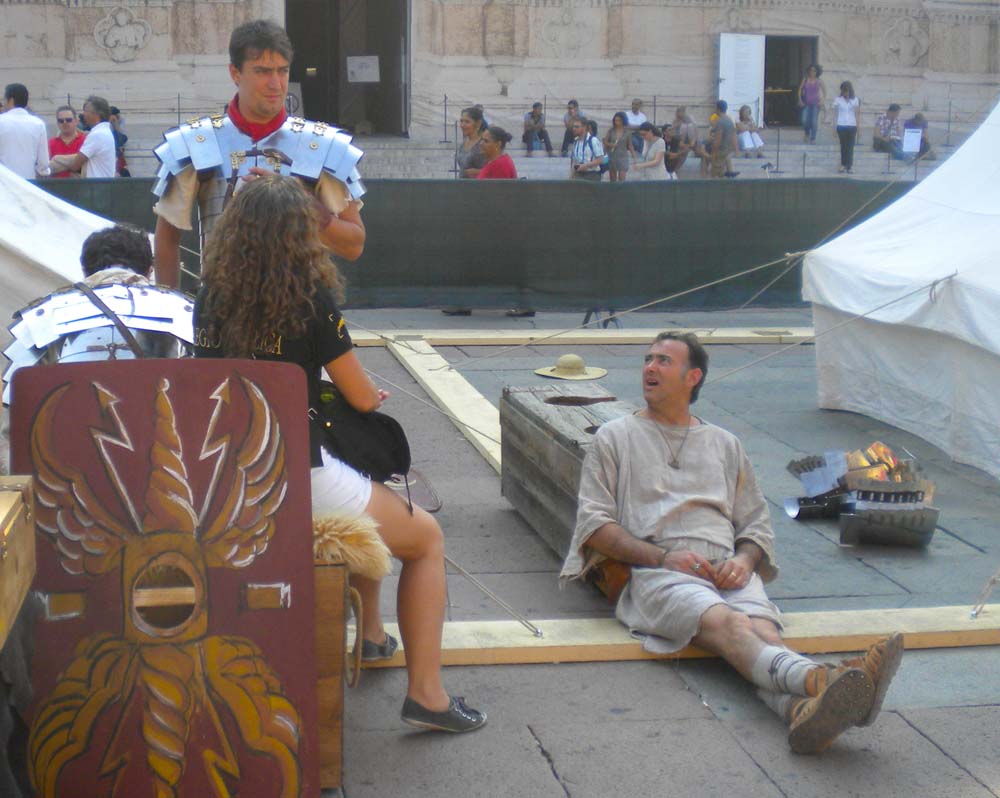
The most outstanding element may be their variety.  They don’t only include soldiers and support but all kinds of camp staff and hangers-on, everyone that might travel with a legion, including my favorite: the camp layabout who won’t do anything helpful.  Here he is refusing to come help this legionary answer questions for the nice lady.  Shortly he will move on to refusing to help the shoemaker, then refusing to help the cook…

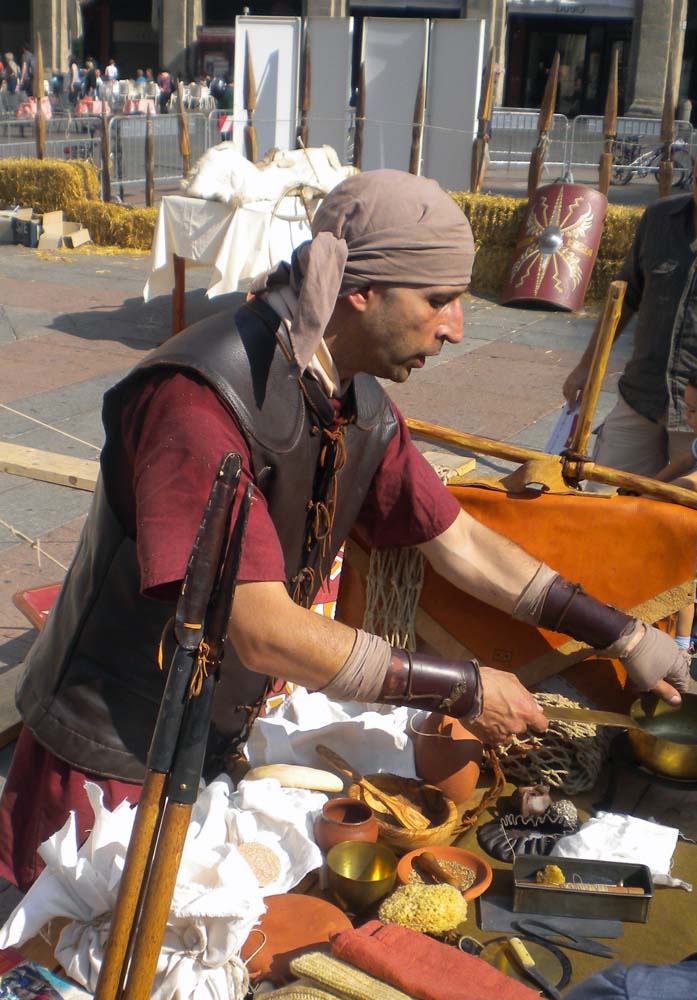
The camp's cook

They do have a cook, complete with samples of all sorts of noxious Roman spices and ingredients.  For those not familiar, if there is one branch of human achievement whose progress has been unilaterally and consistently positive through all of human history, that branch is cooking.  Excluding current perversions of too-artificial ingredients and flavor-free, chemical-plumped out-of-season vegetables (which are issues of farming and distribution rather than cuisine) food has gotten better, better, better as new combinations, techniques and ingredients have expanded the possibilities, and made it possible to leave the stopgaps of the past behind.  Crude early grains became cooked grains, then flour, flat bread, bread which rose and was soft and scrumptious, eventually to such masterpieces as the cake and the croissant.

Brazier, used for heating nuts, meat, shoes, metal pokers... so why do my chestnuts taste like leather?

There are some left-behind recipes and ingredients that are certainly worth revisiting, but as Florentine dishes like tripe and boiled pig’s knuckles teach us, many “old-fashioned” or “rustic” dishes are code for “What we used to eat when we were under siege.”  Many ingredients have faded from the world of cooking because we found better ingredients, and two-thousand-year-old Roman cooking is one step above the random plants and dead animals one would eat if trapped on a desert island.   This camp cook wisely did not offer to let us taste Rue, or the infamous Garum, rotten fermented salty fish paste which the Romans slathered like ketchup on everything, even deserts.  But he did have enough to smell.

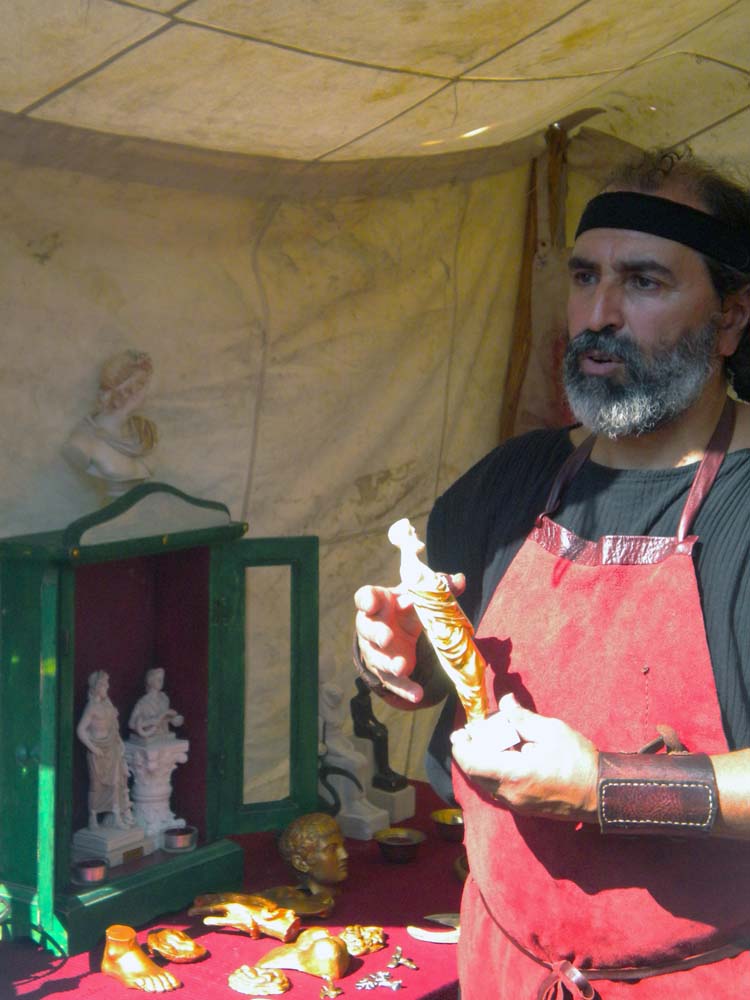
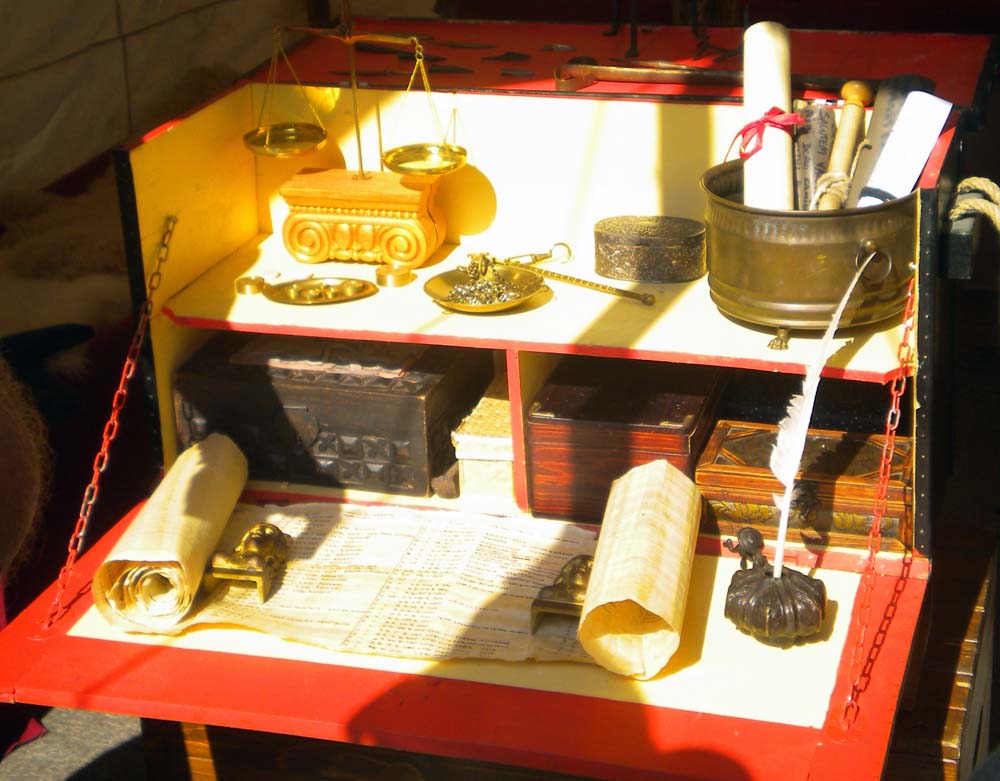
Their doctor is also superb.  He’s a Greek doctor, and will happily explain that he does not want to be here with these idiotic , ignorant Romans.  He studied in Athens, and in Egypt, and he has read the writings of Hippocrates, and he wants to use real medicine and perform real surgery, but nooo…  all these superstitious soldiers want are charms and prayers.  He prescribes sensible things like liver-based ointments and asparagus extracts, but they won’t listen to him unless he also has a shrine filled with irrelevant idols, and a winged phallus hanging from the rafters of the hospital tent.  By the time you’ve listened to his rant, you realize you know what every instrument on the desk is for.

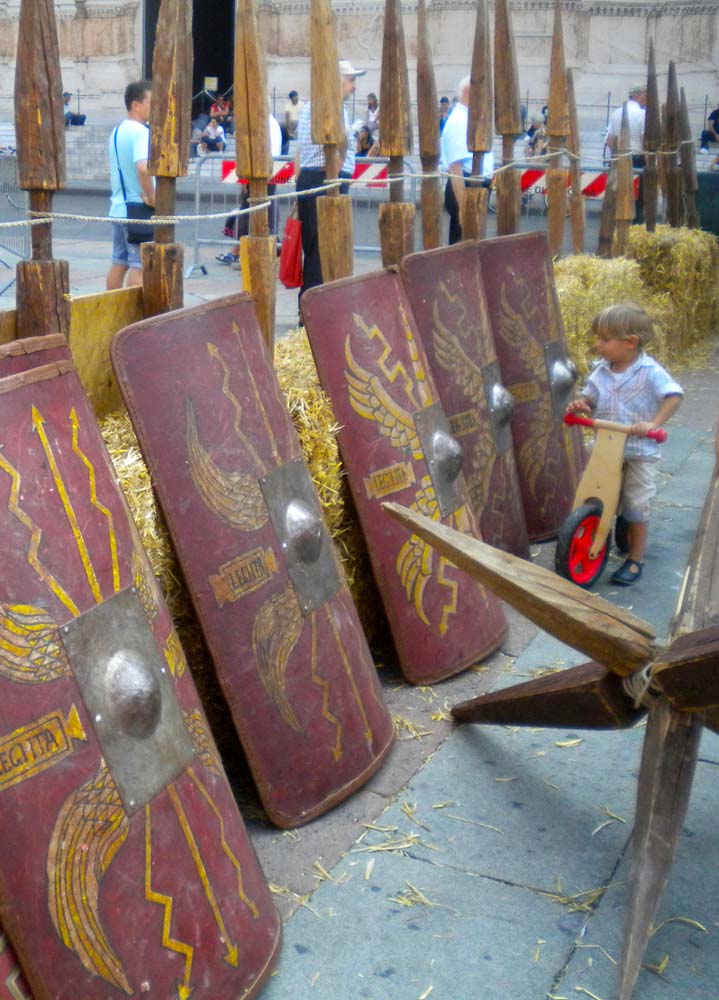
Tricycle age is the correct age to meet one's first Roman legion

Everyone in the world should learn about Rome, but there is a unique import to teaching Italian children about the empire which was, in fact, their own.  This duty the Legio I Italica takes very seriously.

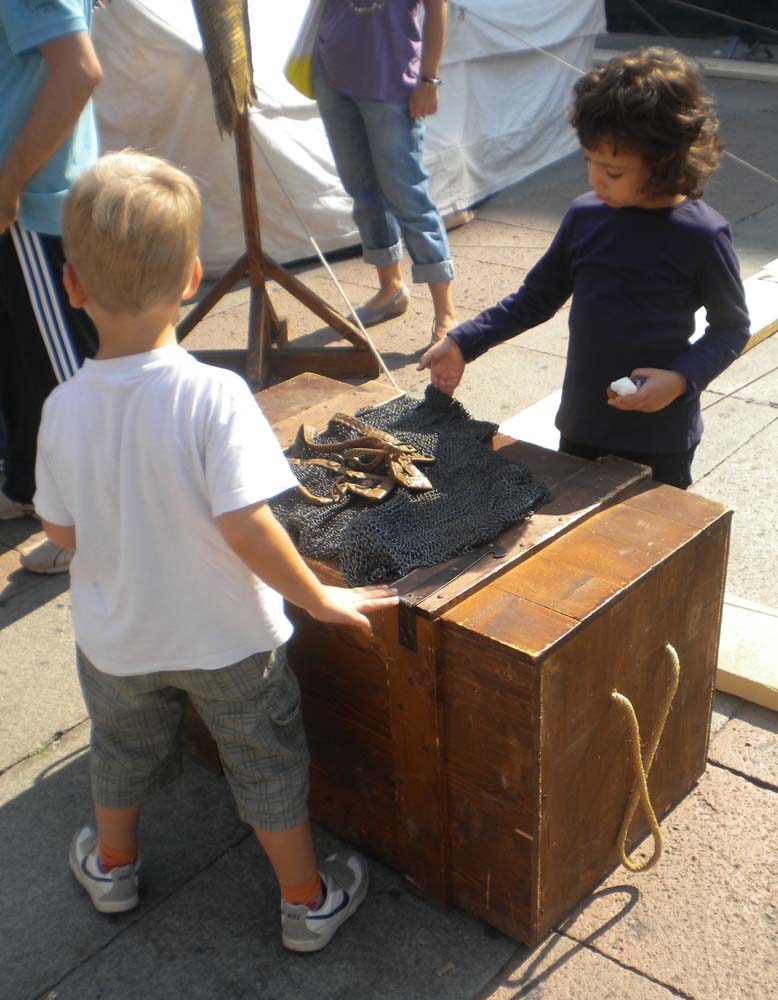
Learning is fun! So is chainmail!

All over the camp, inviting tables of Roman materials were left practically unsupervised, inviting tiny kids to begin as tiny kids do, by simply touching and exploring new objects, learning at their own pace about weight and texture, before asking Mom or Dad or a nearby captain what the heavy metal vest is for, or what the big red things are called.  Adults too were invited to explore the random detritus of the camp and discover for ourselves the tools of a Roman sandal maker, or the different items necessary for the good maintenance of a shield and armor.  Exploration rather than lecture was both more memorable, and more authentic-feeling as one wandered the camp receiving silent half-glares from centurions who were obviously just too lazy to shoo out these curious provincials.

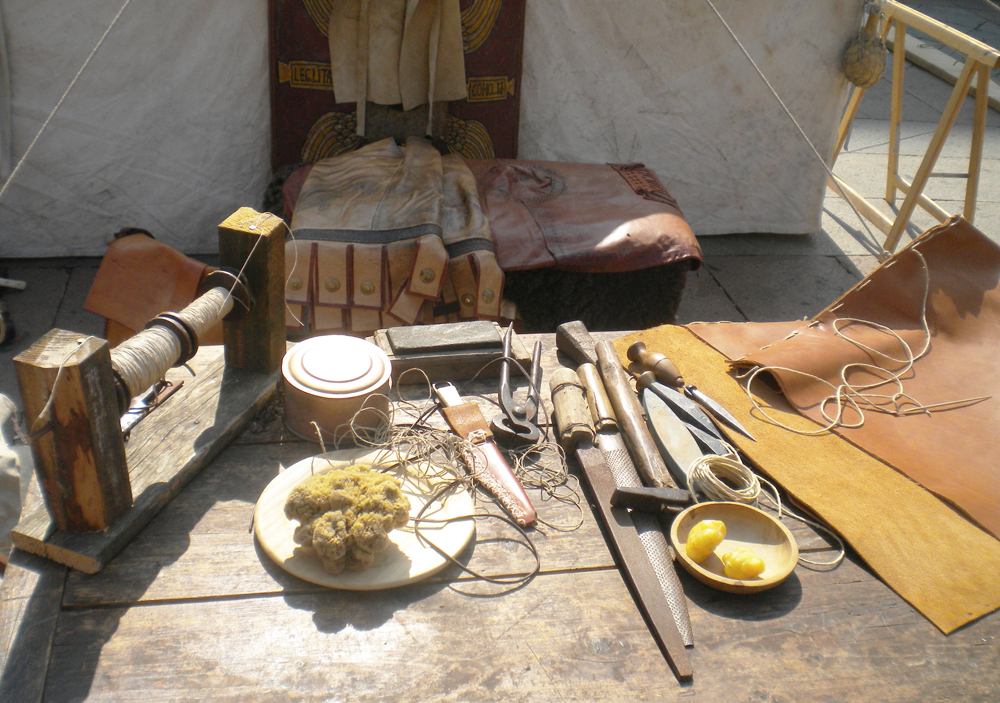
Tools laid out on a table for hands-on exploration.
Camp fix-it guy, always running out of leather.
The doctor's desk
Standards displayed before the central tent


The greatest change, from Rome and Florence, is that all this was in service of Italians.  These legionaries are not a tourist attraction, nor interested, and nothing whatsoever is in English: conversations and banner announcements in Italian, all else in Latin.

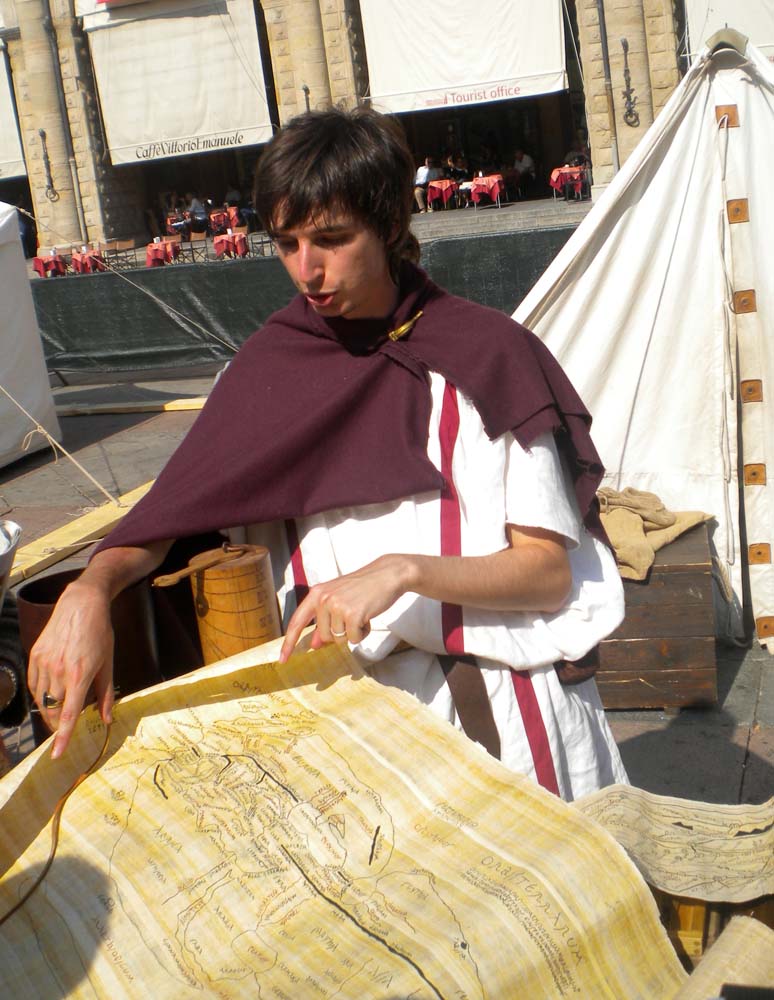
A son of the literate elite, marked by his striped tunic, explains papyrus and mapmaking

Bologna was a perfect venue for them, a lively square, with a trickle of foreigners making the Tuscany tour, but alive with natives, families out for Sunday lunch, and visitors from other parts of Italy in town to taste Bologna’s famous tortellini, or its treasured Mortadella (Mortadella is to humble America sandwich bologna as a butter-soft mouth-watering Prosciutto is to the contents of a 7-11 ham sandwich).

A guide who works in Sicily recently described that he was taking an American around who really wanted a photo of a native old lady in traditional Sicilian dress.  They ran across just such an old lady in a tiny mountain village outside Taormina, wearing a traditional black dress with headdress, and even leading a little black lamb.  They stopped to ask her for a photo.  Smiling, she rubbed her fingers together, asking for cash.

Italy’s dependence on tourist cash cannot be overstated.  Economic discussions these days are monotonously discouraging, but it is still interesting to compare the recession woes of home to the recession woes of other lands.  I chatted yesterday with a man who retired from the exhaustion of chef-dom hoping to set up business on his own in a small way.

Taxes made a restaurant prohibitive, since the taxes on electricity, gas, water, sewage, phone and property rental would, he said, have required millions in overhead, and translated to a cost of more than 300 euros per day for taxes alone for every day a small shop or restaurant was open.  The more modest goal of becoming a guide still involved 200,000 euros’ investment in government licenses.  With enterprise so challenging to undertake (he waxed wistfully about how miraculous it is that other countries, hint, hint, have government subsidies to help launch small businesses), it is no surprise that someone might try to make a living camping by the Colosseum in a plastic helmet, or coax what one can from passing visitors.  This makes the Legio I Italica that much more admirable, as they work far from international tourist centers.  They receive money from the towns that hire them, but while working they solicit and accept no tips, and work away, with the beating sun, uncomfortable armor and no pants, to make sure little Italians grow up with a dose of the real mixed among their fantasies of their glorious ancestry.

The legion enjoys its well-earned tortellini bolognese and mortadella, because people who really know about Roman cuisine don't eat it!
The shoemaker's workstation


Spot the Saint: Nicholas and Befana (Christmas Special)

‘Tis the season for a review of the vague saintly origins of the modern Hallmark Christmas:

Saint Nicholas of Bari (or of Myra; San Nicola, 270-343 AD)

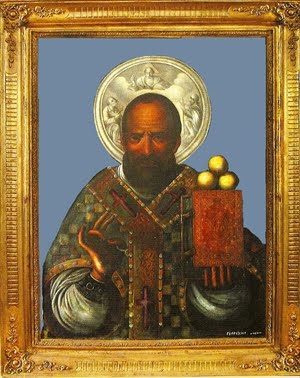
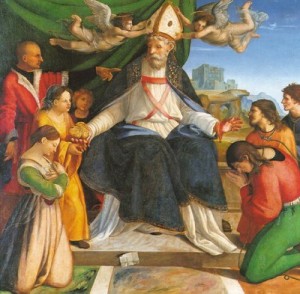
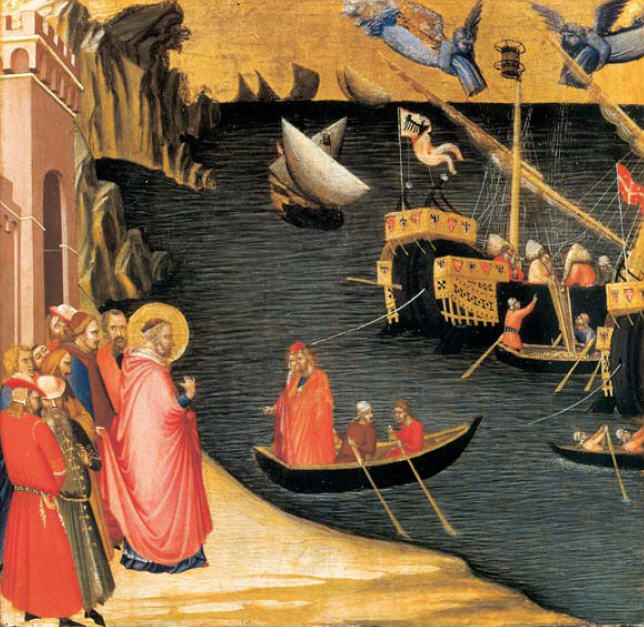
  • Common attributes: Bishop (with robes, hat, miter), holding 3 golden balls, or 3 coins, or 3 bags of gold
  • Occasional attributes: Accompanied by ship, accompanied by barrel containing three kids
  • Patron saint of: Sailors, ships, merchants, fishermen, children, also pharmacists & a few other things
  • Patron of places: Myra (Turkey), Bari (Italy)
  • Feast days: May 9th, December 6th
  • Most often depicted: Standing around with other saints, on the coast near ships, sneaking in a window
  • Relics: Bari (Italy), Basilica di San Nicola

Saint Nicholas was a 3rd to 4th century bishop saint, Greek by birth and active in the Middle East.  He was of a wealthy family but orphaned and raised by an uncle.  He came to the priesthood comfortably (no towers or evil parents or prostitutes or lightning) and progressed to bishop status in good time.  Nicholas is remarkable for the large number of miracles he is supposed to have worked during his lifetime, and for that reason is a very popular saint to pray to, since he is obviously willing to use the powers all saints have.  He saved ships from storms, multiplied grain to save towns from famine, and resurrected three kids.

Nicholas’ most famous story involves, not a miracle, but generosity.  It has several variants, but all revolve around a poor man in the town who had three daughters but did not have enough money to give them dowries so they could marry.  Nicholas stealthily provided the money, which is most commonly said to have been three bags of gold coins, but it varies.  He did it on three successive visits (either three days or three years), each time tossing the money secretly into the house so the father never knew his benefactor.  On the last visit (predictable due to the regularity of the first two), the father lay in wait, hoping to spot and thank his mysterious benefactor.  The ending varies, but in one popular version Nicholas, realizing the man was watching the window, climbed across the roof and dropped the gold down the chimney.  Some versions add the detail that one of the daughters had left her stockings hung up to dry by the hearth, and the money fell into one.  He is also supposed to have given other charitable gifts, including leaving coins in the shoes of those who left them out for him.

Saint Nicholas multiplies grain, so sailors can give some to end a famine and still have enough to deliver.

In 1071, when the area where Nicholas was buried fell into non-Christian hands, the relics were removed to the Italian town of Bari, sparking his large Italian cult.  Some Venetians claimed to have a big chunk, spawning another major church to him in Venice (where a patron of sailors was very popular) but scientists and their x-rays have confirmed that the remains at Bari are mostly intact.  Nicholas’ relics excrete a rose-scented liquid substance, referred to as myrrh, which has healing properties, much like the substance produced by the remains of Catherine of Alexandria.

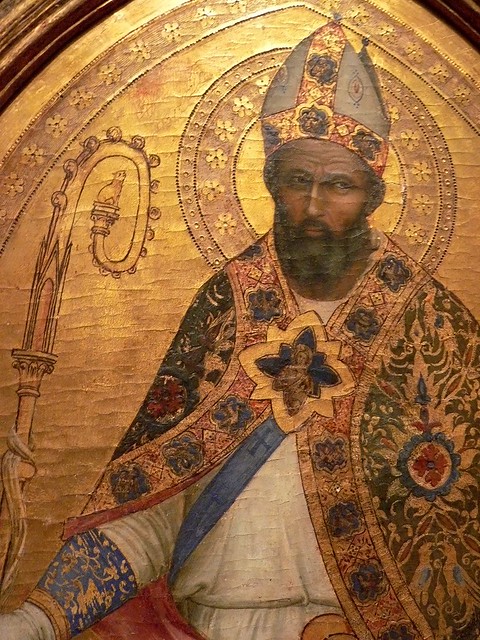
Bishop saints are tricky to identify in art.  They’re easy to tell from other saints, with their curved shephard’s-crook-shaped miters, their pointy, triangular bishop hats (not to be confused with the cone-shaped pope hats with three crowns on them), and their fancy robes, with a cloak with elaborate trim closed by a broach at the breast, and, frequently, gloves with gems on the back of the hand.  Yet they can be very difficult to tell one from another, because their attributes are often unclear, or omitted.

How can we be expected to tell them apart if they have no identifying attributes?  Often the original context of the painting would make it clear, since it would be commissioned by or for devotees of a particular bishop saint, or in a city where a specific one was most popular.  But since pieces are so often in museums now, sometimes all one can do is guess.  Nicholas was one of the most popular bishop saints, along with Augustine and, in Florence, Zenobius, so in general Nicholas is a safe guess.  When in doubt, the artist sometimes provides separate scenes as hints.  Sometimes these are painted on separate panels below or above the main painting, showing a recognizable scene from the saint’s life.  With bishop saints, sometimes scenes from their lives are embroidered on their robes, though this can be deceptive, since I’ve seen Saint Augustine with scenes from the life of Saint Stephen on his robe.

As for Nicholas specifically in art, three golden balls or golden coins or bags of gold are the clearest sign, or a bishop accompanied by ships or standing near the sea.  Beyond that, though, Nicholas is a decent generic guess if you don’t have a better clue for your unidentified bishop.

La Befana, the Epiphany Witch (not a saint, but…)

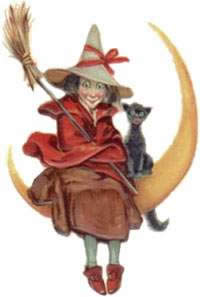
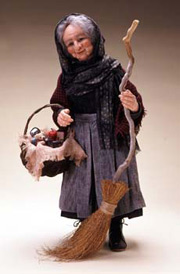
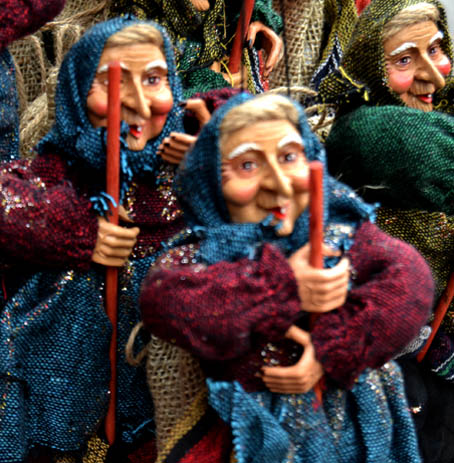
  • Common attributes: Pointy hat, dark shawl, rough dress, old, long nose with warts, scraggly gray hair, spectacles
  • Most often depicted: Flying through the air on a broomstick with a sack of toys

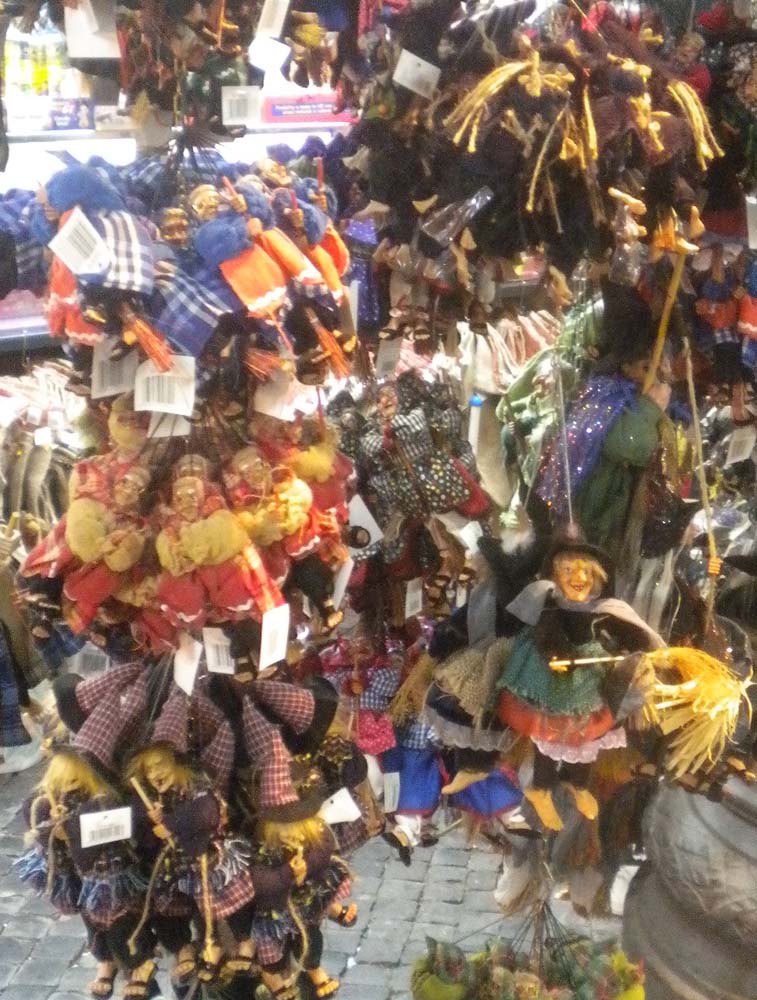
Since Saint Nicholas is not, in fact, a jolly, red-clad toymaker equipped with flying reindeer, someone else has to bring presents to the kids in Italy.  This office falls to La Befana the Christmas Witch, or more accurately the Epiphany Witch, who flies on her broomstick with her sack of toys bringing presents to all the children on Epiphany Eve (Jan 5th).  She looks like a witch in every classic sense, so Christmas fairs in Italy are packed with witches and Christmas decorations often look more like Halloween than Christmas to American eyes.

If you ask Wikipedia about La Befana it will tell you various origin myths.  She was hostess to the Three Wise Men on their way to the Nativity; she regretted not following them and is still looking for the Christ Child so visits all children; she had a child which died so Christ let her be Mom to every kid in Italy; she’s the Sabine goddess Strina.

La Befana ornaments crowd for space at a stall in Piazza Navona, Rome.

If you ask an Italian, in my experience you don’t get any of that.  La Befana is a part of the holiday tradition, unquestioned as Santa in areas where he’s the gift giver, so just as most of those in the Santa region can’t tell you much about Nicholas of Bari, Italians are content with the witch they’ve known since childhood and don’t seem to wonder much.


I have to say, though, Italian kids have more excuse to freak out at shopping malls when parents set them in the lap of someone costumed as the Christmas gift-giver.  A witch!  Why are my parents handing me to a witch?

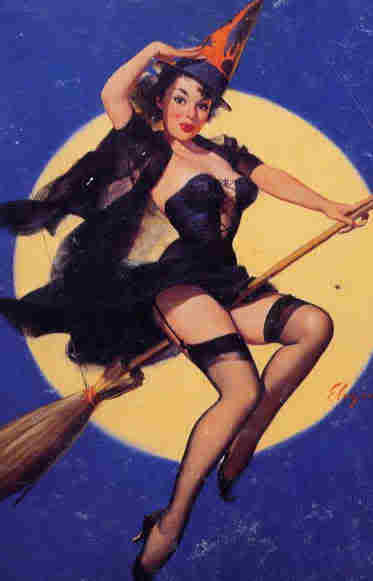
La Befana is also subject to the same bizarre cultural distortions as Santa:


So this year, if you’re the tree-trimming type, get out your broomsticks and pointy hats and have a nice witch-filled Italian Holiday!


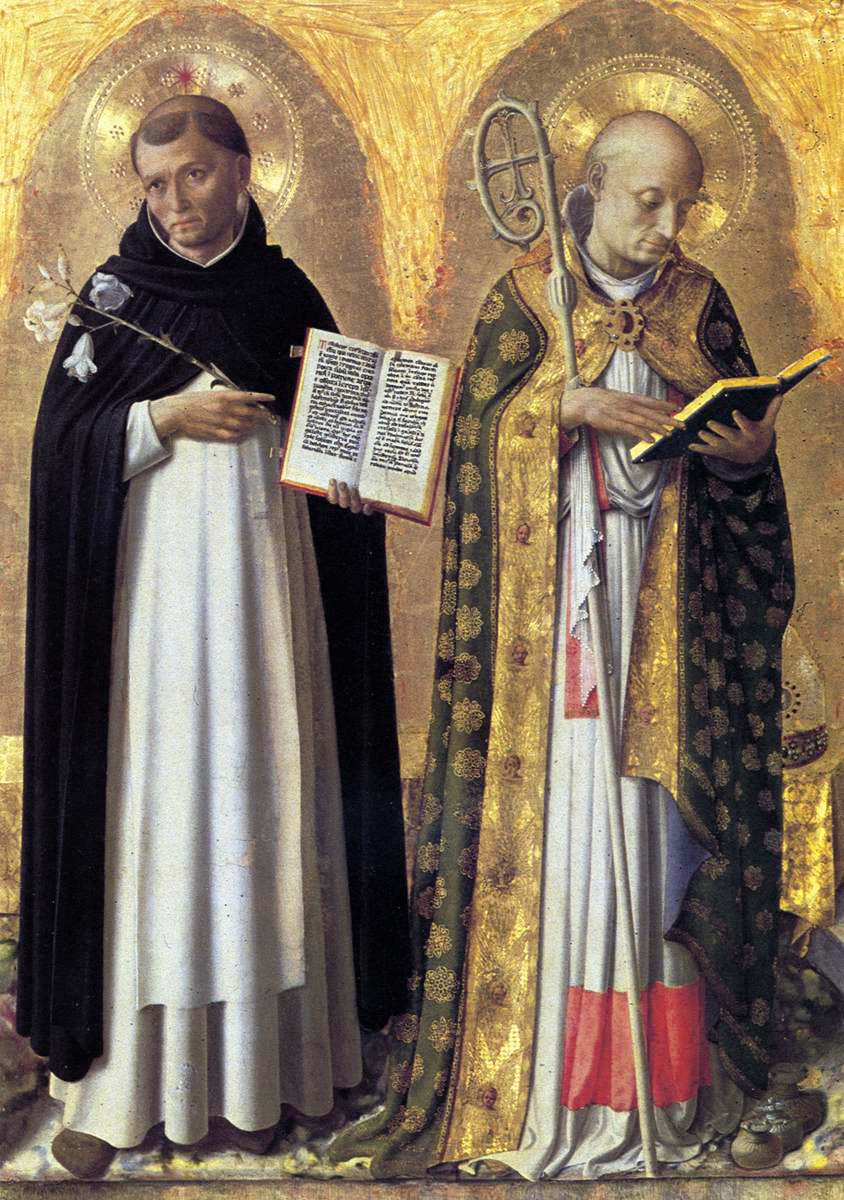
And now, Spot the Saint Quiz Time:

(Click for more detail.  If your eyes are sharp, you should be able to identify a few of the tiny figures on the sides as well as the main ones.  Scroll down for a detailed view of the left-hand main figures.)

A little more detail on the left-hand side:

Skip to the next Spot the Saint entry.

A Passion for Porphyry

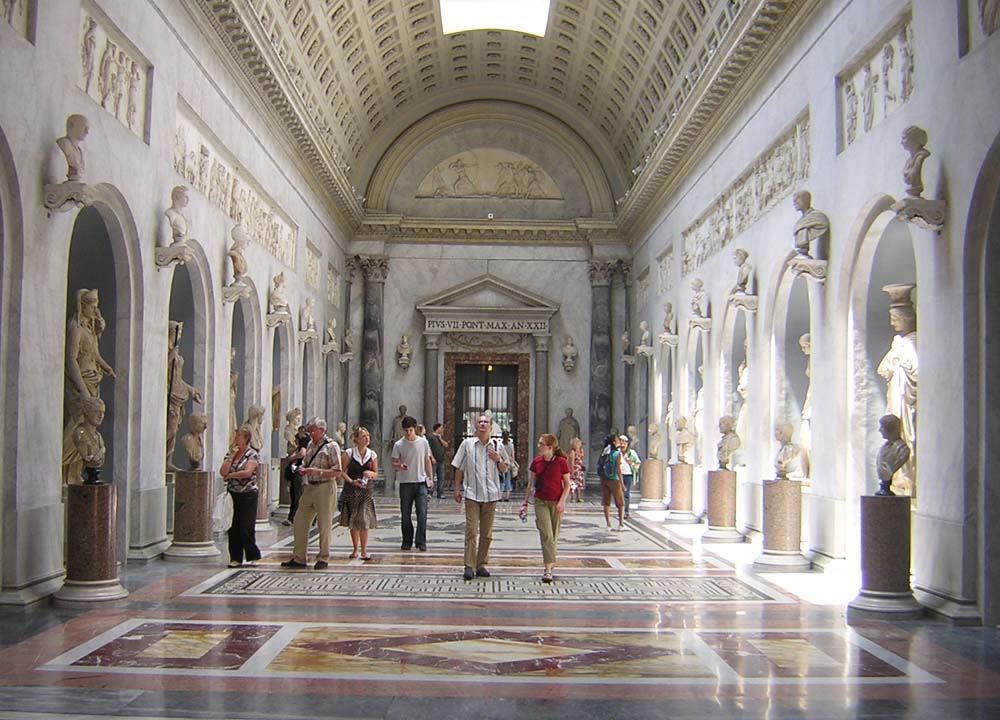
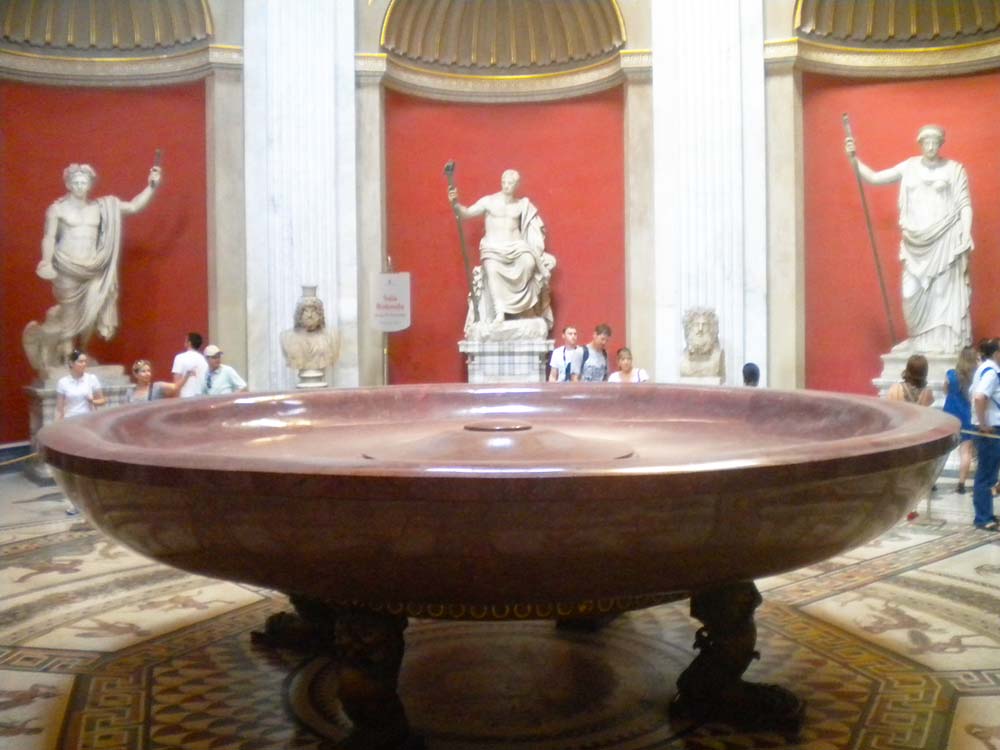
The Vatican museum: hall after hall of ancient Rome.  Shelves crowd the corridors with busts of Caesar, of Cicero, of a hundred obscure Senators, of still more-obscure Romans, anonymous but vivid with two-thousand-year expressions of resolve or grit or whimsy crowded shelf on shelf.  Here sits Penelope still patient, Diana hunting, Bacchus laughing merry, while somewhere in the distance the Sistine Chapel lurks, complacent in its celebrity.  In the Hall of Animals, Roman hounds sniff at Roman horses, rabbits, crabs, crocodiles, camel heads with their enormous, gummy lips, all stone.  The Belvedere Courtyard stunned you with its circle of masterpieces every one of which transformed the history of sculpture: the Belvedere Apollo, the Belvedere Torso that so fascinated Michelangelo, and, as matchless when the Renaissance unearthed it as it was when Pliny called it the best of sculptures 1500 years before, the real Laocoön.  The walls and ceilings of the patchwork labyrinth-palace are such an ocean of gilded cornices and marble tracework that it becomes impossible to tell north from south or ground from upper floors, so all sense of grounded space is long gone as you turn the corner into a grand scarlet rotunda, floored with vivid Roman mosaics.  Statues of gods and emperors loom, more than twice life-height: grim-faced Athena, tired Claudius, the massive gilded Hercules; while the friend beside you stops dead and, slack-jawed, points at a big stone tub in the middle of the room: “Look at the size of that hunk of porphyry!”

Yes, it’s porphyry, a dark, reddish-purple speckly stone, and this room, for the many who enter and ooh and aah and glittering Hercules, is another moment of material illiteracy.  Just as a Catholic spots John the Baptist by his hairshirt, and a fashionista a Gucci handbag by whatever alien cues its curves contain, so from the Roman Republic to Napolean a European knew what porphyry implies: Wealth, Technology, Empire, Rome.

Porphyry has become a generic term for igneous rock containing large spots (crystals), but the source of the name is the Greek word for purple, and the purple form is the true original.  This is referred to as Red Porphry, Purple Porphyry, or, most aptly, Imperial Porphyry.


The Imperial Porphyry found in Italy came from a single mine in Egypt, the Mons Porphyrites.  It was imported by the Romans as a decorative accent stone, for use in tiled floors, as colored columns, or occasionally carved into a vase or sculpture.  Its color invokes Royal Purple, but is also very close to the color of the fabulously expensive shellfish-based purple dye which produced the purple stripe which marked the tunics and togas of the Senatorial class.  This also dyed the completely purple toga worn by those who occupied the rare and severely powerful office of Censor, a special official created only on occasions, whose task was to examine the state of the Senatorial families and judge which were still worthy of office and who should be removed or added to the roster of Rome’s leading citizens.

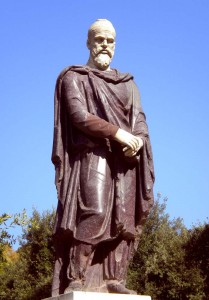
A Roman statue with a purple toga rendered in porphyry, from the Boboli gardens behind the Medici’s Pitti Palace.

Several Caesars held this special office, so purple, and porphyry, and as their palaces became more opulent it became increasingly an imperial symbol.  In Constantinople, once the capitol moved in the late empire, the imperial palace contained an entire room covered in porphyry, and this was traditionally where empresses gave birth, giving imperial princes and princesses the title Porphyrogenos, “born to the purple”.

Porphyry is extremely hard, also dense and heavy.  Even lifting a substantial hunk of porphyry is a great feat, let alone transporting it by ship from Egypt.  It is also so hard that it takes very strong, well-tempered steel to cut it, and even then, achieving any great degree of precision is very challenging.  The Romans had steel good enough, but it too was lost in the Middle Ages, making Roman porphyry artifacts not only symbols of the Caesars but of the impossible godlike skills of the ancients, which their weak successors could only marvel at.  It was physical, recognizable proof that the Romans could do the impossible.  In addition, the location of the mine in Egypt was lost around the fourth century AD, and not successfully rediscovered until 1823.

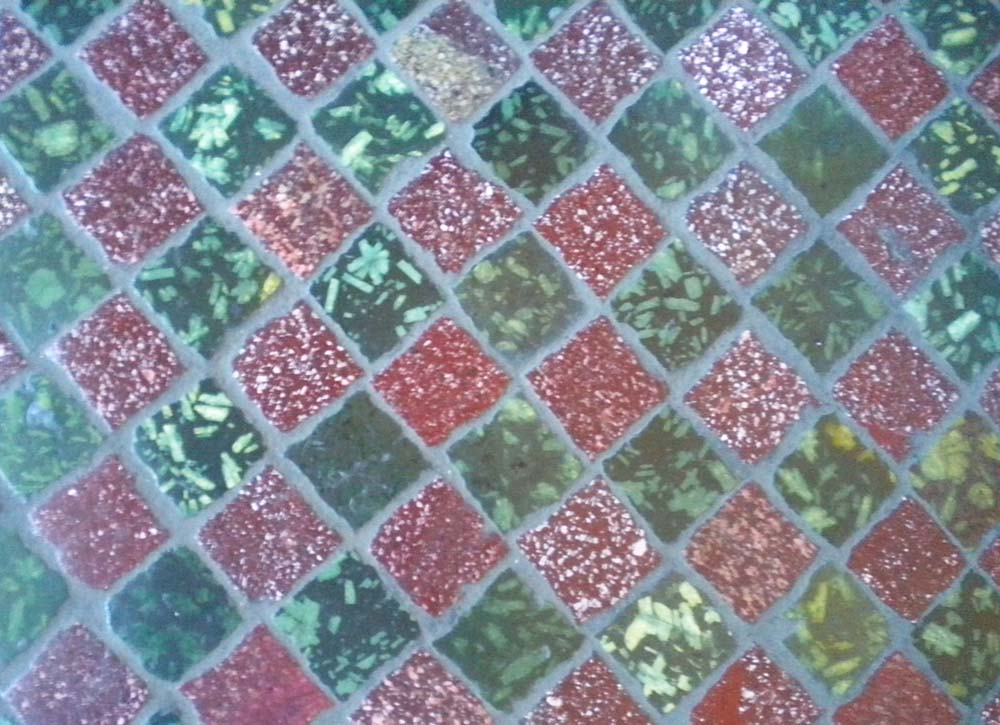
Imperial Porphyry has a cousin, green porphyry, or Lapis Lacedaemonius (or Spartan basalt), commonly called Serpentine (confusingly since it IS NOT the same thing as the far softer serpentine subgroup of stones including antigorite, chrysotile and lizardite, but they are all sometimes called serpentine).  It is just as hard, coming from a mine near Sparta (or near the modern Greek town of Krokees).  It is speckled too though often with larger speckles, many somewhat rectangular or X-shaped.  The combination of rich green and purple, usually set in a white Italian marble background, was an extremely popular decorative element seen all over Rome, in the houses of Rome’s imitators, and especially in palaces and churches which re-used floor tiles looted from Roman sites.  Porphyry ornaments the floors of Rome’s greatest churches, with the size and density of porphyry among the framing stones increasing toward the altar.  The header at the top of this very blog shows a porphyry section from the floor of the Sala della Disputa, the frescoed room in the Vatican which hosts Raphael’s incomparable School of Athens, while the Sistine Chapel Floor (not a phrase you hear often enough) completes the opulence of the other decoration with a dense decoration more purple than white.

In the Middle Ages, then, porphyry meant Rome, specifically the lost power of the Caesars who could reach across oceans and achieve impossible feats.  Anywhere porphyry appeared it was a Roman relic, and anyone who had it could claim thereby to be an inheritor, in some small way, of that lost Imperium.  Porphyry also came, over the middle ages, to symbolize Christ (reddish purple = blood), but in the Middle Ages everything came to represent Christ, from griffins and unicorns to pelicans and pomegranates (no, it’s totally not a co-opted pagan symbol, why do you ask?), so what distinguished porphyry from the zillion other things that represented Christ was still its imperial connection and its technological unachievability.

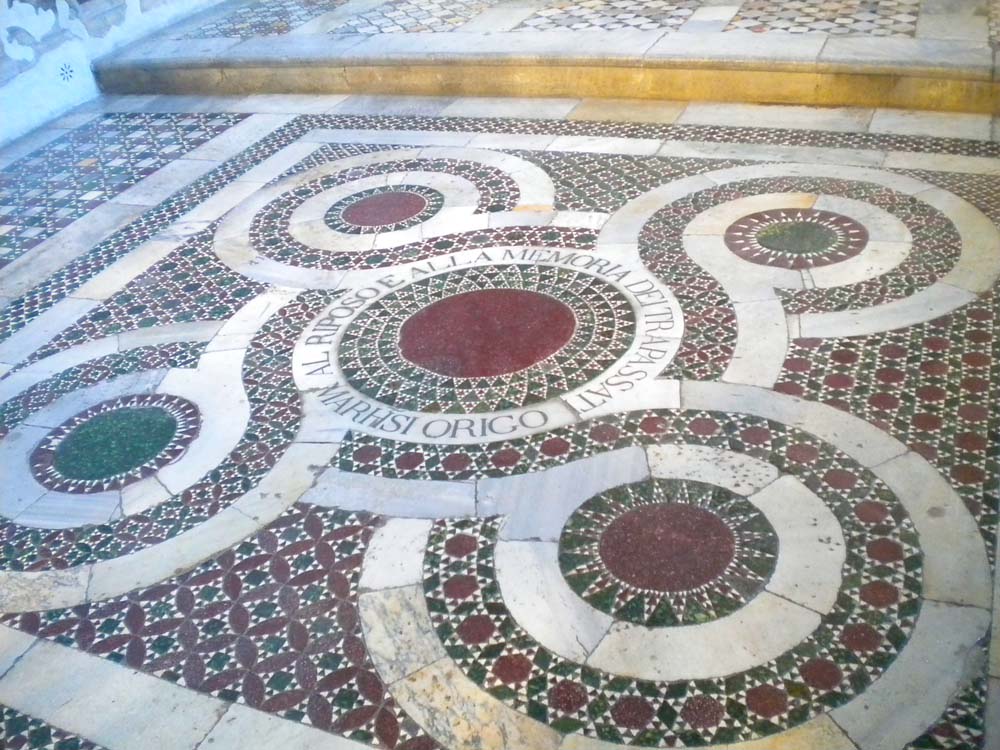
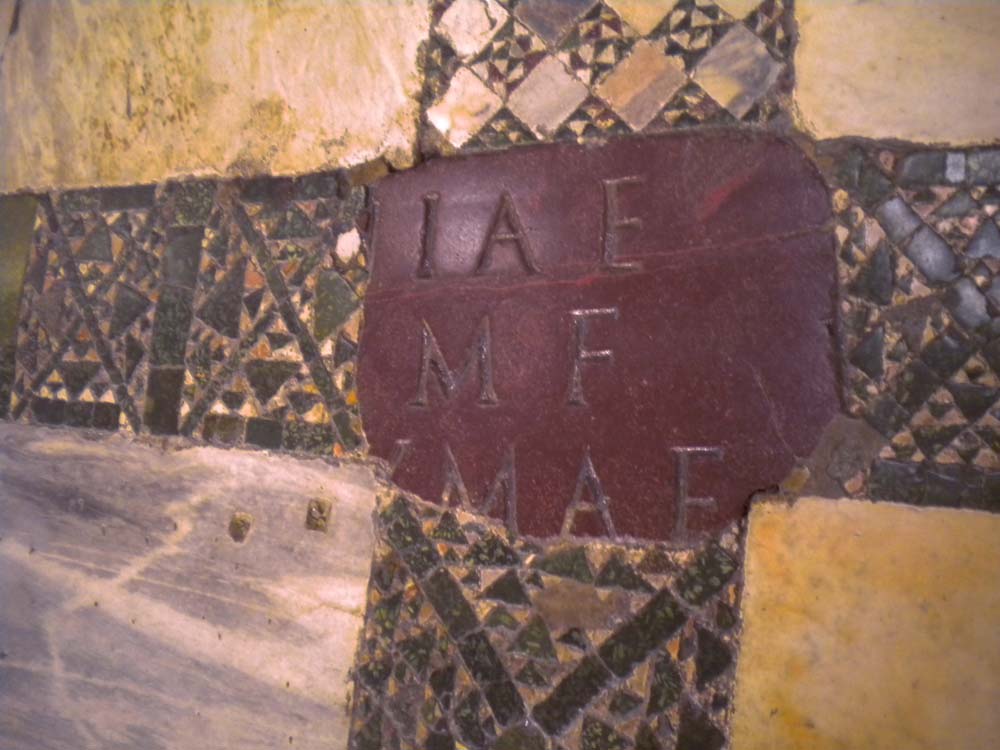
Re-purposed porphyry in a Church floor, with remnants of its Roman inscription.

Thus everyone who’s everyone wanted porphyry, and if you wanted it, you had to steal it.  The only porphyry in Europe lay in things the Romans built, so every prince and republic and sculptor who wanted this symbol of Roman power had to steal it from the source.  Want to put in a nice porphyry floor for a Church?  Loot it from a Roman temple.  Want to advertise the imperial majesty of Mary Queen of Heaven?  Make the altar out of an old, repurposed porphyry sarcophagus.  If a pope wanted porphyry columns for his tomb, he had no better source than to go to some surviving Roman temple (say, the Pantheon…) and rip out the porphyry, perhaps if he’s polite substituting some less valuable stone to keep the looted edifice from falling down.

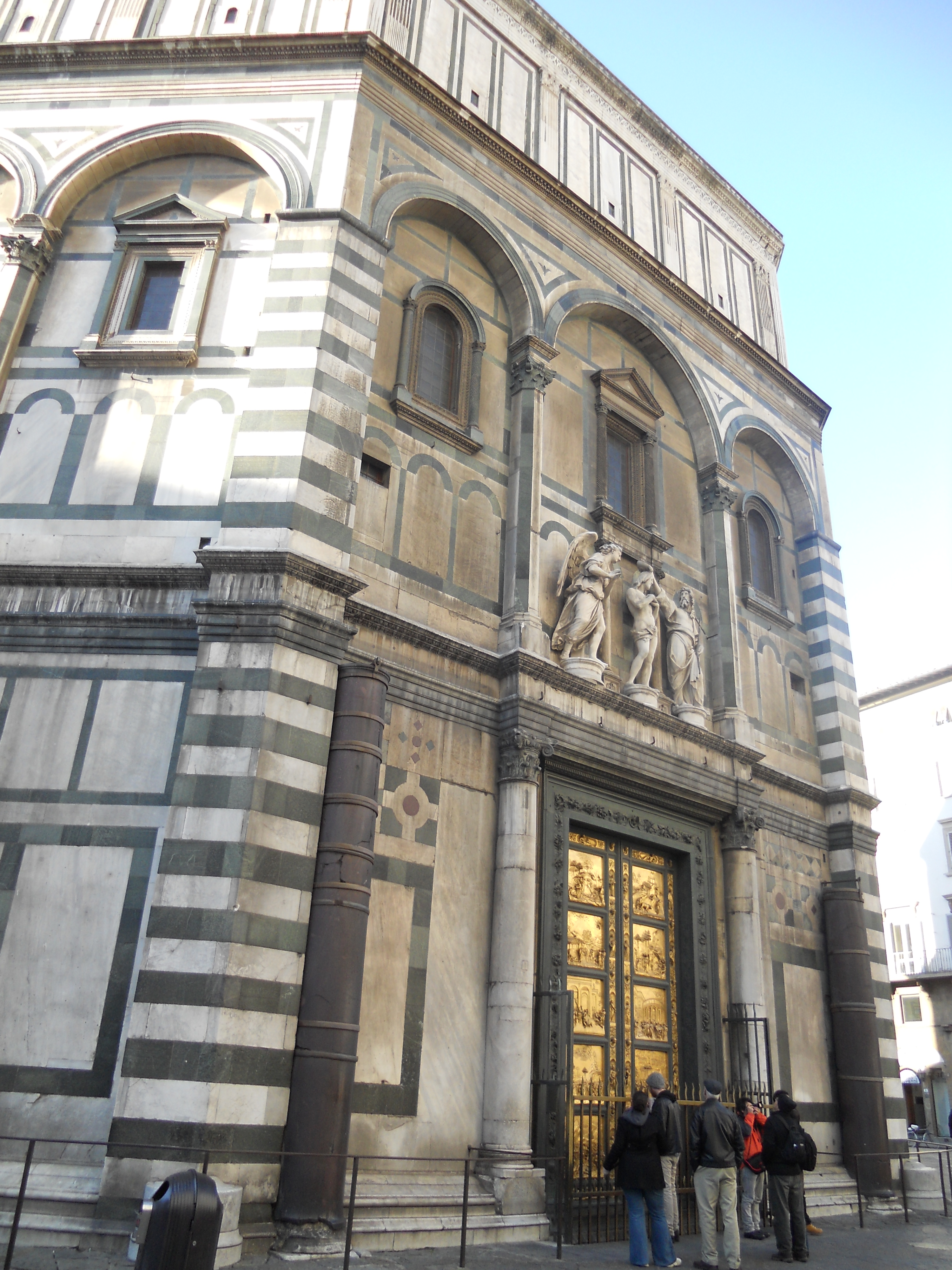
Some places already had porphyry brought there by the Romans, and in these cases it was proudly displayed as proof of the noble Roman origins of a town or province.  Even in Florence, on the baptistery which is the literal heart and center of the city, the gilded Gates of Paradise are still flanked by two old, cracked and mended, asymmetrical dark reddish columns, built into green and white facade despite a complete chromatic mismatch.  So old and dull are they that many don’t even notice them upon first or even third visit, but these are porphyry, relics of the Roman-era Church of Santa Reparata, or its predecessor, preserved and re-used here as proud proof of Florence’s Roman roots.

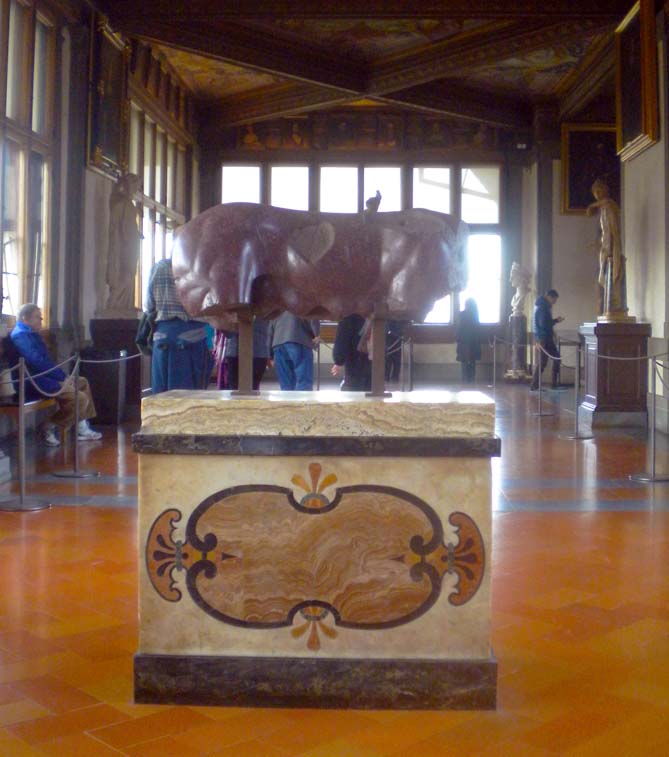
The Uffizi “lupa” i.e. she-wolf

Porphyry sculpture was even more impressive than a tile or column, since working such an adamantine substance into complex shapes required immense time and skill.  Diamond was rare and valuable and not a practical tool for trying to make a large chisel to work large stone, but short of diamond the only means to shape porphyry was to rub it against another piece of porphyry for a very long time, grinding both down, a clumsy, labor-intensive and imprecise technique.  Many, especially the Medici family, poured funds and efforts into researching ways to make a metal sharp enough to carve porphyry, or a solvent capable of weakening it, in hopes of adding this to their list of resurrected Roman achievements.  Even before they succeeded, however, possessing a Roman porphyry sculpture was an even grander boast than possessing simple tiles, and at last now we can understand why, in the Uffizi Gallery, where the great Roman sculpture treasures of the Medici are still housed, one comes around the corner to the very center of the U-shaped gallery, expecting to see in the center some exceptional masterpiece, an Emperor or bold Athena, one sees instead the mangled, limbless torso of an animal.  Look again: those hips, those hanging teats.  This is the mangled, limbless torso of a porphyry she-wolf, the symbol of Rome herself.

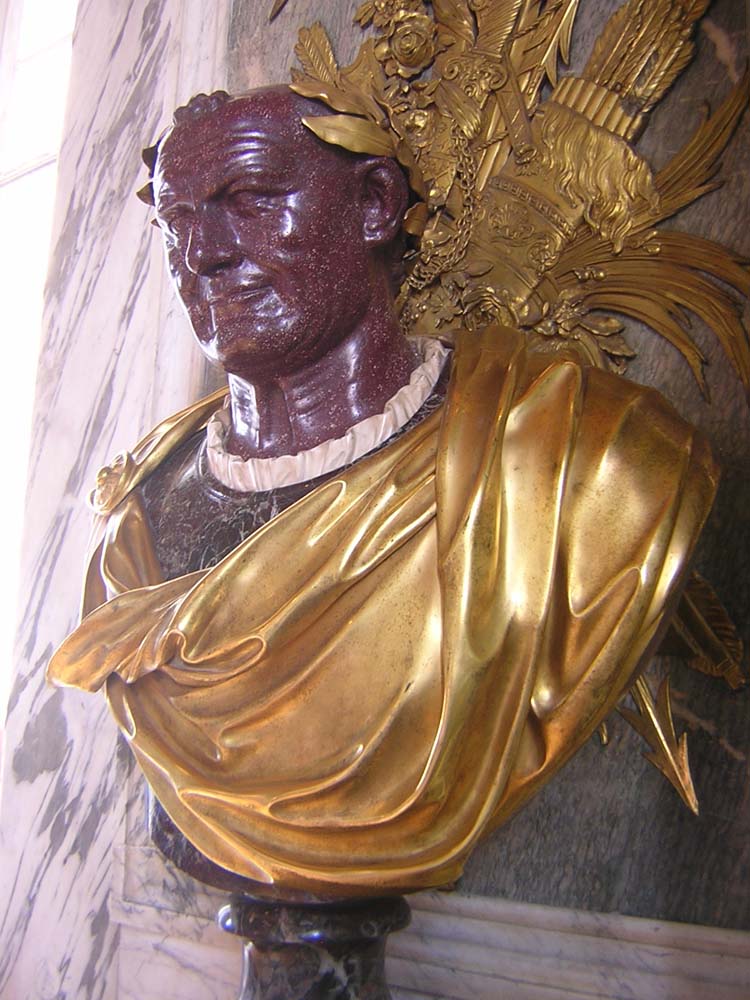
A porphyry bust at Versailles.

Naturally, the greatest concentration of porphyry lay (and lies) in and around Rome itself.  The farther you are from Rome, the scarcer (and more impressive) porphyry becomes.  Florence had a couple columns and the odd basin, but for more porphyry they had to buy or steal from Rome, or elsewhere.  The Venetians carried off large pieces of porphyry from Constantinople when they looted it, and still display them proudly as pulpits on either side of the main alter in San Marco.  Porphyry in northern Italy is comparatively scarce, so a Venetian palace with a few roundels in its facade makes a real statement.  Even as far as France, when Louis was decorating Versailles, porphyry was scarce indeed, but what few busts and vases he got hold of went straight into the best places: the throne room, and the Hall of Mirrors where every visitor would see, and understand, Louis = Caesar.

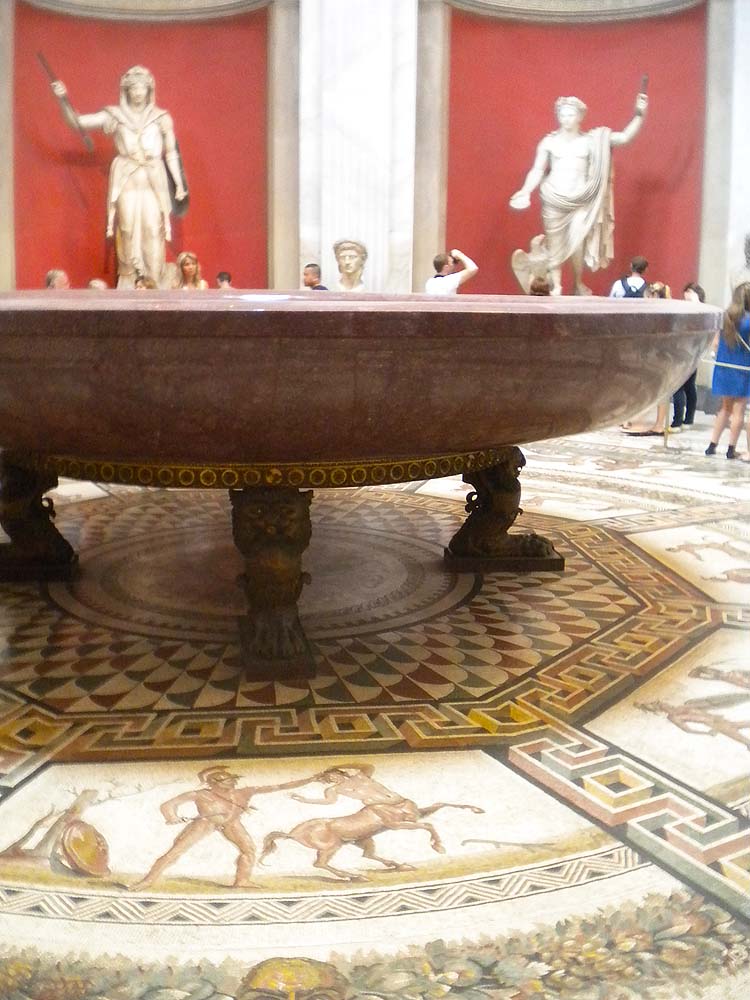
The pope always wins the Who-Has-The-Most-Porphyry Competition, and the Vatican is its grand display case.  The staggeringly enormous porphyry basin in the round sculpture room in the Vatican palace is referred to as Nero’s bathtub, and is the largest piece of porphyry I have ever seen; I would not be surprised to discover it is the largest in the world.

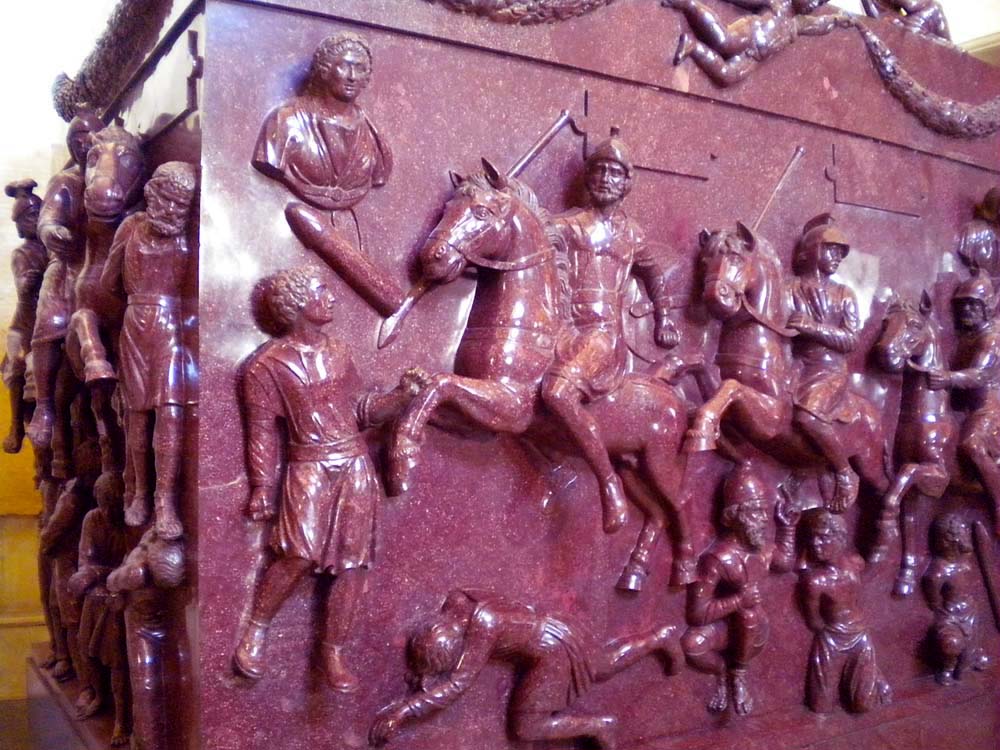
The sarcophagus of St. Helen

One is generally still reeling from trying to imagine the staggering cost and difficulty of creating and moving such an object, when in the next room one encounters an even more impossible vision: two enormous solid porphyry sarcophagi, both taller than a standing person, and covered in deep relief carvings of horsemen, prisoners and acanthus leaves.  This is Rome indeed.  Specifically, these are the sarcophagi of the women of Constantine’s family, including the tomb of his mother, Helen, or more specifically Saint Helen, who traveled to the holy land and brought back the True Cross and the Lance of Longinus and… at least one other major relic, but I can’t right now remember whether it was a nail or part of the Crown of Thorns, or perhaps that piece of the Holy Sponge they have in Rome…  (Spot the Saint moment: Helen’s attribute in art is that she carries the cross.)  Regardless, the two tombs have no Christian imagery, just the most Roman of Roman decorations, horsemen leading vanquished prisoners for Helen, and for the other fertility images.  In deep, impossible relief.  In an era when it was a substantial feat to scrape two looted pieces of porphyry into sufficiently matching shapes to make them seem symmetrical in a floor pattern, there is no purer proof of the godlike power of the ancients.  After that, there is just too much, and every further encounter with porphyry in the Vatican labyrinth feels like one, two, three, five, ten too many.

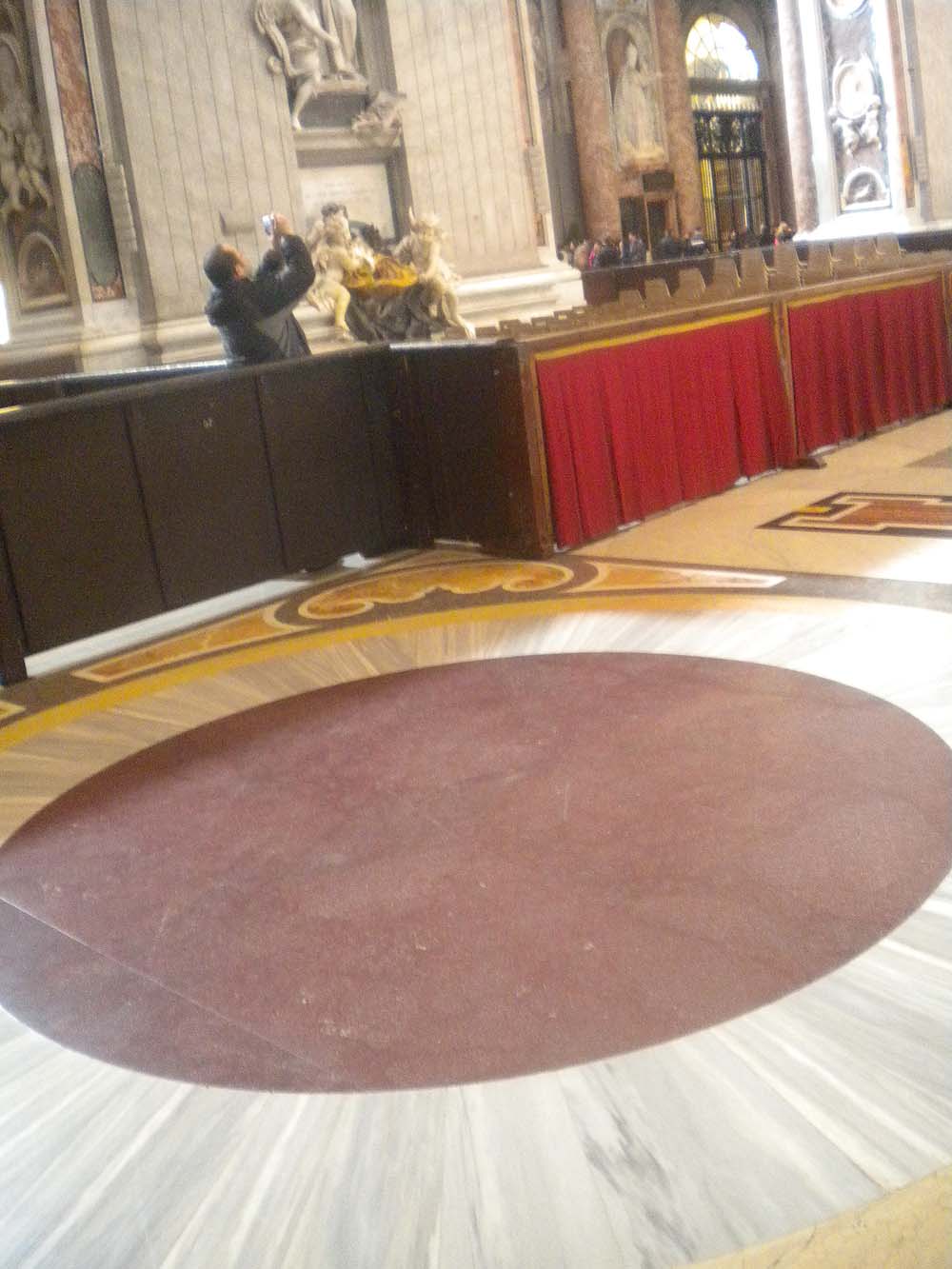
That guy should be taking a photo of the porphyry!

St. Peter’s is just as much a showroom for porphyry, with columns, tiles, tombs.  Every purple object that, from a distance, makes you think “is that porphyry?” turns out to be the genuine article.  And it’s worth keeping in mind that, except for the most modern pieces, they’re all relocated chunks of what were Roman temples scattered around the city from the Caesars’ days.

One large porphyry round in the floor close to the entrance is supposed to be the stone from the original St. Peter’s on which Charlemagne was crowned the first Holy Roman Emperor (and successor to the Caesars) on Christmas day, 800 AD.  It’s just inside the entrance in the exact center of the Church, sort of balancing the altar, secular power facing sacred.

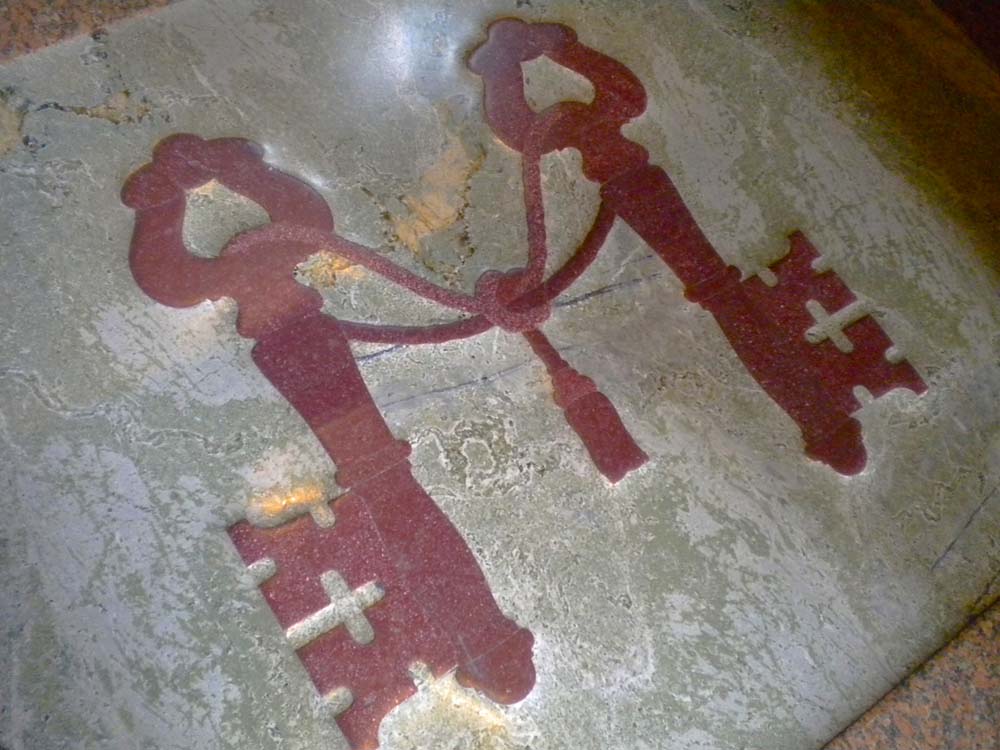
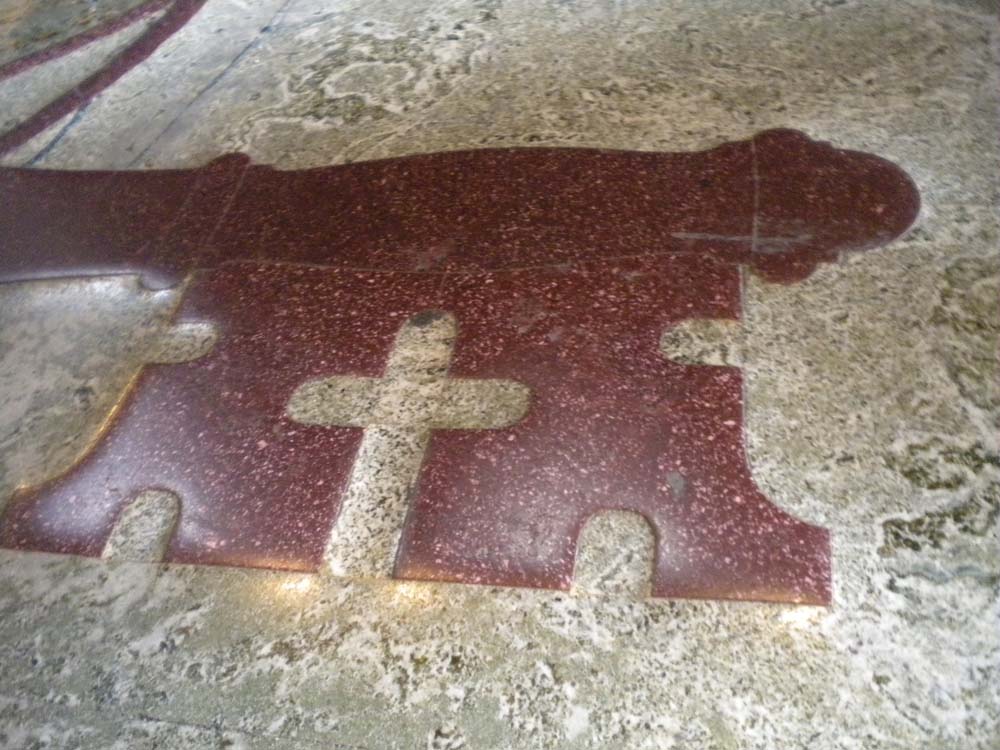
Perhaps my favorite piece of papal porphyry, though, is this set of porphyry keys carved and set into other stonework in the threshold of the Church, so every visitor who enters walks across them.  Most ignore them, but in the pre-modern world one glance at heraldic papal keys in porphyry spells a very special kind of awe: not only does the pope have Porphyry but apparently he has the power to carve it into a Christian shape.  Clearly he is Rome’s successor.  With so many visiting feet for so many centuries, the papal threshold keys are also the best proof I know of the extreme hardness of porphyry, since the stone around them is worn down by more than a centimeter, while the keys stick up, unharmed by the tread of millions.  The Florentine Museum of the History of Science has examples of scientific instruments and grinding stones fashioned from porphyry, chosen for its rigidity and inelasticity as well as for its opulence.

It is not easy stopping traffic long enough to take this detail shot of the threshold of St. Peter’s
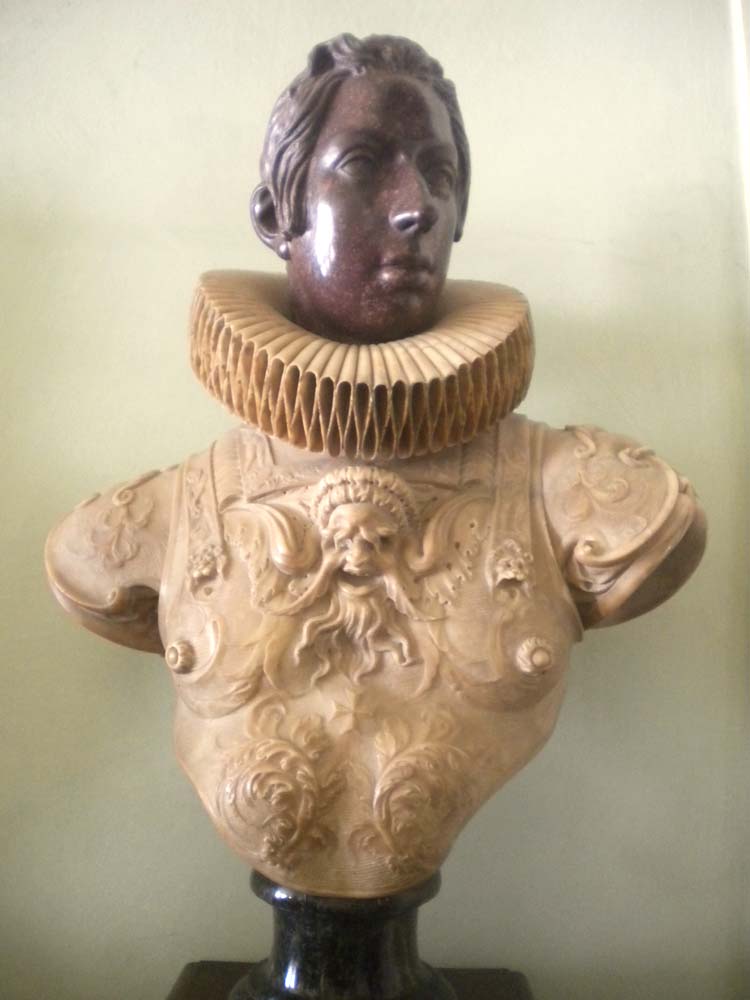
Note how much more detailed the carving on the marble chest is than the porphyry head on this bust of a late Medici.

The ability to carve porphyry was eventually recovered, and in the 18th century Roman relics were transformed into large numbers of sculptures, especially busts, of rather questionable taste and quality.  Porphyry remains hard to work with, so the very subtle curves and scratches necessary to make a really lifelike human portrait are simply impossible in it.  Its products are always a little too smooth and shiny, the edges of the eyes clumsily cut, the wrinkles a little too smooth, like waves rather than folds.  Also, purple with speckles is not the most flattering skin tone.

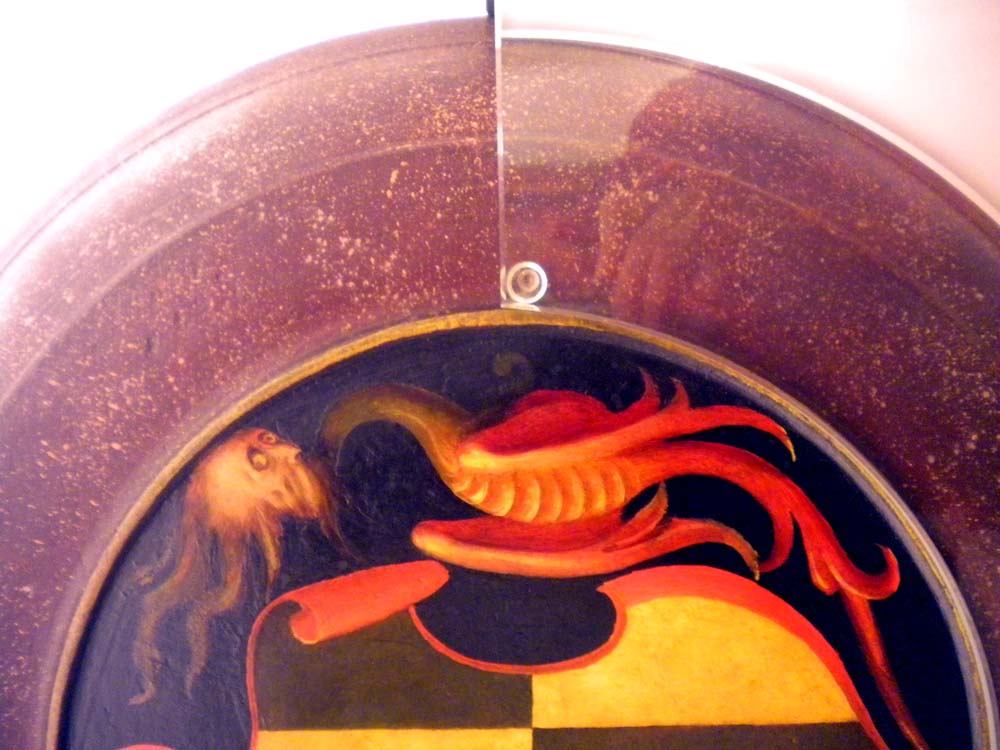
Fake porphyry was, naturally, an industry as well, and many of the most famous buildings in Europe contain not only real porphyry but painted fake porphyry, made of plaster or wood painted with the signature purple and speckles.  This was most often done for bases on which statues sat, or for trim around rooms, but the Villa Borghese in Rome contains whole tabletops of fake porphyry, with real porphyry busts nearby to make them plausible.  Porphyry was also a popular ingredient in painted scenes, especially paintings of imagined palaces, and of places intended to be ancient Rome.  And heaven, of course.  The halls of Heaven, where saints and angels pose for altarpieces, have plenty of porphyry.

Reverse of a decorative wooden platter, painted to look like porphyry

An Unbiased Review of the Marvel “Thor” Movie (Begins Unbiased Reviews Series)

December has been extraordinarily productive for me, with a large number of small articles and other projects now plumply complete, but the down side has been no time to write about Roman churches or ancient marbles or bad gelato and its wicked ways.  I hope to have such leisure again shortly, but in the meantime let me present an old piece overdue for posting in the fandom vein, my review of the MARVEL comics Thor movie which distressed everyone last spring by being nowhere near as awful as expected.

(For those unfamiliar, it will help you in reading this to know that Norse mythology, and Viking culture in general, are a secondary area of special academic interest for me, and also an area in which I compose and perform from time to time.  In both research and on stage I specialize in a certain very important Norse deity who sure as heck ain’t Thor.)

An unbiased review of the MARVEL “Thor” movie.  (Contains spoilers).

I have been driven to write this review since so many people seem to have missed the subtleties of this excellent and richly-worked commentary on Norse Mythology.  First off, I should like to correct a common, basic confusion about the film’s plot, since so subtle was the crafting of Loki’s character that many viewers seem to have been taken in by his brilliant plan, which succeeded, and which was cunningly disguised as a terrible plan which failed.  I apologize for the necessity of spoilers here.  Loki’s primary objective, destroying Bifrost the Rainbow Bridge, was clearly seeded early, when Loki revealed that he had found his own, unique methods of inter-world transit.  He thus ended the film with a triumphant monopoly on inter-world travel, whose consequences the viewer can look forward to enjoying in the sequel.  Concealing all this with the fake throwaway throne-grabbing plan was elegant writing, and provided an opportunity to banish the Thunderer long enough to get in some thoroughly enjoyable cheap laughs.

I should quite like to know how this version of Loki managed to alter things to set everyone up to believe he was Odin’s adopted son rather than brother, but I agree it was a necessary step.  It’s much easier to guilt-trip the Allfather in a father-son relationship than a blood-brother one, and the guilt-trip was integral to the plot.  Far more integral than most of the content of the film, really, but therein too lay some of its brilliance, since the large palette of seemingly superfluous and out-of-place characters provided an opportunity for brief dips into many interesting commentaries on the theology.  The Thunderer’s four seemingly-irrelevant friends, for example, especially the conspicuous ninja, settled in a few short scenes the oft-debated question of whether non-Viking warriors can go to Asgard.  The fact that the non-Viking population of Valhalla both outnumbered and, in one very moving scene, criticized the mourning practices of the one real Viking amng them, brought before the viewer’s eyes the pathos of a dwindling, traditional culture being drowned out by internationalization even in its afterlife.  The brief appearance of the woman identified as both the Thuderer’s mother and Odin’s wife was also a fascinating snapshot of imagined secondary consequences of the death of Baldur, since, indeed, if Frigg failed to produce any further heirs to Odin’s throne, he might of necessity disown his infertile queen and bring Fjorgen to Asgard in order to legitimize the Thunderer.  Even something so subtle as the prop design of Mjollnir proves, by its full-length handle, that in this reimagining the entire creation of the Weapons of Power was conducted differently.  The depth of the impacts of Loki’s deceptions has no limit.

Gender the film treated with rare and unexpected subtlety, and I stand in admiration of how it highlights and embellishes the unstable sexual categories of the Norse mythos.  We are accustomed to Loki’s dual-gendered nature, but instead of re-treading that ground, we are presented instead with a deeper examination of gender imbalance in Jotun society.  When we are informed Johtenheim has a single ruler, we might expect one of the great Jotuns the Thunderer usually battles, such as Bergelmir, or Utgardsloki,  or perhaps  Loki’s father Farbauti.  Instead we find Laufi, Loki’s mother, on the throne, and having taken a male form, presumably in order to command respect from a patriarchal society, much as her famous son/daughter does.  This pathos of this grim portrait of cultural pressures to use shape-shifting to renounce female form in a pre-feminist culture is then multiplied when we see masses of jotuns during the battles and destruction and realize that all of them have the same, hulking, distinctly male form.  What might be attributed to bad CG or chauvinist casting reads now as a silent proof of the sub-human position of women in Nordic culture.  Surely this common Jotun gender-switching is known to all-seeing Odin, but he has kept to himself in his kingdom—perhaps afraid of the ideas it might put into the heads of the Asynir.  Or does Odin have a darker interest in pretending that he believes Laufi is Loki’s male parent?  Is he covering a darker reality?  Are we meant to realize how closely “Far-bauti” i.e. “Far striker” might invoke Odin, the wielder of Gungnir, who, we know, often disguises himself to sire children, and answers already to Hnikar (Spear-thruster) and Hnigakudt (Thrusting-god)?  Is there yet another layer to the Allfather’s deceptions?  The linguist is left delightfully tantalized.
I must confess that, at times, so subtle was the scripting that it was difficult even for an expert to quite make out what it was hinting at (either that or they were stuck with a poor translation of the Eddas).  For example, Audhumla the Ice Cow, who freed Odin’s father (The first god, Bur) from the ice, must be the presumptive grandparent invoked by the Allfather in his reference to “my father and his father before him”, since no other being was responsble for Bur’s creation–unless this is perhaps intended as a roundabout hint that Loki had managed to confuse Odin about his own origins as well as Loki’s?  Clarification is needed.  At other points, though, the film provided almost too much information.  While it’s certainly useful for those of us who might want to repeat the process to learn at last that Mjolnir was forged using the heart of a dying star, I suspect some rather angry and protective dwarven smiths will be demanding reparations for trade secrets lost.

The costuming was excellent, all around.  The mostly-naked Jotun fan-service was much appreciated.  The Thunderer was hilariously adorable with his puny child’s beard.  The way Wayland the Smith went overboard designing these insane helmets was a great way of communicating his silent protest over being forced to build that ridiculous whopping robot thing.  I also admire the hairdressers’ bold speculation that if Sif did follow Freiya into the warrior-maiden calling, it would also give her the guts to finally admit that she was never a real blonde.

My major objection remains the film’s title.  While the Thunderer did get a lot of screen time, mainly because the writers were correct that watching his embarrassing antics on Midgard was a fine way to pass the time while important people were sneaking through inter-world rifts and casting endless incantations, he was so tangentially related to the film’s actual plot that it seems to me misleading to present him as some sort of titular and, presumably, central figure.  If the writers thought they needed the extra deception to keep the viewer from figuring out Loki’s true plan too soon, they must, I fear, be accused of too much double-bluff, since as it is so many viewers seem to have missed the real plot.  I have had it pointed out that the writers may have chosen the title for the merchandising, since I’m certain many lasses will soon be cuddling adorable Thunderer dollies, but I find it hard to believe a film, otherwise so sensitive and scholarly, would stoop to product placement.  If the actual main character could not be titular, Odin at least might have been a better choice, if not something more neutral, like Sons of Asgard, or perhaps Mjollnir Saga, since the hammer did contribute meaningfully more often than its master.

All in all, a well-executed film, if a bit crowded with comic relief; we must hope the authors do not make a similar mistake in the sequel, which should be titled Loki’s Victory, at least in my unbiased opinion.

(P.S. I hear some rumors about a title involving “Avengers’?  Vengeance is good too.)

Click here to read the next installment of the series.


Spot the Saint: Franciscans (Friars Minor)

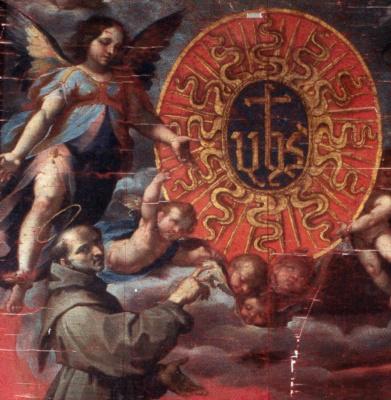
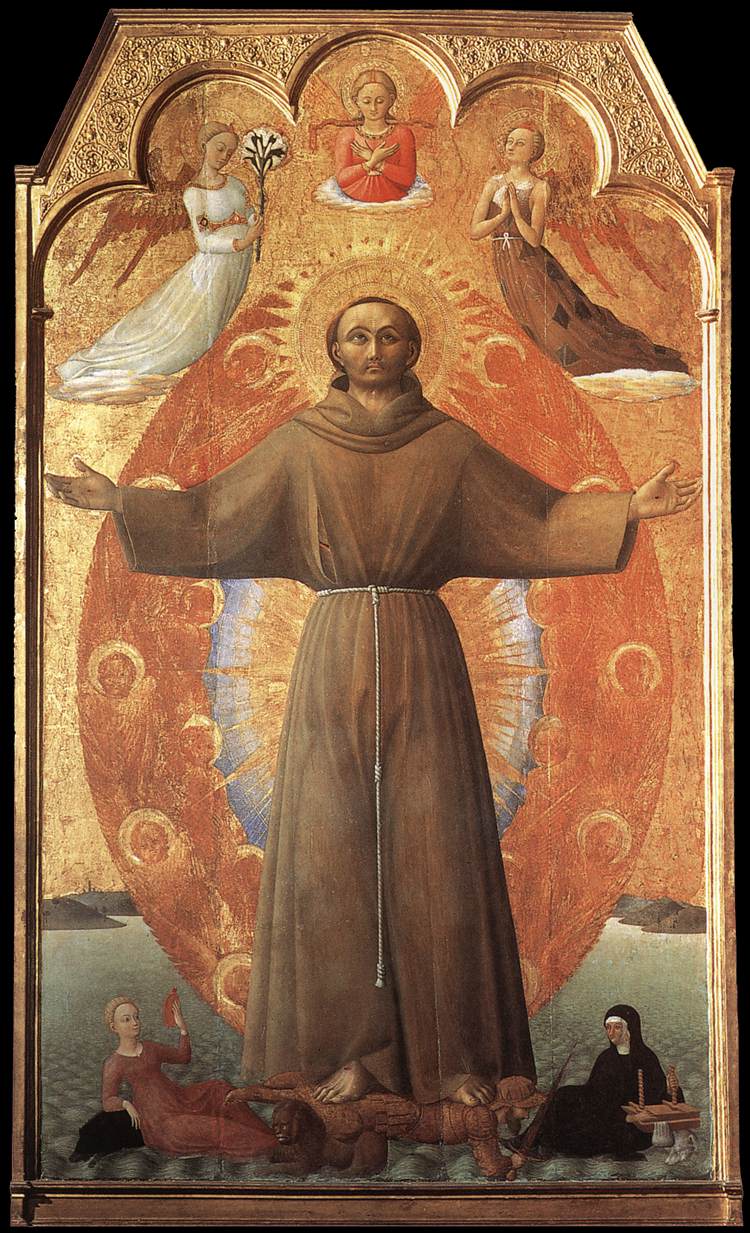
The ecstacy of St. Francis. He is accompanied above by the three angels of Monastic vows, Chastity (with lily), Obedience (with yoke) and Poverty (in patches), while under his feet he crushes the vices of Vanity/Lust, Vainglory, and Greed. This painting is heretical, by the way, since it’s totally not allowed for anyone other than Christ, the Father or the Virgin to have that red corona made of Seraphim, but people really, really love Francis, so just this once…

A dear friend’s visit and a weekend in Rome has delayed this update, but while I was trying to write up my recent tour of fascinating Roman churches, a mix of famous and obscure, I discovered that I couldn’t make the discussion make sense unless I covered a couple other related topics first.  I shall begin with the Order of the Friars Minor, aka. the Franciscans (just as the Dominicans are officially the Order of Preachers).

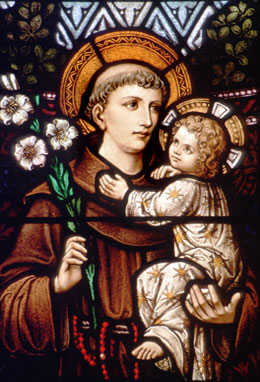
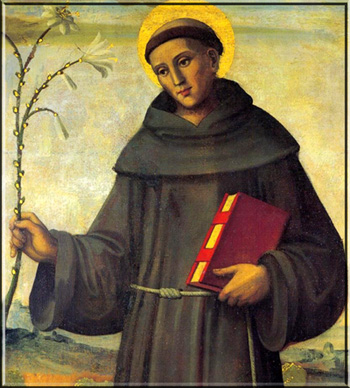
In art, Franciscans wear plain habits that are usually a gray-brown color, but sometimes gray and sometimes brown.  There are several sub-groups of Franciscans, including the Capuchins, but for our Renaissance purposes, and in art, we are concerned only with the main branch.  The Friars Minor are so called in memory of the focus on modesty, humbleness and obedience of their founder.  They were founded at the very beginning of the 1200s, just like the Dominicans.  This means that during the lives of early Renaissance figures like Dante and Petrarch, the Franciscans were a powerful but recent movement, something Italy could be proud of.

Saint Francis (San Francesco) 1181/2-1226

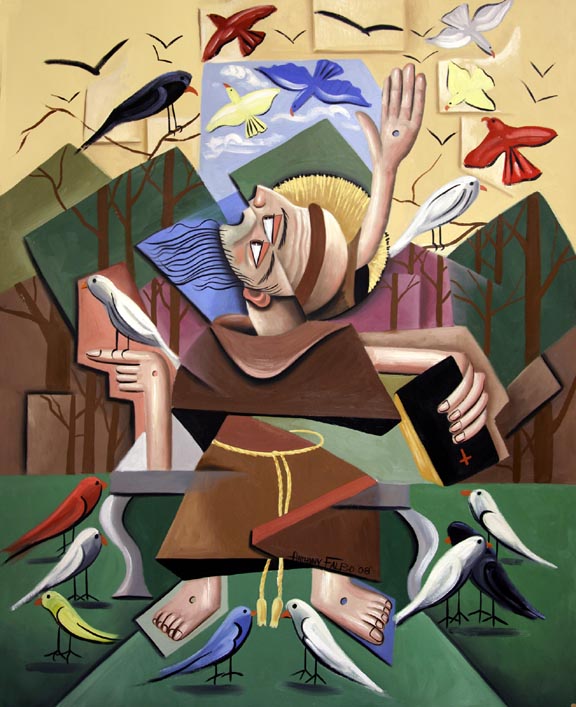
  • Common attributes: Franciscan habit, stigmata (wounds of Christ on his hands, feet, side)
  • Occasional attributes: lamb, bird, wolf, T-shaped cross (“Tau”)
  • Patron saint of: The Franciscan order, animals, merchants
  • Patron of places: Italy (yes, all of it), Assisi
  • Feast day: October 4th
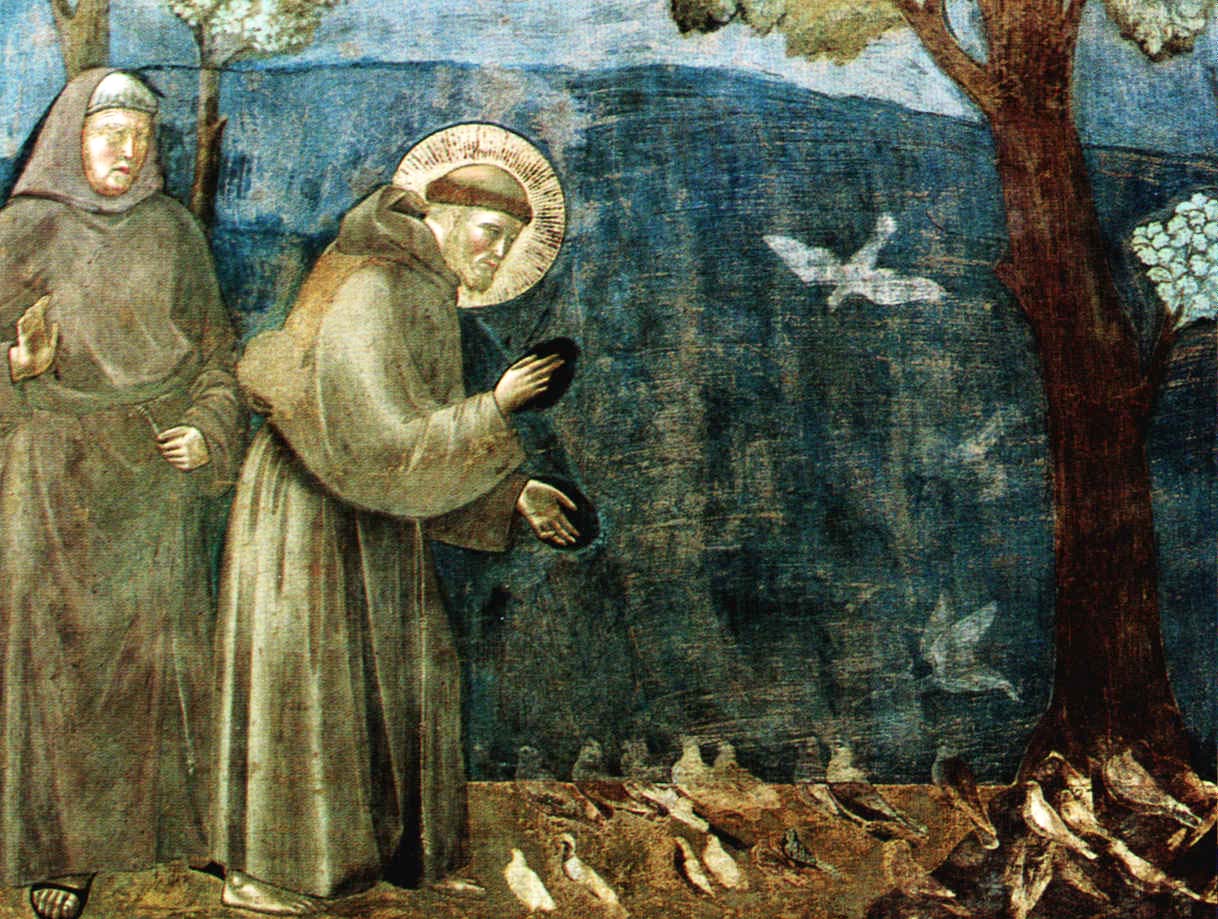
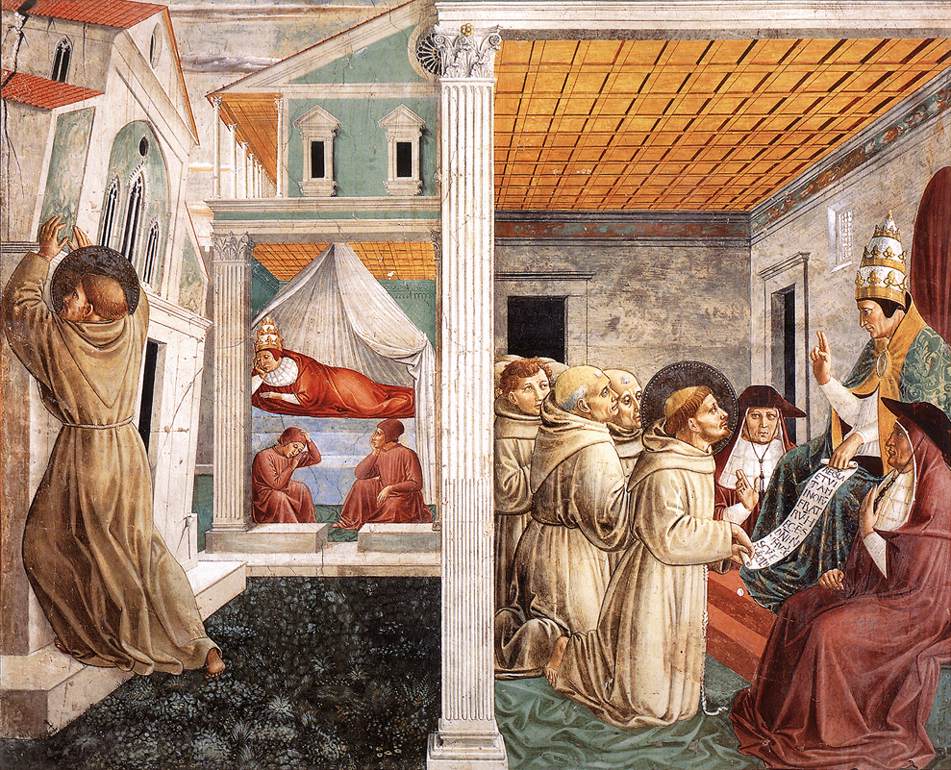
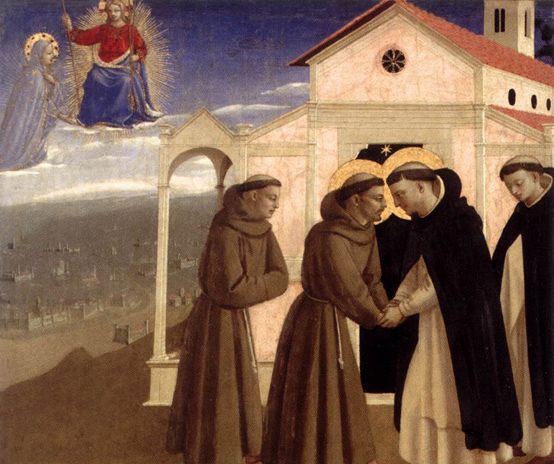
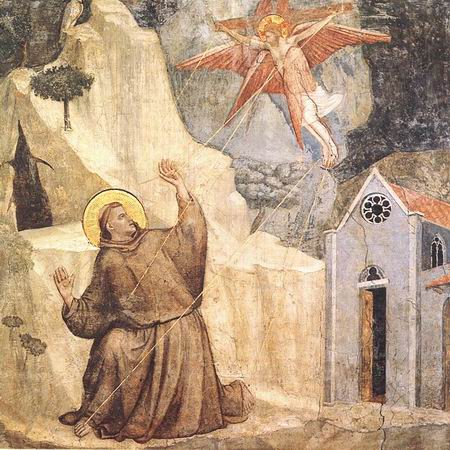
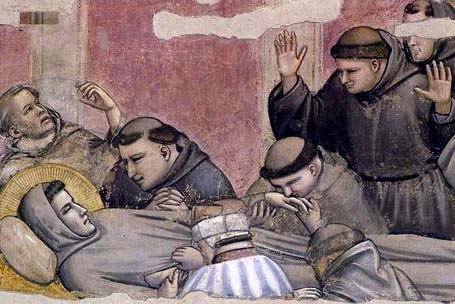
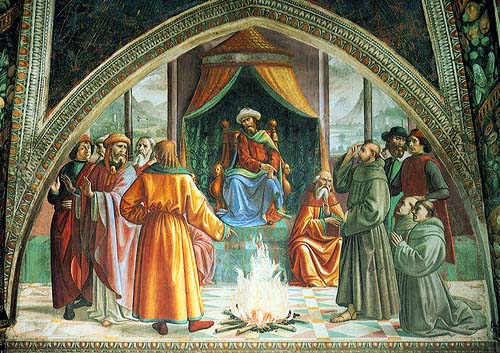
  • Most often depicted: Receiving stigmata from an angel, nude as a young man being received into the Church, kneeling before the pope, preaching to animals, in front of a sultan intending to walk through fire, embracing Saint Dominic, dead with people examining his corpse
  • Relics: Assisi, Basilica di San Francesco

Francis is Patron Saint of Italy.   Not part of it, not a town, not a province, not an order, not a profession; Italy.  Italy had a lot of major saints to choose from: Peter, Paul, Mark, John the Baptist, John the Evangelist, Jerome, Ambrose, Gregory… the fact that the all-important home province went to a saint from the late twelfth century is proof by itself that Francis is something very special within Heaven’s high heirarchy.

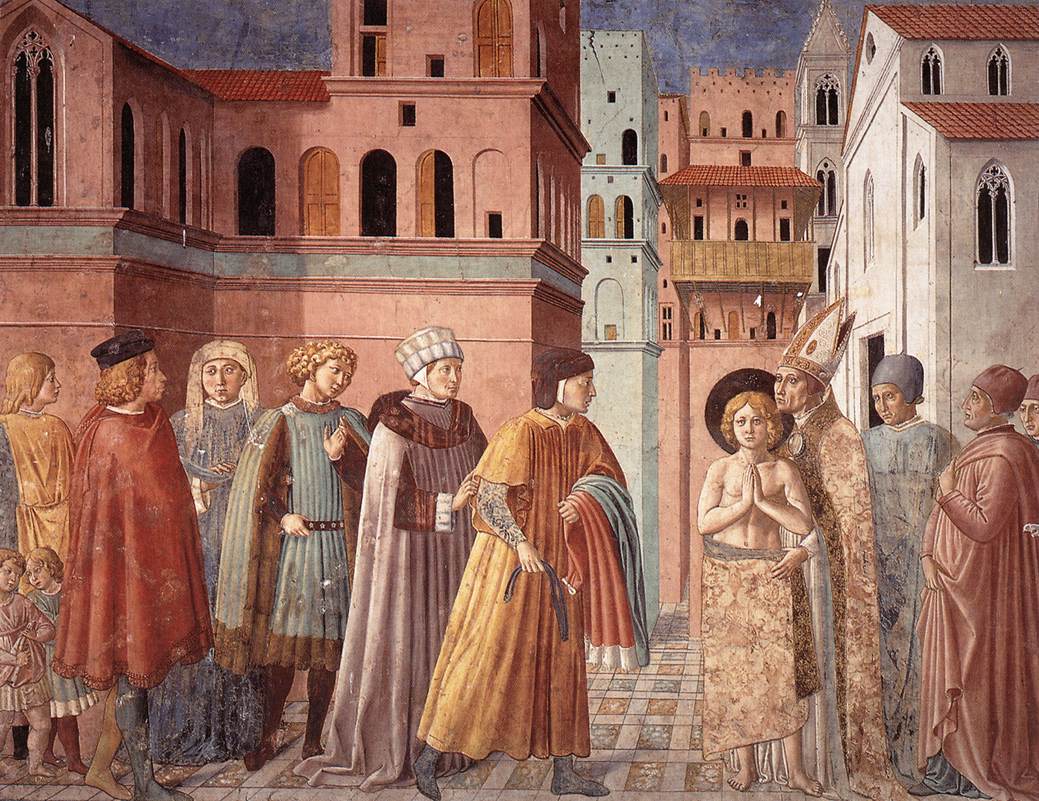
Young Francis returns his clothes to his father, and is welcomed by the bishop.

Francis’ father was a merchant and his mother was French.  As a youth he spoke French, loved French clothes, French songs, French everything, and his baptismal name of Giovanni was soon forgotten in favor of the nickname “Francesco” i.e. little Frenchman.  He took part in some military stuff when young, during which time he seems to have had a religious crisis, and thereafter showed a growing interest in monastic life.  One day, on the way home from selling some of his father’s goods at market, he couldn’t take it anymore, went into a church and insisted he was going to stay there and become a monk.  The priests were terrified, knowing of his father’s wealth and inevitable wrath, and tried to force the boy to leave, but he refused.  He tried to give them the money he had been carrying home, but they didn’t dare touch it, and the bag of coin sat in the church, abandoned out of fear.  After a while Francis’ father came hunting for him, enraged, and insisted that he return.  Francis gave the money back, but refused to come himself.  His father continued to insist that Francis was his and was coming home with him.  Francis then stripped naked and handed his clothes to his father, saying he had returned everything that was his father’s and the rest belonged to god.  At this point, the bishop intervened, and wrapped his cloak around the young man, welcoming him into the Church.  Francis then went on to be the most enthusiastic and influential monk of all time.

Why was Francis so incomparably important?  Put simply, he changed what the word “religious” meant.  In the Middle Ages, when one said a “religious person” one meant a monk, nun or priest, or maybe a hermit.  That’s simply what the word meant.  There was not really the concept that a lay person, particularly an urban person like a merchant or crafts worker, could have a meaningful religious life.  One wanted them to be baptized and to try to live virtuously, but that was mostly in order to prevent earthly divine smiting, and expectation was that someone living a secular life was likely not heaven-bound most of the time, and certainly didn’t participate in religious life or thought any more than occasional churchgoing.  Francis changed that.  He came into the cities and preached to the urban poor.  He encouraged everyone to think about religious questions and have a personal intellectual religious life.  He suggested that merchants and workmen might gather once a week for religious meetings, wear monastic symbols under their clothes as self-reminders of their faith, and in other ways meaningfully do things “religious” people did despite, or rather as an enhancement to, their worldly lives.  He made Christianity welcoming and accessible to ordinary people in a way it really hadn’t been before.  He made people welcome, and for that people adored him, and still do.

St. Francis marries the Angel of Poverty (in the patched, brown dress) while her sisters Chastity (in white) and Obedience (in pink, carrying a yoke) attend.  Note how, unlike her sisters, Poverty has no shoes, and gazes wistfully after Francis as the three depart.


Francis was also very hard core about the monastic life.  Francis was so fierce in his renunciation of wealth and his fixation on wandering and begging that, even when he was an invited guest at someone’s house, he would nonetheless insist on going outside to beg for his supper on the street.  Francis was spiritually married to the Angel of Poverty, one of the three angels of monastic vows, who hangs out with the Angel of Chastity and the Angel of Obedience.

In honor of Francis’ dedication on this front, to this day the Franciscan order, is the only mendicant (begging) order whose members are still forbidden to own any property whatsoever.  All items possessed by Franciscans, from the grand Basilica of St. Francis to the sheets on their dormitory beds legally belong to the pope who lends them to the Franciscans, and the pope can walk up to any Franciscan and demand the shoes off his feet and he has to give them up (I am assured that popes don’t generally actually do this, but I imagine many popes have had fun thinking about it).  The Friars Minor also focus on humility, following the model of Francis who, despite being a great and popular leader, never let himself be in authority, always deferring to the commands of others, and preferring to be led, not followed.

Francis was also big on the mortification of the flesh.  He referred to his physical body as “Brother Ass” which had to be frequently beaten into obedience; he practiced intense fasting, as well as physical mortification, and, among other things, would often throw himself naked into snow (whenever Italy’s clement environment made snow an option).  So fierce was he in this self-mortification that he often made himself quite sick, and would likely have died sooner than he did had his fellow monks not frequently ordered him to eat more, take it easy on himself, permit himself richer foods, etc., and orders Francis eagerly obeyed (thank you Angel of Obedience).

Francis himself did preach, to anybody and anything who would listen (people, birds, wolves, insects), but he led mainly by example.  He himself was not particularly literate and did not know Latin pretty much at all, nor sophisticated theology, and the only book he left was a little collection of sweet prayer poem-songs.

Now, when a new, weird, popular and powerful movement enters a religion and starts getting a lot of momentum, attention, press and money, and is led by someone who isn’t quite preaching the usual, the religious leaders inevitably become nervous.  In the Catholic tradition, a moment of examination arrives, when the new movement hovers on the edge between being welcomed as a breath of fresh reform, and being expunged as a heresy.  It could easily have gone either way with Francis, whose changes to the usual way Chrisitanity had been practiced, particularly in urban settings, was so extreme.  But, especially since Francis was so keen on obedience, he was eager to be part of the Church rather than against it, and was happy to formally acknowledge the authority of the pope.

On the left, the pope dreams that Francis will hold up the crumbling Church; on the right, Francis presents the rule for his monks to the pope for approval.

When one sees paintings of scenes from the life of Francis, one of the most common and, on the surface, least interesting is a scene showing him kneeling before the pope, being received in Rome.  This may seem boring, the sort of moment which should go without saying, but the scene, and repeated images of the scene, were a critical reminder to all that, powerful as the Franciscan movement was, the Franciscans served Rome, Francis served the pope, and the old structure still stood.

The rivalry with the Dominicans came about mainly after Francis’ death.  It was partly a power and money thing.  Even though both orders were founded on the notions of poverty and modesty, there is a life cycle of monastic movements, which generally runs:


  1. Charismatic leader wants to live more modesty, without corruption, imitating Christ, so breaks off from the corrupted institutions of the Church.
  2. Many others find spiritual richness in this, and follow him/her.
  3. Movement takes off, gets official recognition from the Church, becomes established.
  4. People who like the movement donate wealth and land to it, both out of respect for the order, and in hopes that the monks/nuns will pray for them (and thus get them out of purgatory).
  5. Movement becomes wealthy and powerful, and noble families start sending their younger sons into it in order to gain wealth and power.
  6. Corruption leads a charismatic leader to want to break off and live more modestly, imitating Christ.
  7. A new order is formed… (Lather, rinse, repeat.)

This eventually happened even to the Franciscans, spawning the more extreme Capuchin sub-group, and it was mainly in the money and power seekers that the orders rivalry grew.  But there was also an intellectual contrast, as I mentioned.  The well-educated scholar-priest Dominic believed that the best way to reach God was through knowledge, since God is Truth.  Studying the nature of God, the soul, Christ, heaven, even the Earth would help the soul understand the divine and, through understanding, reach toward union with it (those of you who smell Plato’s residue in this are spot on).  The less educated and more passionate Francis focused in stead on reaching God through fierce desire, since God is Love, and that a heart that deeply and sincerely loved God would be drawn toward His heavenly light (those of you who also smell Plato here are also right).  Both movements, and both techniques, were much loved, but Francis’ focus on simplicity, and the idea that one could reach God through passion by itself, without the rigor and expense of education, made the Franciscan movement able to appeal much more broadly to the poor populace, in contrast with the inherent elitism of Dominican literate culture.  To Dominic went the universities, to Francis went the crowds.
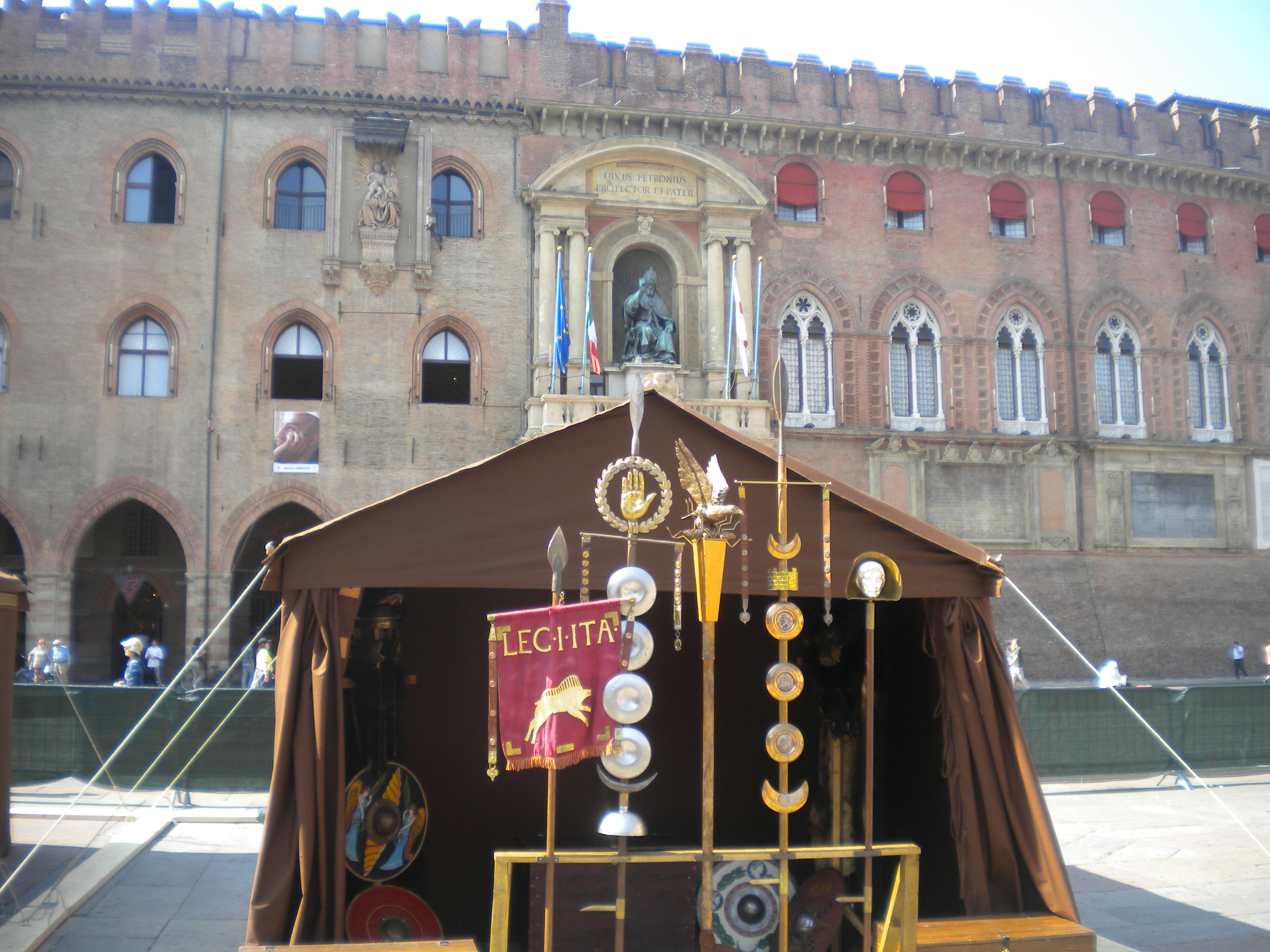
Still, it was an amicable rivalry, since both groups had the same goals.  Perhaps my favorite token of this is in Dante’s Paradiso, where the great and ultra-educated Dominican theologian Thomas Aquinas, before administering the theology exam which Dante must pass to get to the upper levels of Heaven, recites a long, praise-filled biography of Francis, founder of his order’s rival, but still loved by all in Heaven.

Francis was the first saint to have stigmata, the wounds of Christ on his hands and feet, and the spear wound in his side.  An eyewitness account states that he was in the mountains one day when an angel (or possibly a flying crucifix) zapped him with rays of light, and gave him the wounds.  We have accounts of the examination of his body upon his death (often depicted in art, since many were curious to examine the famous wounds up close); medical scientists reading the descriptions of the wounds as having been strange and hard and bumpy believe them to have been some kind of cancer.  In art, Francis is usually holding his hands and feet out so you can easily see the nail marks on them, and often his robe has a slit so you can see the spear wound.  Sometimes rays of golden light are radiating from the wounds.  The stigmata and his Franciscan habit are usually more than enough to make him recognizable.  While he is often depicted in more recent art with a lamb or bird or animals, since the story of him preaching to animals is popular, in Renaissance art he didn’t need that; stigmata was enough.
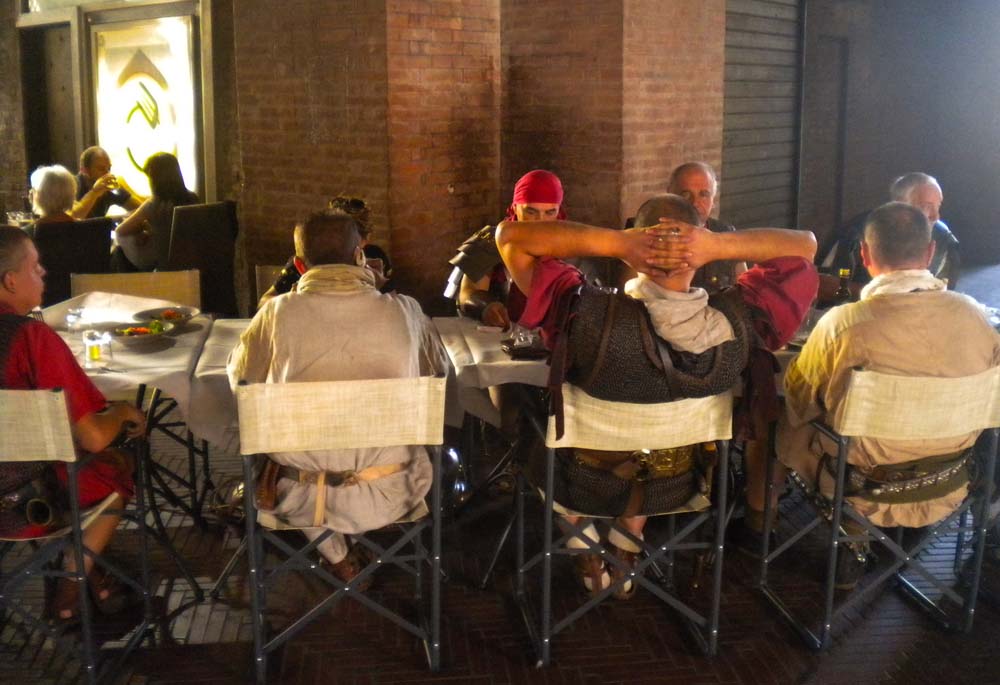
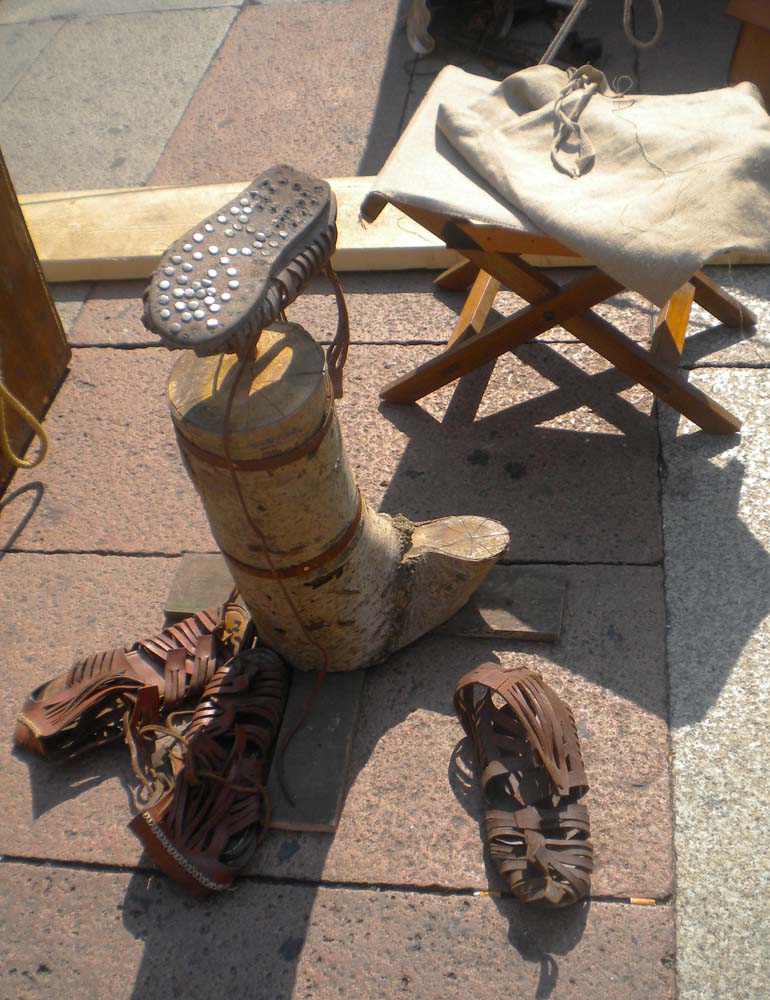
Francis’ story also has enough interesting episodes that he has many distinctive common activities you can keep an eye out for:

  • As a young man, being wrapped in the bishop’s cloak as he stands naked before his father
  • Receiving the stigmata
  • Marrying the Angel of Poverty
  • Hugging Saint Dominic
  • Appearing in a dream, where the pope sees Francis holding up a crumbling church (prophesying how important Francis would be)
  • Kneeling before and being received by the pope
  • Dead, his corpse being inspected by curious mourners, one of whom is reaching into the wound on his side
  • “Walking through fire before the sultan.”  I put this in quotes because the standard image shows him standing before the Sultan, with a big bonfire, and Francis in front of it, while some Arab-looking people shudder and gawk.  The story is that Francis went to the holy land to try to convert the Sultan (or get martyred; it’s win-win!).  He preached earnestly in front of the Sultan, who said he was a sweet kid, and gave him some presents and told him to go home.  Francis then insisted he was going to walk through fire to prove his faith, and asked if the Sultan’s Muslim spiritual leaders would do the same.  Nobody but Francis thought this was a good idea, and, in the official story, the Sultan told Francis that he had convinced him, and that the Sultan had secretly personally converted, but that he couldn’t reveal that publicly without causing a civil war, so he told Francis to please go home and stay safe before someone murdered him.  Francis then went home, so the scene is actually a depiction of Francis not walking through fire in front of the sultan.

Saint Antony of Padua (San Antonio) 1195-1231

  • Common attributes: Franciscan habit, tonsure
  • Occasional attributes: Book, flaming heart, carrying Christ child, lily, occasionally bread or fish
  • Patron saint of: Lost objects (and those seeking them), travelers (and their hosts), the elderly, lots of other rather random typical stuff like barrenness, harvests, oppressed people etc.
  • Patron of places: Portugal, Brazil, Native Americans
  • Feast day: June 13th
  • Most often depicted: Standing around with other Franciscan saints, preaching, holding the Christ Child and looking friendly
  • Relics: Padua, Basilica di San Antonio

Antony, or Anthony, was originally named Fernando, and came from Lisbon, Portugal, from a noble family, but insisted on becoming a friar.  An Augustinian friar, at first, an old and lucrative order, which Thomas Aquinas’ parents would’ve approved of.  When he was still young, early on in the history of the order (11 years after Francis founded it) five Franciscans came through Lisbon on their way to Morocco, and stayed in the guest house young Antony ran.  He was impressed by them, and even more impressed when they got martyred (a great political coup for the Franciscans, and good proof of why the Dominicans made such a fuss over Peter “I have a big knife sticking out of my head” Martyr).  Seeing the five martyrs’ bodies as they were being brought home, young Antony was struck by their devotion and got special permission to quit being an Augustinian in order to become a Franciscan.

Since there weren’t Franciscans outside Tuscany yet really, Antony went to Tuscany and lived as a semi-hermit with the order, doing nothing in particular, until one day a bunch of Dominicans came over to, you know, do monk things together, and there was a bit of a fuss over whose job it was to preach to the assembly, each order expecting the other to step forward.  After some kerfluffle, somehow Antony wound up on the podium, and everyone discovered suddenly that he was an extremely well educated child of the nobility and preached with extreme clarity and erudition.  A stellar career of preaching, fame and distinguished service followed.  He did not succeed in his childhood dream of martyrdom, but did become one of the best loved and most famous of his order and a major international hero of the church.

In art, Antony is very tricky.  His attriutes have varied a lot over time, tending gradually toward the more adorable.  Early on he usually has a lily and a book, just like Dominic except with a brown/gray Franciscan habit.  Later he often has a flaming heart, representing his passion for preaching.  Sometimes he has flame and separately a heart, just kind-of sitting there, on a tray or something.  He also, in early art, often had a book with an image of the Christ Child on it, then later a book with the Christ Child kind-of coming out of it as if it were coming to life, and, eventually, he just holds the Christ Child (do not confuse him with the equally adorable St. Christopher who does the same, and who is, with Antony, co-patron saint of travelers).

These days Antony almost always has the adorable Christ Child with him and the whole thing is terribly cute.  Often in early art, though, the best way to spot him is process of elimination: there are two Franciscans here and only one can be Francis, therefore the one without stigmata is probably Antony.  Antony is also the only major Franciscan to carry a book, since Francis was not particularly literate, and left only a few vernacular songs.

As patron saint of lost objects and those seeking them, Saint Antony is a very popular and frequently-invoked patron in practical and everyday life.

One of my favorite proofs of how incomparably valuable relics were in the Renaissance is the official Life of St. Antony of Padua.  The little book is divided into three sections of roughly equal length.  The first describes his life.  The third describes his posthumous miracles.  The middle one describes the virtual civil war which broke out in Padua after his death, when it was obvious he would be made a saint, so the different groups who had a potential claim to his body (the monastery he lived at, the one he was visiting when he died, local lords, local communal government) divided into fiercely-opposed camps even before he died, and in the end martial law had to be declared and the force of the Holy Roman Emperor called in to settle the dispute.

Saint Bernardino of Siena, 1380-1444

  • Common attributes: Franciscan habit, plaque or other item with the Coat of Arms of Christ! (Christogram), narrow chin and dour expression
  • Occasional attributes: Three mitres (representing 3x he refused to be made a bishop; note, despite looking I have NEVER actually found him with this attribute).
  • Patron saint of: Advertising, advertisers, public relations work & PR employees, chest conditions (coughs, asthma etc.), gambling addicts
  • Patron of places: Aquila (Italy), San Bernardino CA
  • Feast day: May 20th
  • Most often depicted: Standing around with other Franciscans, glaring at you looking angry, brandishing the Coat of Arms of Christ! (Christogram) and making you feel guilty you don’t have one.  Yes, you!  I’m talking to you!!
  • Relics: Aquila, Italy; his personal tablet with the Coat of Arms of Christ! is at Santa Maria in Aracoeli in Rome.

Bernardino was an orphan from a noble family, and became an extremely popular preacher.  He resolved feuds, reconciled enemies, fired hearts, drew crowds, held vast bonfires of the vanities, and, when he was eventually called to Rome by the inquisition, who needed to make sure everything he did was orthodox, he impressed the pope so much that the pope had him preach in Rome and held a big procession.  He turned down offers of being made bishop of Siena, Ferrara and Urbino in turn, to focus on his preaching rather than career things.  He also ministered to the sick, and contracted the Black Death himself, from which he recovered.

Bernardino’s big thing was the Christogram, aka. the Coat of Arms of Christ! A Christogram is when you use an abbreviation of some part of one of Jesus’ names, i.e. X for Christ, or IHS for the Greek form of Jesus.  Bernardino used a certain common version of the IHS monogram, surrounded by a distinctive circle with radiating sun rays, which had been a favorite of, among other figures, St. Bernard of Clairvaux.  Bernardino would end every sermon by dramatically unveiling a tablet with the Coat of Arms of Christ on it, gilded, to the great excitement of the crowd.  Bernardino encouraged people to put it everywhere, and even suggested that in a perfectly pious world all coats of arms would be replaced with the Coat of Arms of Christ!  Thanks to him you see the Coat of Arms of Christ! on Churches and even simple houses all over Tuscany and central Italy, and in a rather Kilroy-esque sense, it always translates in my mind to “Saint Bernardino of Siena was here.”

The Coat of Arms of Christ! It’s so exciting!

In art, Bernardino wears a Franciscan robe, and usually carries the Coat of Arms of Christ!   He also generally looks like he’d be no fun at a party.

Bernardino is one of the few saints who lived late enough that Renaissance art was developed enough that there were good, lifelike portraits of him made while he was still alive.  As a result, actual images of his real face were available when the first icons were made, so he doesn’t have a generic face in art but a distinctive one, based on what he seems to have really looked like.  He looks… like he’d be no fun at a party.  That’s my best description: a narrow, dry, bony face with a very pointed chin and sunken cheeks, who just looks like he’s about to go on and on about, well, in his case probably the the Coat of Arms of Christ!

The unique face does make him extra fun to spot, though, since it feels more like recognizing a real person than a symbol of a person, and sometimes it’s enough by itself to spot a dour, prune-faced Franciscan to know it’s him, even if some artist didn’t include his Coat of Arms of Christ!

Here, by the way, here is the actual Saint Bernardino of Sienna, visible in his tomb in Aquila, Italy, which proves that his particular Franciscan habit was more on the brown side than gray:

The variable attributes on Antony make Franciscans a little hard to tell apart, but usually a simple mental order of operations flow chart will do the trick:

  • (1) Does he have stigmata?  If yes, it’s Francis.  If not…
  • (2) Does he have the Coat of Arms of Christ!?  If yes, it’s Bernardino.  If not…
  • (3) Does he have a lily, a book, a heart, fire, or a baby?  If yes, it may well be Antony.
  • (4) Does he lack all of the above, and look like a narrow-chinned un-fun guy?  If so, back to Bernardino as our prime suspect.
  • (5) If none of the above, you may be dealing with a different Franciscan.

And now, Spot the Saint Quiz Time:

Skip to the next Spot the Saint entry.


5978

"Warm, generous, and inviting," Inventing the Renaissance provides a witty and irreverent journey through the fantasies historians have constructed about the supposed Dark Ages and golden Renaissance, and exposes the terrible yet often tender reality beneath.